I feel so lucky to live in a place with abundant and fascinating natural variety just outside my door. Even during stretches like the past few months when I only rarely got to wander around our woods and meadow (ugh, what a sad time), interesting wildlife kept showing up right around the house, so there was basically always something cool to see. Here are some highlights of creatures and plants that captured my attention in August through December of this year!
Quite a few interesting insects showed up around the house toward the end of summer and into fall. Here's a Lettered Habrosyne (Habrosyne scripta), a super fancy moth that visited our porch lights on August 6:

Throughout August, every time I walked past a small American Witch Hazel shrub I planted in our front yard earlier this year, I would see several of the same small winged creatures perched on this plant's bare twigs. These turned out to be tiny robber flies (genus Holcocephala, I think), and I suppose this plant must have made for a perfect perch from which to hunt other nearby insects. Here are a couple of these little hunters on August 14:
And here's one of these small robber flies with an even tinier insect-y meal:
On August 21, a Giant Swallowtail -- only the second individual of this species I've seen -- stopped by to feed from the large zinnias on our deck. Even with most of one wing missing, this big butterfly was an impressive sight:
The Spicebush plants in our front yard were once again host to a few Spicebush Swallowtail caterpillars this summer. Last year, all of the Spicebush Swallowtail caterpillars on our bushes were eaten, so this year I brought two of these amazing creatures inside the house so they could munch on fresh Spicebush leaves in safety, and so I could see them grow into their awesome snake mimic costumes. Here's one of these caterpillars on August 22 -- I temporarily held open the leaf tunnel it had pulled around itself so I could take this picture:
When the Spicebush Swallowtail caterpillars were ready to pupate, they changed from green to yellow -- ah, so pretty:
The caterpillar in the above picture actually died in the process of forming a chrysalis, and I'm not sure why that happened. But the second caterpillar successfully transformed into a neat little leaf-like structure -- with rows of blue dots just like its caterpillar form -- and this chrysalis is now safely tucked away in an unheated room attached to our house for the winter. If all goes well, a butterfly will emerge from this structure in the spring:
On September 2, a White-marked Tussock Moth caterpillar (Orgyia leucostigma) climbed up the wall on the front of our house and made its cocoon right on our window. I didn't think to take a picture of this caterpillar when we first saw it wandering onto the wall -- it's a wild-looking one, but we see them fairly frequently. I was excited to have this view into a caterpillar's silken cocoon as it went about pupating:
A little over two weeks later, on September 19, the adult White-marked Tussock Moth emerged from her cocoon. It turns out White-marked Tussock Moths are a species where the females are wingless:
This female never left the remains of her cocoon, and on September 22 she laid a frothy mass of eggs right there:
And then she died soon afterward. What a fascinating glimpse into this species' life cycle.
I planted several new native plants in our front yard this year (I love being able to gradually increase the diversity of this place), and this Brown-eyed Susan (Rudbeckia triloba) became one of my favorites; here's a picture of this plant's wall of cheery flowers on August 14:
Here's one of the Common Yellowthroats that lived in our yard and meadow this summer (this picture is from August 21):
And here's a large Eastern Garter Snake that was sunning next to our driveway on August 24:
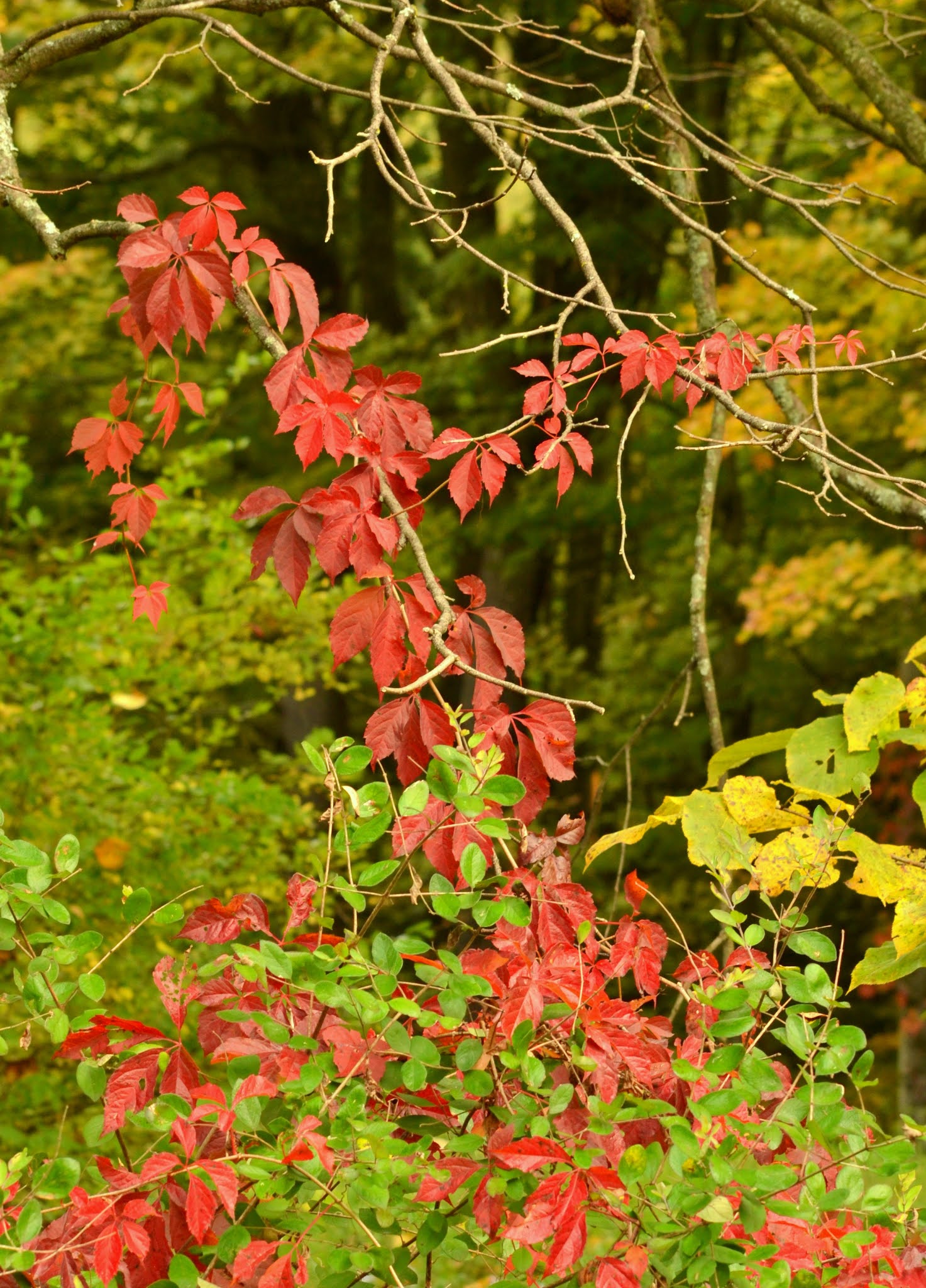
On September 27, I walked out into our meadow and woods to admire the fantastic fall colors. This was an especially wonderful year for colorful foliage! The Virginia Creeper leaves had turned a deep red, which was beautiful on smaller individual vines:
And the Virginia Creepers were even more stunning where they covered the trunks of Black Cherry trees at the edge of our woods:
Here's our house nestled between colorful ridge and meadow:
This sumac at the edge of the meadow was sporting a bizarre (yet strangely festive?) gall formed by a little aphid, Melaphis rhois (there's an aphid on the bottom of the gall in this picture):
In the meadow, goldenrods and asters were putting on a fantastic show, with New England Aster as the star. I'm so happy that these beautiful plants have made a stronghold in our meadow after we spread seeds over the disturbed areas in 2017:
A Banded Argiope spider (Argiope trifasciata) had strung a web among goldenrod in the meadow:
Here's a closer look at this fancy big spider:
In the woods, I was surprised to come across an Ovenbird. These loud little birds bred in these woods during the summer, but I expected that they would all have been gone by now. This little creature watched me quite close-up for a little while -- perhaps it was surprised to see me, too:
I love the row of tiny dark dots along the lower edge of this bird's fancy costume:
Back up at the house, I was happy to meet up with one of our Eastern Phoebes:
And I admired the blanket of asters nearby (these are two of the many species of asters on our property, and I need to finish identifying them one of these years):
On October 21 while walking through the meadow, I stopped to identify two species of insects that were making their quiet buzzy songs among the grass. Here's a Marsh Meadow Grasshopper (Chorthippus curtipennis), who was constantly moving from leaf to leaf close to the ground, pausing every few seconds to rasp both of its hind legs against its wings:
And here's a Short-winged Meadow Katydid (Conocephalus brevipennis), who was sitting perfectly still and right in the open on its dried grass stalk, but it still took me quite a while to locate the source of its sound:
In the woods, I loved seeing this Black-capped Chickadee foraging amidst hawthorn spines:
And this Yellow-rumped Warbler in its beautiful and muted fall costume was foraging in an apple tree next to our house:
Fantastically, this year has brought Evening Grosbeaks to our yard again. The last (and only) time I saw these birds before this year was when they visited us in late 2018, and I thought that could have very well been a once-in-a-lifetime event. How wonderful to get to see these amazing northern finches again! Here's a small flock that stopped by our feeder on November 18, along with the first real snow of the season:
Ah, so cool! While I was already near the feeders with my camera, I took the opportunity to photograph some of the other (more familiar, but still wonderful) birds hanging around. This Black-capped Chickadee made some dramatic poses as it worked at the sunflower seed clasped in its feet:
This American Goldfinch had the most perfect spot of white on its forehead, like a permanent resting snowflake:
And this American Tree Sparrow was (for the moment, anyway) more interested in the abundant goldenrod seedheads just behind the feeder stand than in the sunflower seeds in the tray:

I've been really happy this winter to see how much the birds -- especially the Dark-eyed Juncos and American Tree Sparrows -- have been enjoying the many wild seeds on offer in our yard and meadow. Mostly this is goldenrod, and mostly this is in places where we simply... didn't mow. (Sure, the yard looks kind of messy in places, but I'm happy to justify less yard work with more food for birds!) But some of these seeds come from plants we put there on purpose, which feels great. The mixture of native seeds we spread in the disturbed part of the meadow in 2017 included Little Bluestem, and that grass has grown fantastically, even forming lovely stands on rocky ground that probably would have been barren otherwise. I've enjoyed watching the Little Bluestem plants grow and change over the past few months, from purpleish/blue stalks in mid-August:
To purpleish/red stems in late September:
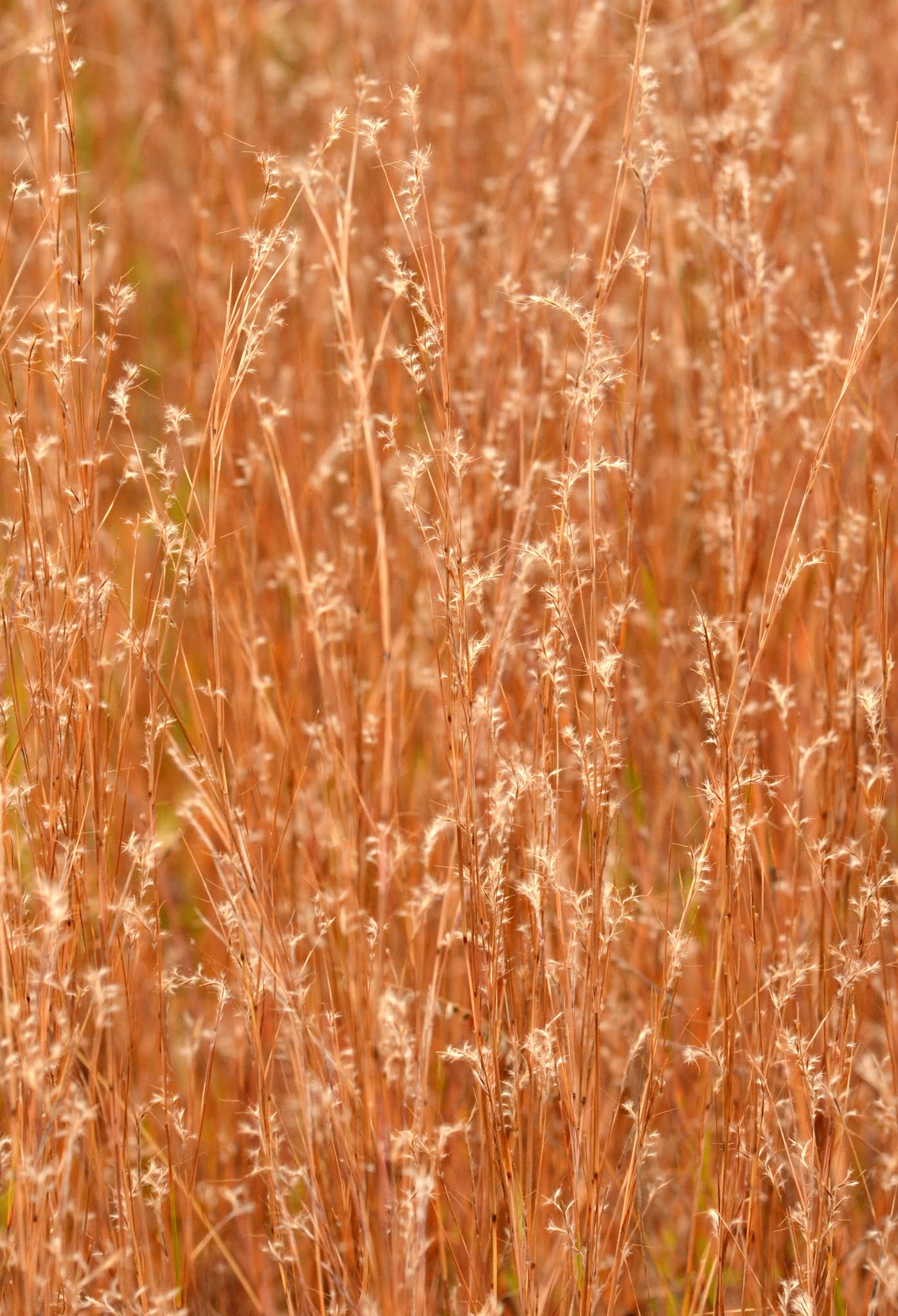
And finally to reddish/brown stalks with frilly white seedheads in mid-October:
I've watched flocks of American Treen Sparrows leaping up onto these stems and weighing them down to the ground to get the seeds. When we got nearly two feet of snow in the middle of December, it became especially clear how much the sparrows were enjoying this grass's seeds. Here's a patch of Little Bluestem on December 19, with the remains of the sparrows' feasting scattered on the snow:
I'm glad I've been able to see all these wonderful things over the past few months, but I still wish I had been outside more than I was. Ah well, we've reached the end of 2020, and who knows what the new year will bring!