This past Saturday was chilly and gray and rainy, and I did a dance with the weather for much of the day -- I kept trying to go outside, and then the rain would push me back inside. But I saw so many creatures in the time I was outside. Lots of birds that I hadn't seen yet this year are now back in the area, and they were out despite the wet weather, so I needed to be out there, too!
On Saturday morning, I drove out to a nearby park, and on my way home (after the rain sent me back to my car), I stopped to admire a bunch of swallows gathering on a fence next to the road. Tree Swallows are always beautiful, even in the rain:
I'm not used to seeing Tree Swallows and Barn Swallows hanging out in the same spot like this:
The birds seemed to be taking the rain as a bathing opportunity. Shake off those raindrops, little bird:
When I got home, the rain let up again for a bit, so I wandered outside near our house, where fields of bright yellow flowers make for quite a dramatic landscape, especially below heavy clouds and mist:
I'm guessing these yellow flowers are some sort of mustard, and the Red-winged Blackbirds at least seem to be making good use of them. I saw several male Red-winged Blackbirds displaying in parts of the field, and this female was picking up what looks like nesting material from among the yellow flowers:
So many birds in the area were taking advantage of the halt in the rain to move around. Every few minutes, I'd look up and see a different bird passing by overhead -- a heron, various hawks, vultures, ducks.... An Osprey circled over our neighborhood a couple of times, perhaps eyeing the ponds:
Even a Common Loon flew by at one point, heading toward the nearest Finger Lake, I'm guessing. I'm amazed that this creature could fly with all those damaged feathers on its left wing (and now I know that loons trail their big feet behind them when they fly, how cool):
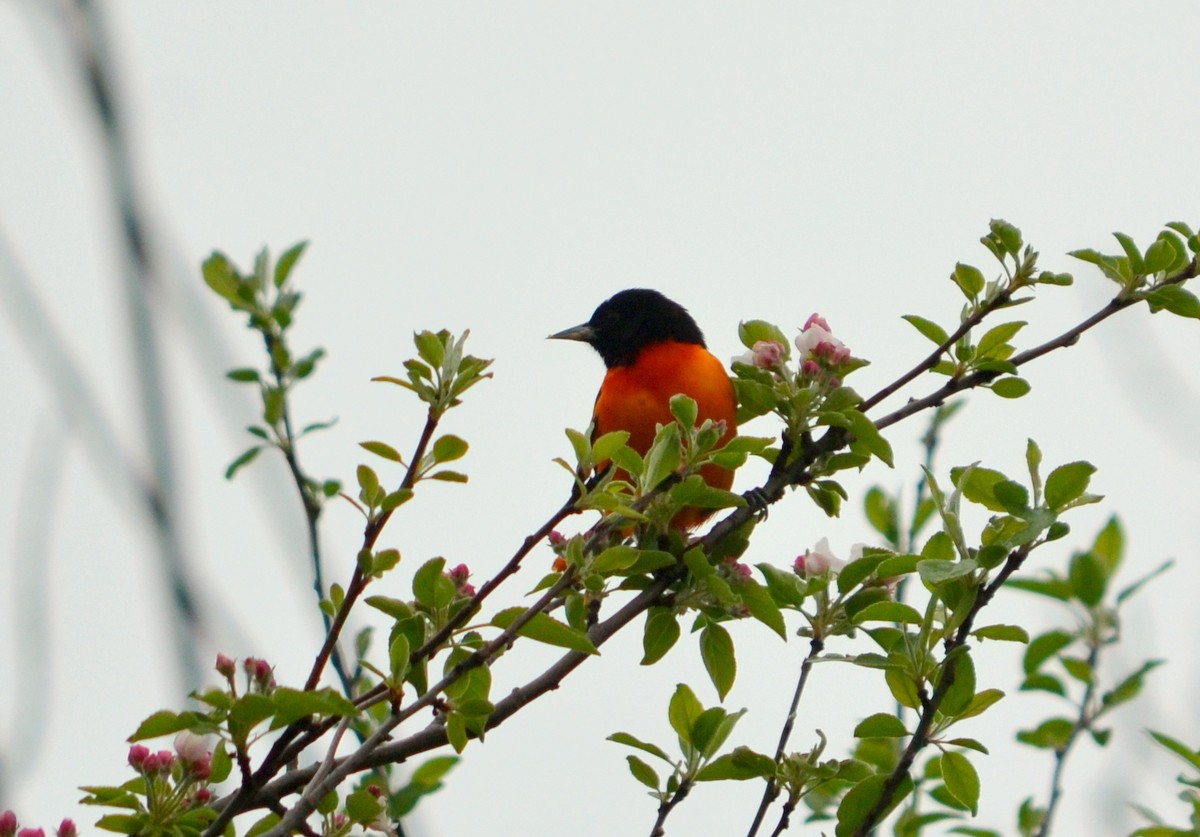
Lots of birds were moving around in the trees next to the fields, including my first Baltimore Orioles of the year. This handsome male oriole had an especially brilliant breast that was almost red in places. What a sight on a gray day!
I was very excited to see a male Bobolink, too, who was singing his weird robot-song and snacking on flower petals. I've only seen Bobolinks twice before, and that was a few years ago, all the way back at the Connecticut shore. It's so cool to have these funny meadow-dwelling birds nearby:
A few White-crowned Sparrows have been hanging around our yard for the past week or so, and one fellow in particular frequently takes up a post in the blossoming apple tree outside our window to sing. White-crowned Sparrows only pass through this area during migration, and I'm glad to have these pretty birds as neighbors at least for a little while. Here's a picture of our apple-tree-songster from inside the house on this rainy day:
At this point in my life, the place where I've heard White-crowned Sparrows singing the most was at the coastal dunes in Humboldt County, CA (since these birds breed there). It's been very strange to hear those dune sounds again here in rainy, lush, springtime Central New York! Best wishes on the rest of your journey, little sparrow, when you do decide to move on; and thanks for stopping here for a few days:
A Green Frog was also out and about on this rainy Saturday, settled nicely in a puddle next to a field:
Hooray for spring, when even rainy days are exciting and full of things to see!
I couldn't find the Piping Plover pair that's been hanging out at Silver Sands State Park when I visited yesterday morning. They may have decided to nest somewhere else, or perhaps they were just particularly well hidden.... I'll continue to keep an eye out for these little birds on future visits. Even without nesting plovers, however -- and despite the occasional drizzle -- there were tons of cool things to see. The park was positively overflowing with activity!
One of the first creatures I saw when I first arrived was also one of the most exciting, because I've only seen them once before, and never before a male in his super strange breeding plumage. Look, a Bobolink!
Make that a whole bush full of male Bobolinks, with their black bellies and yellow caps:
When these birds weren't perched in bushes and singing their weird metallic bubbling songs, they were foraging in the grass. The dandelion heads were apparently particularly interesting:
Bobolinks are pretty uncommon in this part of Connecticut, so I consider this a lucky encounter indeed!
In the marsh, two Willets (large-ish shorebirds with distinctive black and white wings) were preening:
This happy Willet made some cool ripples as it bathed:
Also wandering through the marsh were several Semipalmated Plovers. These birds are small like Piping Plovers but they have brown backs and wings like Killdeer; and, like all plovers, they're adorable:
I've commented many times in this blog on the secretiveness of Clapper Rails, who I often hear calling in these marshes but who typically remain hidden among the grass. The more I visit Silver Sands State Park, however, the more these birds defy my expectations. I've seen them several times now in July and August, after their chicks have hatched. A couple of weeks ago, I actually saw one calling from a slight rise in the marsh landscape. And then yesterday, who should come walking out onto the open mudflats, bold as can be, but a Clapper Rail:
The bird spotted me, but it only ambled (rather than raced) toward cover in the grass, walking right by me in the process. In fact, it seemed to strut and pose as it passed.... Well, sure Mr./Mrs. Rail, I'll gladly take your picture. What a gorgeous bird!
Rail tail!
Clapper Rails have such unusual body shapes. I'm struck by how skinny/compressed this bird looks from behind. It's thin as a... haaaang on.
I've now looked up the phrase "thin as a rail" to try to find out where it comes from. Several online sources say that no, "rail" in this phrase doesn't refer to a man-made bar or post (as I've always assumed), but rather to the bird, which is quite thin and thus better able to move through marsh grass. But then a few other sources say that in fact, no, you had it right the first time: It's not the bird, as some people have recently suggested, but rather the man-made object! So basically, if I say that the Clapper Rail is "thin as a rail," I still have no idea whether I'm being clever, or redundant, or silly. Ah well. Regardless, I'll think of this bird now whenever I hear that phrase.
A second Clapper Rail was even camped out nearby, again in plain view, and the two birds cackled at each other when the first one got close:
Are these birds not actually as secretive as I thought? I'm not complaining! Be as bold as you like, Clapper Rails.
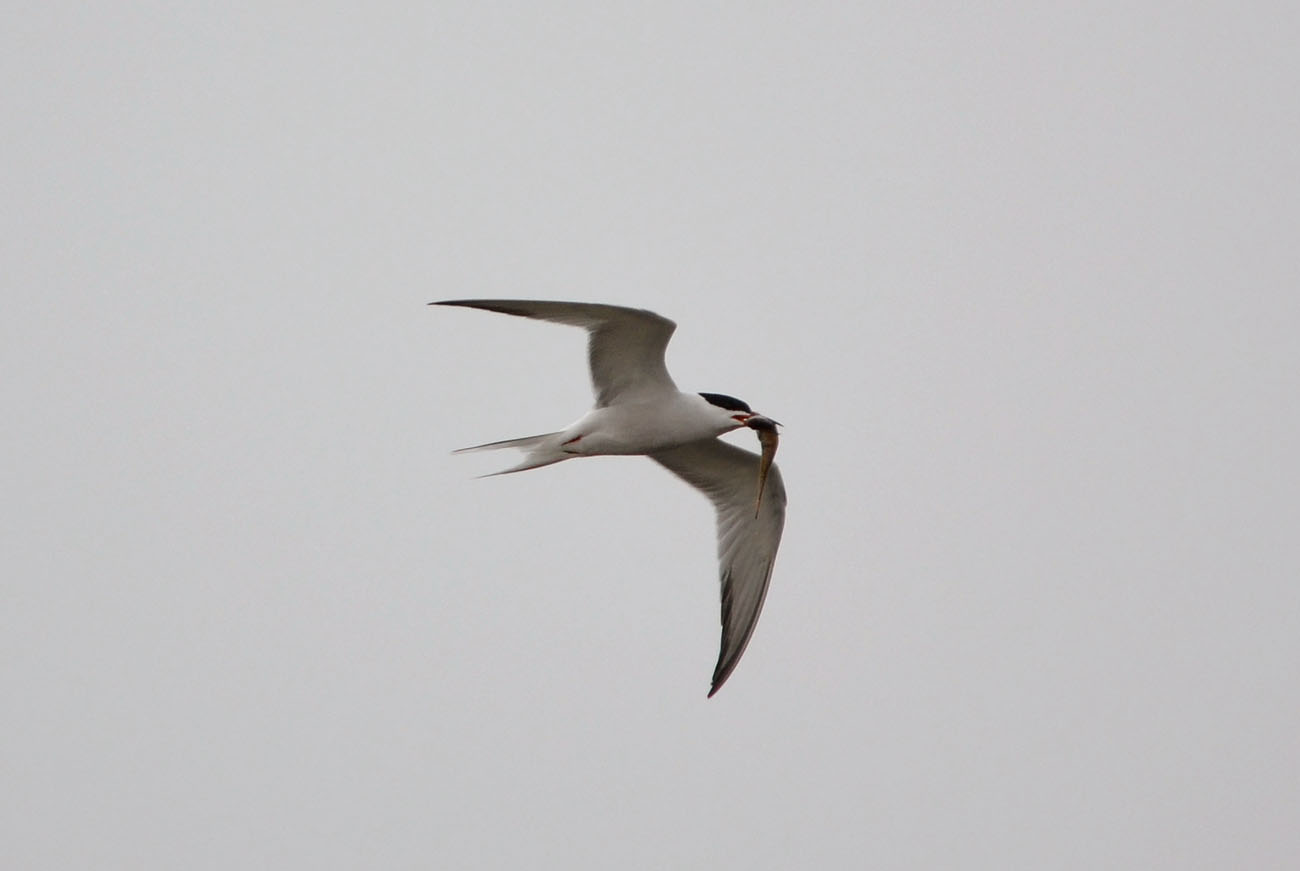
On the beach, a trio of Common Terns were chasing each other across the sky, one of the terns carrying a fish (perhaps for courtship purposes):
There have been so many male Red-winged Blackbirds in this park in recent weeks, it's nice to see the females showing up as well:
Yellow Warblers nest in this park's fields, and a few males were fluttering around and calling during my visit:
These bright little birds make quite a sight, even from a distance:
And this is why people (in North America) don't like European Starlings. I checked on the nesting cavity that the Northern Flickers worked so hard to excavate over the past few weeks, only to find a starling sticking its head out of the hole:
I know it's not the starlings' fault that they're on this continent, and it takes a feisty bird to chase off a powerful Northern Flicker, but... starlings have so many nesting options. Couldn't they have left this cavity to the flickers? Yes, you're very fancy with your spiky throat and triangle wings, but I'm not impressed. Eh, starlings:
In more overall positive nesting happenings, I was happy to see this cool structure hanging from a tree branch:
A Baltimore Oriole nest! The male oriole was singing nearby and keeping another male from his territory, while the female oriole was busy using her excellent weaving skills:
This is such an amazing structure, and I'm curious about the material she's using. Some sort of plant fiber perhaps? Here's a video of the female at work:
Here are a couple more happy sights to close out my visit. This patch of Lance-leaved Violets (Viola lanceolata) made a small field of stars shooting up from the muddy ground:
And I loved seeing this Savannah Sparrow perched near the ground, its yellow eyeshadow so perfectly matching the blooming dandelions:
There are so many amazing things to see right now!