Showing posts with label white-crowned sparrow. Show all posts

Monday, September 18, 2023

May-June, 2023

I've already posted about the Eastern Bluebirds who raised their families in our yard this spring and summer, but we had a lot of other cool sightings during that time, too! Here are some highlights from our property during May and June of this year.

May is peak migration time, and it's always fun to get glimpses of the birds that pass through our yard on the way to their summer breeding grounds, near or far. Here's a White-crowned Sparrow on May 7, pausing briefly here during its journey to somewhere in northern Canada:

Migration also meant that we added three new bird species to our yard list in May this year, bringing our total list of bird species seen and/or heard on our property to 116! (Wow!) Bird #114 was a Least Flycatcher who was hunting and calling from a big apple tree in our meadow on May 7 (thanks to Merlin's sound ID feature for helping me to confirm this little bird's identity). Bird #115 was, incredibly, an Eastern Whip-poor-will who called for a few minutes after 9:00 PM on May 11; the bird was singing from somewhere beyond our property, but it was loud enough that I heard it from inside the house. (Eastern Whip-poor-wills are rare around here, and I expect that this was a once-in-a-very-long-while event.) Bird #116 was a Prairie Warbler who moved quickly through our yard, singing a few times, on May 28.

Of course it's also wonderful to come across birds that I see more regularly, especially birds who are only around during the warmer months. This Broad-winged Hawk circled overhead for a bit on May 7; I'm fairly sure that these hawks nest somewhere in the woods bordering our property, but I don't know whether this individual was here to stay for the summer, or whether it was planning to move on:


This male Common Yellowthroat was singing insistently at the edge of the meadow on May 14, perhaps establishing his territory for the season (this is another species that breeds here):


Also on May 14, this male Scarlet Tanager made a nice contrast with newly emerging Shagbark Hickory leaves and flowers:

Just a few days after I took that picture, we had a late hard freeze that destroyed most of this Shagbark Hickory's leaves (and many emerging leaves on other plants, too). This tree and pretty much everything else recovered fine, but it was tough to see so much blackened and bare plant life in the second half of May.

On May 16, I got to admire this Black Swallowtail butterfly up close after it emerged from a chrysalis that overwintered in our unheated mudroom:

Downy Woodpeckers had a nest in a partially-dead tree at the edge of our property this year. I didn't get to see the babies, but I certainly heard them, and the parents made frequent visits. Here's the male at the nest hole on May 27:

On May 30, this Eastern Chipmunk was stuffing its cheeks full of Silver Maple seeds that had fallen from the tree in our front yard:


Those are some big cheeks! And I love this view from behind:

On May 31, a swarm of Honey Bees settled briefly high up in the branches of an oak tree in our front yard:


I'd never seen a Honey Bee swarm in person before! Here's a closer view -- wow, that's a lot of bees:


I didn't take a whole lot of pictures of wildflowers during this time, but here's an especially floriferous Starflower plant along our woods path on June 2; I don't usually see three of these lovely blossoms on a single plant:


And I was pretty well blown away by the Wild Lupine display in our meadow this year. I wonder if these plants were helped along by the extremely dry May we had, or maybe they've just been really successful at increasing their population each year (despite the ever spreading goldenrod). Whatever the reason, there were more lupine flowers in the meadow this year than I've ever seen before, and it was glorious. I'm so glad these plants took off when we scattered their seeds after excavation work in the meadow in 2017! Here's a view of a small portion of the lupine show on May 31:


And a wider view on June 2:


I loved seeing some variations in colors among different plants, like these bicolor white-and-purple flowers on June 4:


These flowers were a big hit with the pollinators, too. Here's a Honey Bee enjoying the lupines on June 5:


This male Brown-headed Cowbird was looking fancy in newly emerging Redbud shoots on June 6 (after the tree's first attempt at new growth was entirely destroyed in the May 18 freeze):

In the woods on June 15, I happened to spot a Small-eyed Sphinx (Paonias myops). This moth was doing a very good dead leaf impression, dangling by its front legs from a Multiflora Rose stem:


Up close, this moth's wings look to me like they're decorated with gold leaf; ah, so pretty, and the shapes of these wings are so interesting:


(Incidentally, Multiflora Rose is one of those nasty invasives that I'm trying to gradually remove from the property; there's quite a lot of it out there, but it hasn't totally taken over any areas yet, and I've been making slow but steady progress each year. My strategy this year was to cut some plants to the ground and place a wide flat rock over each stump, and that actually seemed to work pretty well, as long as the rock was wide enough. Last year, I tried cutting down plants and treating the stumps with triclopyr, which mostly worked, but some of the plants still regrew. We have an abundance of wide flat rocks on the property, so I'll likely keep going with that strategy for now.)

On June 21, I saw one of our Eastern Phoebes hunting in the meadow, using young trees as convenient perches:


Here's another picture of this lovely bird perched on a small hawthorn sapling:


(I wonder how long it will be before this area is no longer quite a meadow, with small trees and shrubs moving in. I don't feel the need to maintain this strictly as a meadow, and I'm very curious to see how this landscape will change over the years.)

Also on June 21, a couple of Ovenbirds in the woods came near me and made sharp sounds and generally made it clear that I wasn't welcome -- I think they may have had a nest somewhere near the path. Yes, you are bold little birds, and also adorable:

Speaking of adorable, here's a young Tufted Titmouse at the edge of the meadow (also on June 21):


On June 29, I was surprised to see a juvenile Dark-eyed Junco grooming itself right in the middle of a small table on our back deck:


This little bird then sat on the table for several minutes, apparently resting -- it didn't seem to be hurt, and it flew away after a little while, but it was definitely strange to see this young bird lounging on our deck furniture:


Finally, our trail camera in the woods picked up several cool sightings in June, so here's a small selection of clips, featuring: 

  1. Our first sighting of an American Mink on our property. This was a surprise, because I've only seen mink around water before! But this mustelid-type creature was too big to be a weasel and too small to be a Fisher (both of which have appeared on the camera in this spot in the past), and there are wetlands just a little further downhill from here; and it sure looks like a mink.
  2. An Ovenbird doing its chicken-like walk across the log.
  3. A mother White-tailed Deer and her twin fawns.
  4. A Raccoon with two babies (and sounds!).


And that's it for May and June! As I'm writing this, the fall season is arriving (yay, fall!), but the next posts on this blog will feature summer sights. Next up: July!

Thursday, May 11, 2017

Cold and Rainy, But Lots of Birds!

This past Saturday was chilly and gray and rainy, and I did a dance with the weather for much of the day -- I kept trying to go outside, and then the rain would push me back inside. But I saw so many creatures in the time I was outside. Lots of birds that I hadn't seen yet this year are now back in the area, and they were out despite the wet weather, so I needed to be out there, too!

On Saturday morning, I drove out to a nearby park, and on my way home (after the rain sent me back to my car), I stopped to admire a bunch of swallows gathering on a fence next to the road. Tree Swallows are always beautiful, even in the rain:


I'm not used to seeing Tree Swallows and Barn Swallows hanging out in the same spot like this:


The birds seemed to be taking the rain as a bathing opportunity. Shake off those raindrops, little bird:


When I got home, the rain let up again for a bit, so I wandered outside near our house, where fields of bright yellow flowers make for quite a dramatic landscape, especially below heavy clouds and mist:


I'm guessing these yellow flowers are some sort of mustard, and the Red-winged Blackbirds at least seem to be making good use of them. I saw several male Red-winged Blackbirds displaying in parts of the field, and this female was picking up what looks like nesting material from among the yellow flowers:


So many birds in the area were taking advantage of the halt in the rain to move around. Every few minutes, I'd look up and see a different bird passing by overhead -- a heron, various hawks, vultures, ducks.... An Osprey circled over our neighborhood a couple of times, perhaps eyeing the ponds:


Even a Common Loon flew by at one point, heading toward the nearest Finger Lake, I'm guessing. I'm amazed that this creature could fly with all those damaged feathers on its left wing (and now I know that loons trail their big feet behind them when they fly, how cool):


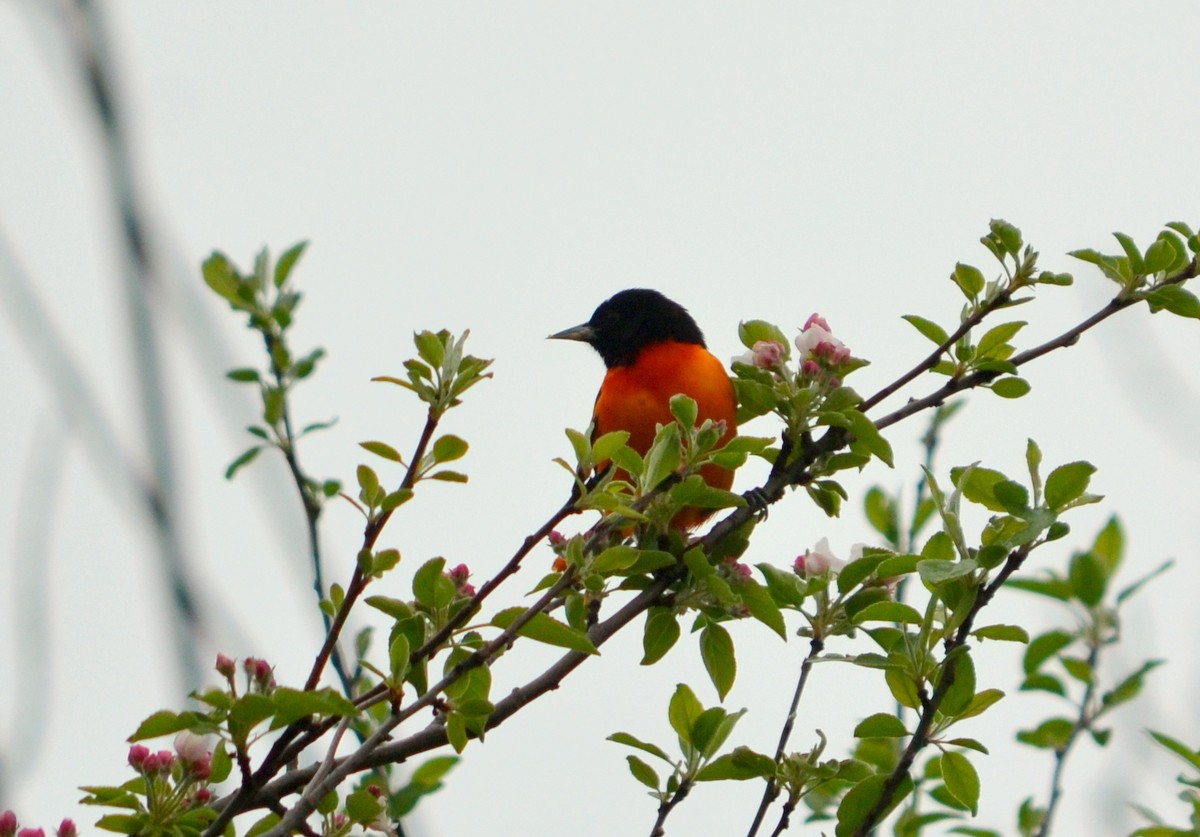
Lots of birds were moving around in the trees next to the fields, including my first Baltimore Orioles of the year. This handsome male oriole had an especially brilliant breast that was almost red in places. What a sight on a gray day!


I was very excited to see a male Bobolink, too, who was singing his weird robot-song and snacking on flower petals. I've only seen Bobolinks twice before, and that was a few years ago, all the way back at the Connecticut shore. It's so cool to have these funny meadow-dwelling birds nearby:


A few White-crowned Sparrows have been hanging around our yard for the past week or so, and one fellow in particular frequently takes up a post in the blossoming apple tree outside our window to sing. White-crowned Sparrows only pass through this area during migration, and I'm glad to have these pretty birds as neighbors at least for a little while. Here's a picture of our apple-tree-songster from inside the house on this rainy day:


At this point in my life, the place where I've heard White-crowned Sparrows singing the most was at the coastal dunes in Humboldt County, CA (since these birds breed there). It's been very strange to hear those dune sounds again here in rainy, lush, springtime Central New York! Best wishes on the rest of your journey, little sparrow, when you do decide to move on; and thanks for stopping here for a few days:


A Green Frog was also out and about on this rainy Saturday, settled nicely in a puddle next to a field:


Hooray for spring, when even rainy days are exciting and full of things to see!

Sunday, April 24, 2016

Not Upsetting Everybody

This post is about California Quail!

I saw my first California Quail when we visited Mount Shasta in March. A male quail ran/scuttled across the road ahead of my car while we were driving through town, and I was very excited (quail!) and pulled over to look at it. Unfortunately, I stopped in front of a house, and dogs started barking, and a lady in a robe came out to see if everything was OK and also to tell me: "you're upsetting everybody." I really don't like to upset people (let alone everybody!) so of course I apologized and we went on our way. (I'm not trying to be snarky; I really should've been more aware of my surroundings.)

But then this past Thursday afternoon, I got my second chance to see quail! Paul and I were driving on the very end of the peninsula on the north side of Humboldt Bay, coming back from the dunes there, and we saw a group of small pudgy birds feeding in the grass near the side of the road. Ahh, quail!


And with no other people around or other cars on the road, I could sit and admire these awesome birds to my heart's content! The males were super fancy, with stripes, masks, and bobbing head-ornaments:


And the females were beautiful as well:


I love the wash of pale feathers on the male's forehead:


And the white line from his beak to his eye that seems to give him a goofy grin:


And I'm entranced by the intricate pattern of feathers around the back of both the male's and female's necks:


What incredibly fancy birds! Here's a video of these two foraging, with the male's feathery ornament bobbing all over the place:


I'm so glad I got to see California Quail -- the state bird -- to help round out my California experience.

And while I'm already sharing fancy birds at the dunes, here's a lovely White-crowned Sparrow who was hanging out in a nearby Yellow Bush Lupine:
 

Yay, birds! 

Sunday, June 21, 2015

Welcome to California's North Coast

And here we go! I'm excited to say that for the next year or so, I'll be living and working in Humboldt County, California, all the way up in the northwestern part of the state. Think Pacific Ocean, giant redwoods, moderate temperatures year round.... This is a huge change from anywhere I've lived before, and it's kind of amazing.

In the week and a half since we arrived at our new home, Paul and I (along with my parents, who generously helped us move) have briefly visited a broad range of nearby natural places; our goal has been to get a basic idea of what's around here so we can explore them in more detail in the months to come. Basically, this is the tourist phase. So here's a sampling from our preliminary adventures in this new and exciting place. Consider this a teaser of things to come!

We're living on a peninsula between the Pacific Ocean and Arcata Bay, which means that just a few minutes drive from our house (or a 20-minute walk), we have vast expanses of beach:


We spent some time walking among the dunes and beaches at the Humboldt Coastal Nature Center and the nearby Ma-le'l Dunes, and I was pretty impressed with this alien landscape:


There are so many specialized plants on the dunes, with lovely flowers and interesting growth patterns, and all of them are entirely foreign to me. I'm looking forward to getting more familiar with the plants in my new almost-backyard. Here's some Yellow Sand-verbena (Abronia latifolia) and Purple Owl's Clover (Castilleja exserta) to get things started:


I was happy to meet lots of White-crowned Sparrows who were raising families in the dunes' shrubby growth, since I'm at least passingly familiar with these birds from back east. This adult was chirping through a beakful of caterpillar:


A juvenile White-crowned Sparrow made an appearance as well:


I've never before lived in a place where Common Ravens are actually common, so it's pretty cool that I've already seen these birds several times around here. This raven sat on a tower near the nature center and made a weird gurgling sound that we thought at first might come from some sort of amphibian:


Another raven showed up on the same tower an hour or so later; with those bits of pink skin at the corners of its beak, I'm guessing this is a juvenile:


At the shore, there were even more things to see. Look, waves!


A big flock of Marbled Godwits was working over the wet sand:


I guess there are some tasty critters in there:


This godwit walked along the beach then did a double-take and rushed back to a spot it had just passed:


It pushed its beak deep into the sand and pulled up... I'm not sure what kind of creature:


It was a big prize, whatever it was, and the godwit had a bit of a hard time swallowing it:


But it got it down eventually. I have to say, I'm impressed by these birds' skills at hunting out such buried creatures:


One of the most amazing sights on the beach the day we visited was the hundreds of washed up By-the-wind Sailors (Velella velella), beautiful blue jellyfish-like creatures (actually colonies of hydrozoans) that float across the open ocean with the help of their stiff "sails":


I think I knew such creatures existed, but I'd certainly never seen one before, and apparently they only wash up on shore under certain unusual conditions. What an amazing encounter!

So we've got easiest access to sandy beaches and dunes, which I'm sure will provide us with tons of entertainment. Driving north up the coast, the shoreline becomes more rocky and intense. We explored a bit of Patrick's Point State Park, which features some dramatic cliffs along the ocean:


Big rocks just offshore are obviously popular resting spots for birds (like the assorted cormorants on the left):


There are a lot of ocean birds here that I'll need to learn. Small groups of Common Murres (this group accompanied by a cormorant) flew over the water and fished in the waves:


A family of hyperactive Chestnut-backed Chickadees was busily eating seeds from the conifers in the park:


It's so cool to see chickadees in these new costumes; I think the chestnut vest is very handsome indeed:
 

And it's nice to see a Turkey Vulture's familiar face (these big birds are all over the place out here):


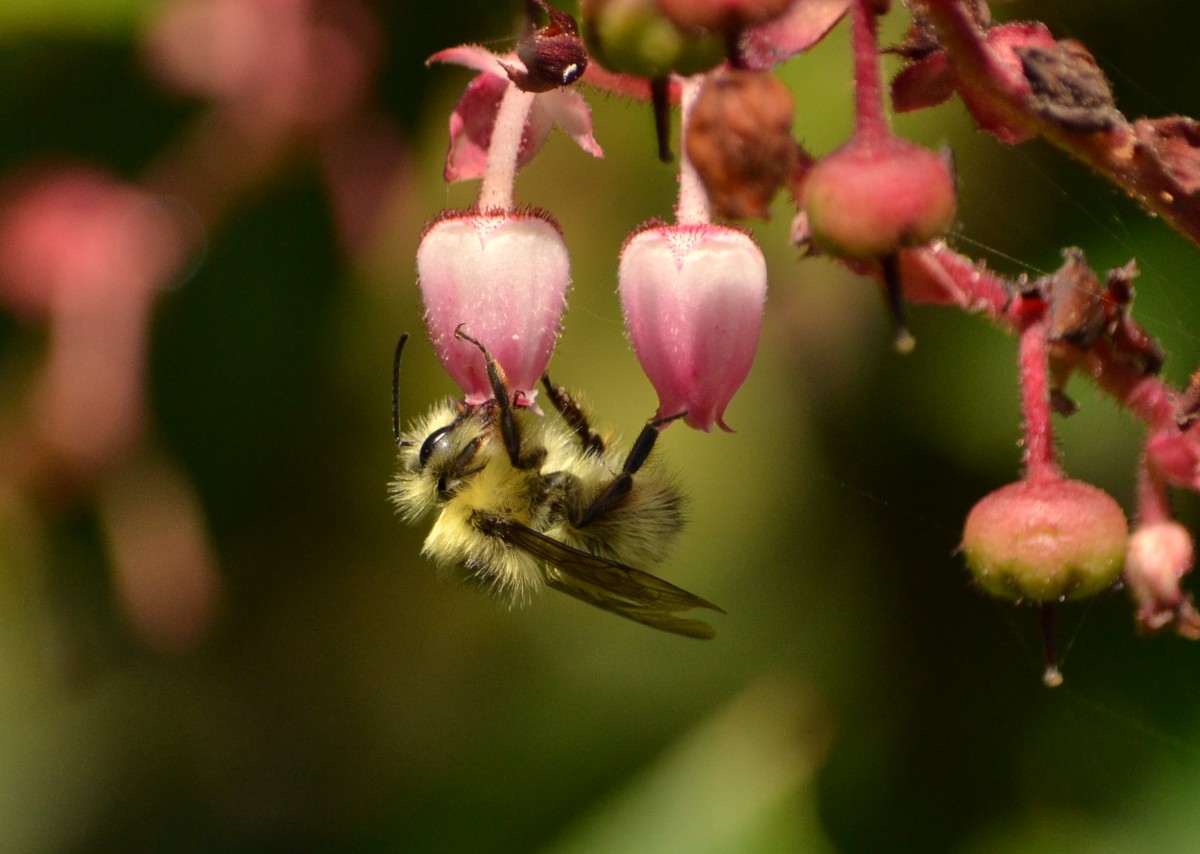
This super fuzzy bee was feeding from almost-as-fuzzy Salal (Gaultheria shallon) blossoms:


And on a stone/sand beach neighboring Patrick's Point, we found a small grasshopper (possibly in the genus Microtes) with some of the best camouflage ever. See it?


How about now?


I especially love the grasshopper's patterning from above:


OK, beaches and dunes and rocky shores are all amazing, but here's maybe the coolest part about our new home: A half hour drive gets us to the Redwood National and State Parks, which protect over 40% of all remaining old-growth Coast Redwood (Sequoia sempervirens) forests. Some of these trees are really ancient (upwards of 2000 years old), and these are the tallest trees in the world. I mean, that's pretty awesome. For our first foray among these ancient trees, we walked the Lady Bird Johnson Grove trail, which features old-growth redwood and Douglas Fir trees; these aren't the biggest examples of these trees (because the trail is at a higher elevation than some other parts of the forest), but they're still pretty darn tall:


We spent a lot of time just looking up and marveling at these giants:


I absolutely loved wandering through this forest:


There were lots of interesting flowers growing on the forest floor. Here's a carpet of Two-leaved Solomon's Seal (Maianthemum dilatatum):


And a lovely mixture of Redwood Violet (Viola sempervirens) and Western Rattlesnake Plantain (Goodyera oblongifolia) -- my first northwestern orchid (although it's not blooming yet):


A warbler (Wilson's Warbler, I suspect, although I didn't get a good enough view to confirm that ID) quickly crossed our path with food for its family:


And that's it so far. I've got tons of new animals and plants to learn about (my Western North America bird book should be arriving any day now) and so many new environments to explore in more detail. I can't wait!