Showing posts with label american mink. Show all posts

Monday, September 18, 2023

May-June, 2023

I've already posted about the Eastern Bluebirds who raised their families in our yard this spring and summer, but we had a lot of other cool sightings during that time, too! Here are some highlights from our property during May and June of this year.

May is peak migration time, and it's always fun to get glimpses of the birds that pass through our yard on the way to their summer breeding grounds, near or far. Here's a White-crowned Sparrow on May 7, pausing briefly here during its journey to somewhere in northern Canada:

Migration also meant that we added three new bird species to our yard list in May this year, bringing our total list of bird species seen and/or heard on our property to 116! (Wow!) Bird #114 was a Least Flycatcher who was hunting and calling from a big apple tree in our meadow on May 7 (thanks to Merlin's sound ID feature for helping me to confirm this little bird's identity). Bird #115 was, incredibly, an Eastern Whip-poor-will who called for a few minutes after 9:00 PM on May 11; the bird was singing from somewhere beyond our property, but it was loud enough that I heard it from inside the house. (Eastern Whip-poor-wills are rare around here, and I expect that this was a once-in-a-very-long-while event.) Bird #116 was a Prairie Warbler who moved quickly through our yard, singing a few times, on May 28.

Of course it's also wonderful to come across birds that I see more regularly, especially birds who are only around during the warmer months. This Broad-winged Hawk circled overhead for a bit on May 7; I'm fairly sure that these hawks nest somewhere in the woods bordering our property, but I don't know whether this individual was here to stay for the summer, or whether it was planning to move on:


This male Common Yellowthroat was singing insistently at the edge of the meadow on May 14, perhaps establishing his territory for the season (this is another species that breeds here):


Also on May 14, this male Scarlet Tanager made a nice contrast with newly emerging Shagbark Hickory leaves and flowers:

Just a few days after I took that picture, we had a late hard freeze that destroyed most of this Shagbark Hickory's leaves (and many emerging leaves on other plants, too). This tree and pretty much everything else recovered fine, but it was tough to see so much blackened and bare plant life in the second half of May.

On May 16, I got to admire this Black Swallowtail butterfly up close after it emerged from a chrysalis that overwintered in our unheated mudroom:

Downy Woodpeckers had a nest in a partially-dead tree at the edge of our property this year. I didn't get to see the babies, but I certainly heard them, and the parents made frequent visits. Here's the male at the nest hole on May 27:

On May 30, this Eastern Chipmunk was stuffing its cheeks full of Silver Maple seeds that had fallen from the tree in our front yard:


Those are some big cheeks! And I love this view from behind:

On May 31, a swarm of Honey Bees settled briefly high up in the branches of an oak tree in our front yard:


I'd never seen a Honey Bee swarm in person before! Here's a closer view -- wow, that's a lot of bees:


I didn't take a whole lot of pictures of wildflowers during this time, but here's an especially floriferous Starflower plant along our woods path on June 2; I don't usually see three of these lovely blossoms on a single plant:


And I was pretty well blown away by the Wild Lupine display in our meadow this year. I wonder if these plants were helped along by the extremely dry May we had, or maybe they've just been really successful at increasing their population each year (despite the ever spreading goldenrod). Whatever the reason, there were more lupine flowers in the meadow this year than I've ever seen before, and it was glorious. I'm so glad these plants took off when we scattered their seeds after excavation work in the meadow in 2017! Here's a view of a small portion of the lupine show on May 31:


And a wider view on June 2:


I loved seeing some variations in colors among different plants, like these bicolor white-and-purple flowers on June 4:


These flowers were a big hit with the pollinators, too. Here's a Honey Bee enjoying the lupines on June 5:


This male Brown-headed Cowbird was looking fancy in newly emerging Redbud shoots on June 6 (after the tree's first attempt at new growth was entirely destroyed in the May 18 freeze):

In the woods on June 15, I happened to spot a Small-eyed Sphinx (Paonias myops). This moth was doing a very good dead leaf impression, dangling by its front legs from a Multiflora Rose stem:


Up close, this moth's wings look to me like they're decorated with gold leaf; ah, so pretty, and the shapes of these wings are so interesting:


(Incidentally, Multiflora Rose is one of those nasty invasives that I'm trying to gradually remove from the property; there's quite a lot of it out there, but it hasn't totally taken over any areas yet, and I've been making slow but steady progress each year. My strategy this year was to cut some plants to the ground and place a wide flat rock over each stump, and that actually seemed to work pretty well, as long as the rock was wide enough. Last year, I tried cutting down plants and treating the stumps with triclopyr, which mostly worked, but some of the plants still regrew. We have an abundance of wide flat rocks on the property, so I'll likely keep going with that strategy for now.)

On June 21, I saw one of our Eastern Phoebes hunting in the meadow, using young trees as convenient perches:


Here's another picture of this lovely bird perched on a small hawthorn sapling:


(I wonder how long it will be before this area is no longer quite a meadow, with small trees and shrubs moving in. I don't feel the need to maintain this strictly as a meadow, and I'm very curious to see how this landscape will change over the years.)

Also on June 21, a couple of Ovenbirds in the woods came near me and made sharp sounds and generally made it clear that I wasn't welcome -- I think they may have had a nest somewhere near the path. Yes, you are bold little birds, and also adorable:

Speaking of adorable, here's a young Tufted Titmouse at the edge of the meadow (also on June 21):


On June 29, I was surprised to see a juvenile Dark-eyed Junco grooming itself right in the middle of a small table on our back deck:


This little bird then sat on the table for several minutes, apparently resting -- it didn't seem to be hurt, and it flew away after a little while, but it was definitely strange to see this young bird lounging on our deck furniture:


Finally, our trail camera in the woods picked up several cool sightings in June, so here's a small selection of clips, featuring: 

  1. Our first sighting of an American Mink on our property. This was a surprise, because I've only seen mink around water before! But this mustelid-type creature was too big to be a weasel and too small to be a Fisher (both of which have appeared on the camera in this spot in the past), and there are wetlands just a little further downhill from here; and it sure looks like a mink.
  2. An Ovenbird doing its chicken-like walk across the log.
  3. A mother White-tailed Deer and her twin fawns.
  4. A Raccoon with two babies (and sounds!).


And that's it for May and June! As I'm writing this, the fall season is arriving (yay, fall!), but the next posts on this blog will feature summer sights. Next up: July!

Tuesday, January 20, 2015

Mammals at a Winter Marsh

I visited Sheldon Marsh State Nature Preserve this afternoon to see what kinds of creatures hang out in these marshes and woods next to Lake Erie during the winter. The marshes were all iced over and quiet:
 

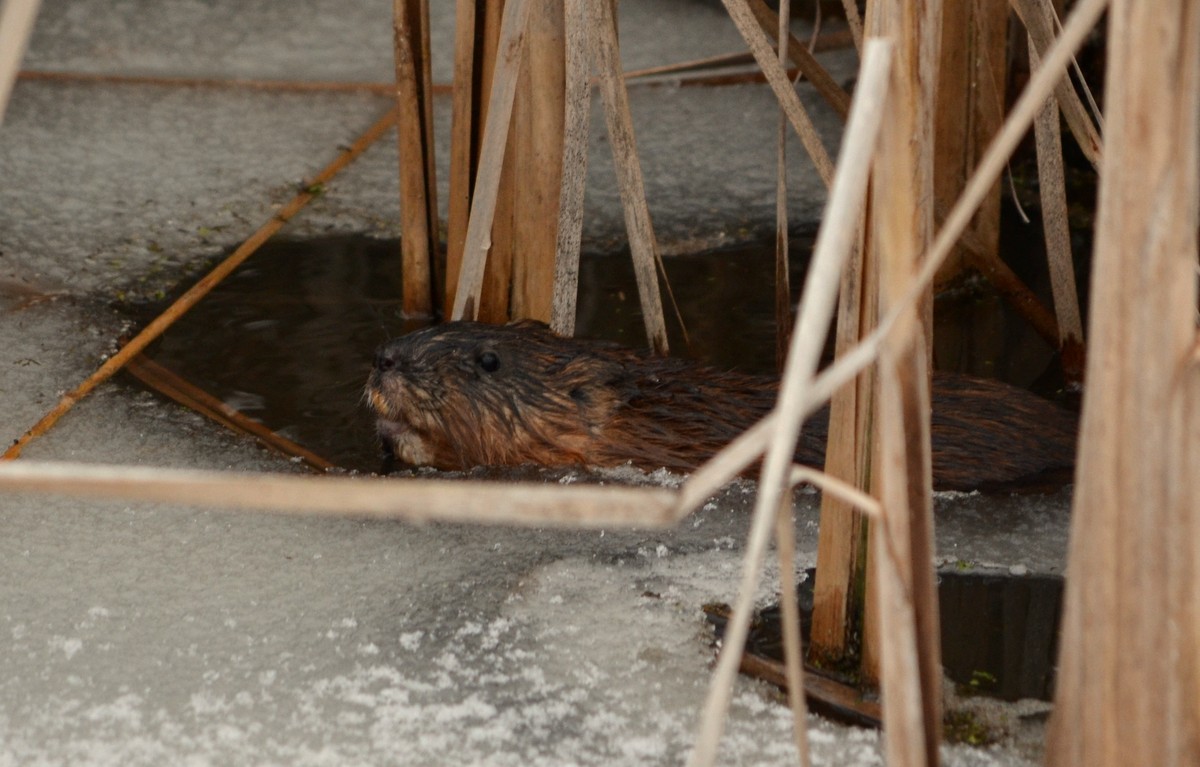
Quiet, that is, except for the loud splashes I kept hearing as I walked by this part of the marsh. I stood around for a while, and it turned out that the creatures who made the mounds in the above picture were popping in and out of holes in the ice. Hello, Muskrat!
 

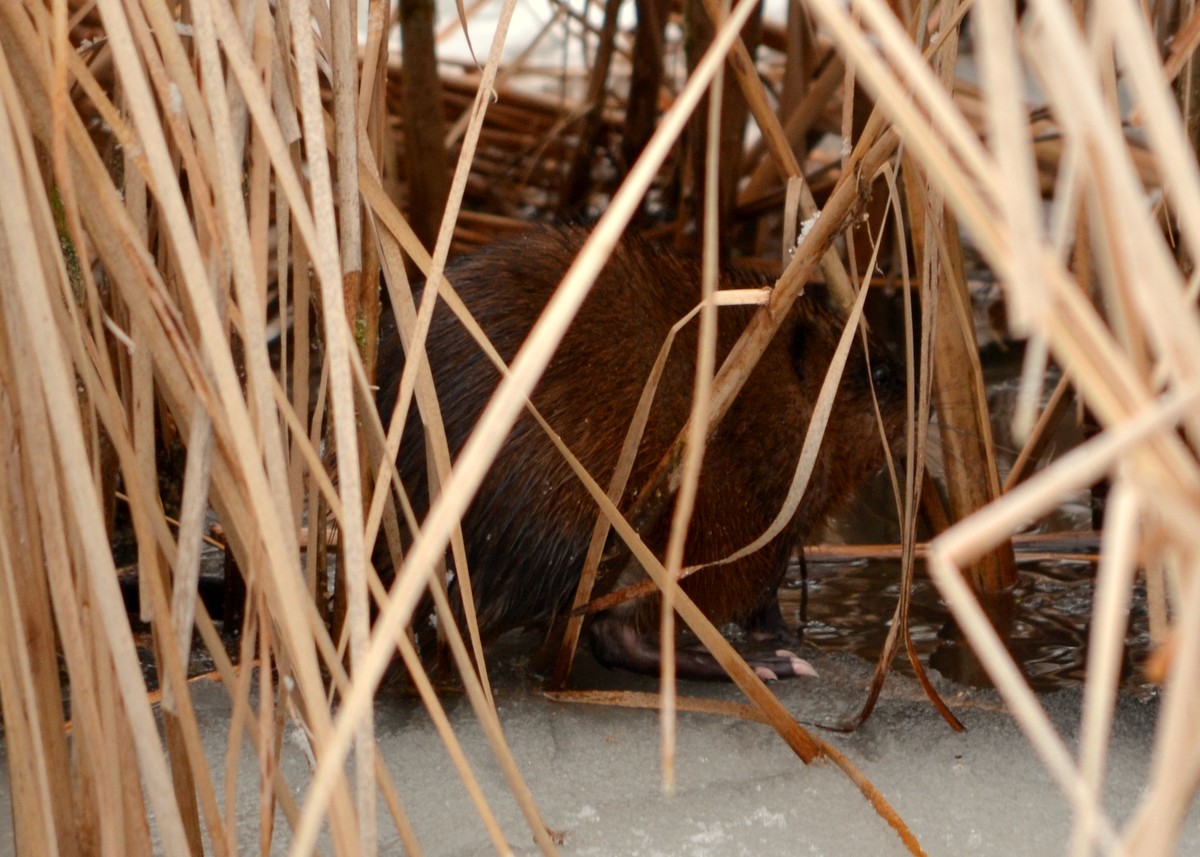
These guys came out of the water several times, but they mostly stayed hidden in the cattails, so usually I only knew they were there because of some mysteriously waving reeds and then a splash as they flopped back into the water. I only got brief glimpses of their whole bodies. Look at those weirdo feet:
 

The Muskrats weren't the only mammals living in the icy marsh, either. At one point, I looked down at the big rocks piled at the edge of the water, and a little American Mink face was staring back at me! I missed that picture because the creature dashed off too quickly (alas), but another mink (or the same one) showed up a little later on the ice:
 

How can a creature be so cute and so fierce-looking at the same time? Right after I took this picture, the mink dove into the water and emerged a second or so later with a little fish in its mouth. Those are some pretty impressive hunting skills. Apparently mink eat muskrats (even though they're about the same size), so this seems like a pretty risky living situation for the muskrats! It was definitely cool to get to see these reclusive animals at their icy home.

There are tons of Fox Squirrels in this park; I saw them basically everywhere I turned. Fox Squirrels are such handsome creatures:
 

A fuzzy Fox Squirrel next to fuzzy Poison Ivy vines:
 

Somebody's almost certainly been feeding the Fox Squirrels at this park. This lovely girl walked right up to me and touched my boot as I made my way down the path:
 

She seemed confused when I kept walking without giving her anything. (I'm sorry! Don't look at me like that!)


This Red-tailed Hawk, for its part, was doing its best to keep the Fox Squirrel population in check:
 

While a second Red-tailed Hawk watched on from a neighboring tree:
 

I so rarely get to see adult Red-tailed Hawks from behind. Those rusty red feathers really are beautiful, and I love the pattern on this creature's back:


I'm so glad such wonderful surprises are out there, even the middle of winter.

Thursday, March 15, 2012

Meeting a Mink, and Various Spring Sights

For the past few days, I've been visiting my family in Maryland, where spring is in full swing -- flowers everywhere, reptiles and amphibians out and about, mid-70s temperatures, the works! I very much enjoyed the vacation, but I was a little worried that I might be missing some key springtime events up here in Connecticut. So when I got back home this afternoon, I took a trip to Naugatuck State Forest, to see how much had changed while I was gone.

And I did miss some things, but not too much. The Wood Frogs have made their first appearance, for starters. I didn't see or hear any of these frogs during my walk today (it had cooled down significantly by the time I got out there), but I did find the results of their earlier activity:


There should still be many more eggs to come, and I'm confident that I'll get to see the frogs when they continue their reproductive activities on future warm days. I heard a few scattered Spring Peepers calling today as well, so it seems the time for amphibians has really arrived!

And there are tiny leaves emerging out there -- the new-spring greenery I saw today was all on invasive plants, but I'll take whatever green I can get right now. The Multiflora Rose stalks were sending little green shoots out all over the place:


Some of these rose leaves were even starting to unfold and take shape:


The Autumn Olive leaves were peeking out, too:


While not green (and not invasive), clouds of puffy gray pussy willows spoke of spring as well:


The most exciting part of my visit to the woods today, though, wasn't strictly spring-related. I was rounding the lake towards the end of my walk, when a long, thin, furry creature bounded across the rocks just to the left of the path, then dove quickly down into a crevice and out of sight. I only saw it for a split second, but I was pretty sure I knew what it was: an American Mink.

I had seen what I thought must've been a mink at this lake once before, last May, but that was from a great distance and I hadn't seen any more signs of the creatures until now. I was really curious to see this creature a little better -- and so close! -- so I decided to see whether, by some chance, the mink would venture back out while I was waiting there....

So I stood as still as I could, and sure enough, after about five minutes or so, a dried plant stalk rustled slightly, and then out of the rocks came a tiny searching nose, little ears and eyes:


Yes, you are a mink! Hello, little creature!

The mink was cautious, and gave me a good looking-over from its safe place in the rocks:


When I didn't immediately lunge forward and try to eat it (and the sounds of my camera's shutter didn't cause any harm), the little creature eventually became quite bold, emerging from its rocky hideout entirely to saunter along the water's edge right in front of me:


Well, that was way more than I expected! Seeing this creature up close, I was actually surprised at how small it was -- it looked about the same size as a pet ferret, and somehow I had pictured minks as bigger in my mind. (I mean, really, how much fur could you get off of this little creature? The whole idea seems less than practical, now that I've seen a mink in real life.)

There were plenty of little fish swimming in the water near the rocks, and I'm sure this must've been what the mink was after. (And hard at work trying to catch them, if that wet fur is any indication.) In any case, it seems like he or she has an excellent setup here: plenty of rocky crevices to hide in and travel through, and food that swims right up to the doorstep. When I left, the mink was popping in and out of the rocks and water a little further along the shore, keeping an eye on me but basically just going about its business as usual:


I suppose it's possible that this mink has gotten fairly used to people, living as it does right next to a path. In any case, it was a wonderful treat to meet such a bold creature. Happy fishing, little mink!

Friday, May 6, 2011

Kingfishers and slinking mammals

I see a Belted Kingfisher almost every time I go to the woods. He (it's usually a male) swoops low over the water, calling loudly, and is always on the other side of the lake from wherever I am. Today, however, was different: I saw a kingfisher, but a female this time, and sitting not too far away. And strangely enough, she actually sat still long enough for me to take a few pictures.


This is probably the best picture I'm ever likely to get of such a high-strung bird. You can tell this is a female Belted Kingfisher because she has that orange-y coloring on her sides -- this is one of the few species of bird (and the only one that I know of) where the female is actually more colorful than the male. Isn't she pretty, with her wild stand-up hairdo and gigantic beak perfect for catching fish? :)

I saw something else at the woods today that I've never seen before: a medium-sized brown mammal, of the weasel-ish variety, loping along the shore of one of the lakes. Here's an extremely blurry picture of the creature -- it's running to the left, with its tail sticking out behind it (and a Common Merganser looking on):


And here I thought there were too many people and dogs frequenting this area for furry things like this to be around, let alone to show themselves! From the color and the length of the tail (and the habitat), my best guess is that this is an American Mink, and I've certainly never encountered one of these creatures before. What a cool and totally unexpected discovery!

Here are some other assorted finds from today's adventure:


This pretty butterfly landed in my path and didn't stay around long (hence the blurry picture). I believe it's an American Painted Lady (although it could just be a regular Painted Lady).


Here's Dwarf Cinquefoil. This flower is a little abnormal in that it has six petals instead of the usual five. But oh well, things like that happen sometimes.


This is Japanese Barberry, an invasive species. From what I've read, these plants can really take over wooded areas, but fortunately I only found this one bush here.


And here's another new violet! This is one I just learned about because it recently showed up in two other nature blogs I read (Saratoga Woods and Waterways, and You Hike the Giant, too!): it's an Arrow-leaved violet (also called Ovate-leaved violet, Viola fimbriatula), which can be identified by its fuzzy-furry leaves and stems, and leaves that are oblong rather than heart-shaped. I just love the colors and patterns on those flowers. :)

I'll close this post with another bizarre fungus, one that I don't have a name for. These growths are about the same size, shape, and color as acorn caps, and kind of cute: