Showing posts with label moths. Show all posts

Monday, December 27, 2021

June and July, 2021

When last I shared some sights from around our property -- several months ago, oops! -- it was a green and sunny June. It feels strange to be going back to the height of summer now, when we've just recently passed the Winter solstice, but I can't very well let the second half of the year slip by without highlighting some more of this place's natural goings-on that I love so much. So here are some sights from June and July, 2021!

On June 23, I crossed paths with this male Black-and-White Warbler who snatched up a moth for processing -- I'm pretty sure that's dust from the moth's wings floating around in this picture:

Little colorful creatures in the yard are always fun. Here's a male Ruby-throated Hummingbird showing off iridescent blue/green feathers along his back while visiting hosta blossoms on July 17:


And here's a bright Red Eft (juvenile Red-spotted Newt) making its way across the stone path in front of our house on July 18:


The Eastern Phoebes successfully raised four babies in the nest above our front door, their second brood of the year. On July 16, the babies' eyes were starting to peek open:


And by July 23 the baby phoebes were alert and nearly ready to leave -- I kept my distance for this picture to avoid startling them out of the nest too early; I love seeing the frumpy looks on these little birds' faces when they reach this stage each year:

This lovely Striped Hairstreak (Satyrium liparops) who showed up in our yard on July 8 was a new butterfly for me:

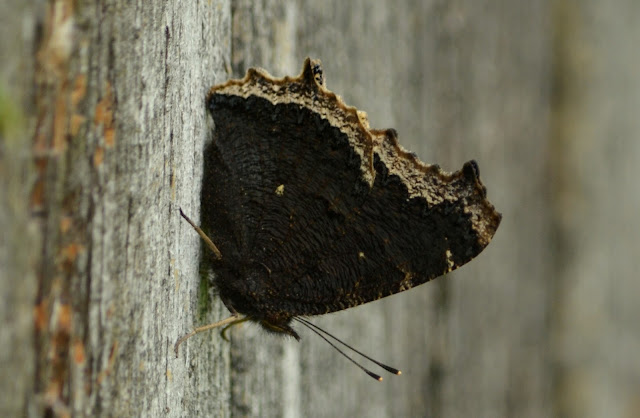
And I love the finely striped pattern on this Mourning Cloak butterfly who was resting on a shed wall on July 16:

On July 21, I found this perfect little cache of Chokecherry berries in the middle of our yard, presumably stored away by a mouse or other little creature for later; the low grass and clover seemed like a strange place to hide food, but oh well:


This small White-spotted Sable (Anania funebris) moth was enjoying some Buttonbush blossoms on July 23:

What a fancy stripey underside this moth has:


Here's another White-spotted Sable on fuzzy Wild Bergamot (Monarda fistulosa) flowers in the meadow on July 28:


Nearby, a Silver-spotted Skipper was also visiting Wild Bergamot blossoms:

And this Eastern Tiger Swallowtail looked extra stunning on Purple Coneflower blossoms:

Meanwhile, this Widow Skimmer hunted from a perch in the sunlit meadow:

One last series of sights from July 28: While walking at the back corner of our meadow, bordering the woods, I must've wandered into the overlapping territories of some very antsy male birds -- perhaps one bird's scolding encouraged the others to come keep a close eye on me as well. In any case, I ended up with some very close looks at three local breeders who usually stay much more hidden and/or distant from me. This male Common Yellowthroat was the first to show himself, popping out of the honeysuckle hedge at the edge of the meadow:

What a fancy guy:

Our resident male Indigo Bunting showed up next -- with his patchy blue-brown-white costume, I assume this is quite a young male, but I'd seen him singing in our meadow at various times this summer, so I suppose he must have successfully established the meadow as part of his territory and had a family hidden somewhere nearby:


And then most surprising of all, an Ovenbird emerged from the woods to perch on an old moss-covered apple branch over the trail and watch me intently:
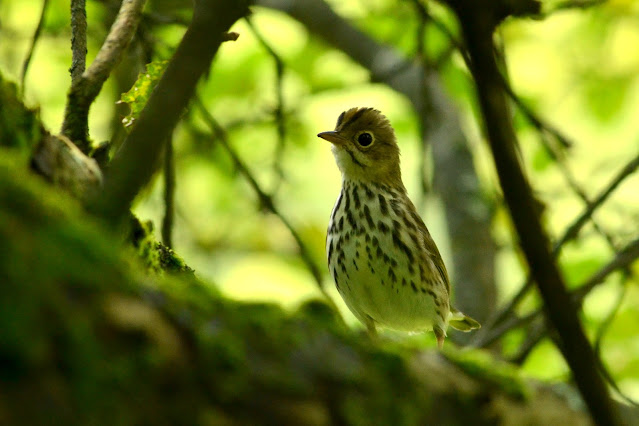

I don't know for sure whether this was a male or female Ovenbird, but given that the first two birds were territorial males, I assumed that's what was going on here, too:


Either way, this Ovenbird didn't take its eyes off of me while I was in the area, and it stayed quite close:

What a treat to see one of our resident Ovenbirds so close-up, and it was being such a good lookout -- all three of these birds did a great job, really, and I felt lucky to meet them:


I had the trail camera running in the woods throughout June and July (and then I neglected to set it up for the rest of the year), so here are a few video clips from our woods trail when no people were around:

1. A Raccoon pausing to survey the woods at night.

2. A mother White-tailed Deer with her baby, the mother making soft raspy vocalizations (what was she saying?).

3. A young White-tailed Deer (the same one from the previous clip?) getting close to the camera.

4. An Ovenbird picking out a morsel (a caterpillar?) from the forest floor.

Every year continues to be a mixture of increasingly familiar sights and new surprises. There's more to share from 2021, so that'll be the next post!

Sunday, August 9, 2020

Mid-summer Sights

July and early August this year have been suitably summery, with warm days and temperate nights, some rain but not too much, plentiful vegetables from the garden (we've been eating really well), and lots of interesting summer-time animal sightings around our property. Here are some assorted highlights from the past several weeks!

The trail camera in the woods has continued to gather some fantastic glimpses of our local wildlife, including more videos of Bobcats and Ruffed Grouse -- I'm still astonished and thrilled that these animals have been such regular visitors in our woods this year. The following video compiles a few clips from the trail camera: (1) A bobcat walking on the trail during the day (our first daytime sighting!) on July 14. (I love this big cat's beautiful colors, and those white patches on the backs of its ears; and after a Blue Jay calls and the Bobcat turns back around toward the camera, I think it even opens it mouth and makes a tiny sound!) (2) Our resident Ruffed Grouse family of an adult and two growing chicks on July 11, settled down for a grooming session on the sun-soaked path. (It's too bad this video got a little over-exposed... but I still think it's really cool.) (3) A group of Wild Turkeys -- at least two adults and several partially-downy young -- foraging along the path on July 16. (4) A family of Northern Flickers foraging on the ground and making soft noises on July 30:


Speaking of Northern Flickers, on August 3, I found one of these birds' beautiful feathers on the woods trail. "Yellow-shafted" indeed:
 

Our Eastern Phoebes successfully raised their second brood in their traditional (at least four years running now) spot above our front door. Here's one of the little phoebe faces appearing over the edge of the nest on July 12 (at 10 days old):
 

The phoebe parents did a great job of keeping these babies fed, even throughout a particularly trying few hours one day when a group of people were doing some excavation work in our yard. The phoebes made it clear that they weren't happy about people in sight of their nest, but they were very bold, and they persevered. Here's one of the parents making a food delivery on July 13:
 

These phoebe babies proved to be tenacious, too: A few days before they were ready to fledge, the nest suffered a major structural collapse (I don't know how this happened), yet the three babies stayed put in their partial-nest for the remainder of their nestling time. These are such good birds! Here they are on July 18:
 

Amazingly, we had a third Eastern Phoebe brood this year as well. I wasn't looking out for any more phoebe breeding attempts, so I was shocked to notice on July 20 that a fresh crop of fuzzy babies were jostling around in the same first nest the phoebes built this year (in the small shed on our property). These babies looked like they were about a week younger than the second brood (porch) babies, so the two nests must have been incubated at the same time, which I think must mean that we had two female phoebes nesting on our property at once. The Audubon Field Guide suggested a single male Eastern Phoebe might sometimes hold a territory with two mates, so perhaps that's what happened this year. What drama! Unfortunately, I think the third brood failed, because I wasn't able to see the baby birds again before they would have been old enough to fledge. :( Well, two broods of phoebes -- and eight new birds total -- is still pretty great!

In other nesting news, an American Robin built her nest in a tidy nook on the front of our house, making her next-door neighbors with the phoebes. This nest also failed, but it was nice to have a robin family nearby while it lasted. Goodness, nesting is rough! Here's the mama robin on her nest on July 18:
 

More happily, a pair of Gray Catbirds successfully raised a nest full of babies to fledging in the thicket of forsythia that monopolizes a corner of our property, and Cedar Waxwings have an active nest in the maple tree above the small shed. The House Wrens also have a second brood in the same nest box they used earlier this year. This place does a good job of producing baby birds!

This male Common Yellowthroat was keeping a close eye on me on July 20 while his young family foraged nearby:


Eastern Garter Snakes have been hanging around our yard quite a bit this summer, including this beautiful reddish individual who was lounging on a flat rock next to the house on July 13:
 

This has been a great summer for Red Efts (juvenile Red-spotted Newts)! Several times in the past couple of weeks, I've seen one or more of these awesome amphibians hunting in the flower bed right next to our front porch, where rain plus compost seems to attract a nicely eft-appropriate buffet of insects. I'd never seen efts actively hunting and eating before -- I usually come across them just walking from one place to another -- and I tried to capture this activity on video but ended up with footage too shaky to share. Oh well! Here are some still pictures of two efts in our flower bed on July 23 instead:


On the night of July 27, I noticed a small frog on the railing of our back deck. Expecting a Spring Peeper, I went to visit the little creature up close... and it wasn't a peeper, but rather a very young Gray Treefrog! Ahhh, so wonderful!! The two adult Gray Treefrogs who showed up on our porch this past May were the first of this species I'd ever seen, and it's so cool to get to see how small these creatures start out. I love this little frog's green patches and its round clinging toes:
 

Here's a Common Wood-Nymph butterfly feeding on blossoms of (I believe) Wild Basil (Satureja vulgaris) on July 20 in the meadow:
 

And a Hummingbird Clearwing moth visiting Wild Bergamot (Monarda fistulosa) on August 3 -- these awesome moths have been particularly common this year, which makes me very happy:
 

On the night of July 14, I decided to see what would happen if I set up my camera in the meadow with a really long (30-second) exposure time amid the fantastic firefly shows we were getting during that part of the summer. I didn't try to do any fancy processing with these photos, but I think these haphazard results look pretty cool. I love how the fireflies and stars overlap in this picture:
 

And I really like seeing the dotted trails individual fireflies make as they fly and flash across the camera's view:
 

Finally, these strange tracks appeared in looping trails all across our pollen-covered lawn mower in mid-July. Comparing with other pictures online, the best I've been able to figure out is that these are probably marks left by a snail or slug as it fed. So weird!
 

Summer is certainly an interesting time!

Saturday, December 7, 2019

From Brown to White

The landscape becomes so brown in late November. Although it's a mostly quiet and dormant time of the year, there are still plenty of interesting things to see. On November 25, I wandered in our meadow, admiring the wide variety of textures and shades-of-brown on the plentiful dried plant stems remaining after this year's growth. These arching goldenrod seedheads were especially fluffy and pretty:


And I love the mix of puffball seedheads and curly dried leaves on this aster:


Wider views of the undisturbed part of the meadow (the part that wasn't excavated and reseeded afterward) showed interesting patchworks of dried plants:


Red pedicels on Gray Dogwood (Cornus racemosa) shrubs at the edge of the meadow added some color among all the brown:


A few familiar winter-season birds were out and about as well. This Black-capped Chickadee was busy processing a sunflower seed and didn't seem to mind me standing nearby:


And a fluffy White-breasted Nuthatch worked its way along a tree trunk:


Hey, do you have a seed, too?


November 25th and 26th were relatively warm days, and I was surprised to see several moths -- which turned out to be Fall Cankerworm Moths (Alsophila pometaria) -- both during the day and at night under our porch light:


Here's another one of these moths that ended up in our house for a bit:


And after I saw my first wingless female moth earlier in the year, wouldn't you know it, female Fall Cankerworm Moths are wingless as well. (The moths in the above pictures are males.) Since that was the only species of moth I saw on those warm-weather days, I have to assume that this wingless moth on our porch on November 26 is a female of that species. Nature is so interesting and weird!


And speaking of insects, on November 25 I moved a log against our house's foundation and uncovered a pile of hibernating ladybugs; that's a lot of bugs, but given how many ladybugs we find in and around our house on warm days, I'm not particularly surprised to find this big of a group here:


On December 2, we got our first big snowstorm of the season. And it was a big storm, bringing a layer of ice followed by about a foot of thick, clinging snow overnight, and then more snow throughout the day. Most places around here closed that day -- including my work -- so I had some extra time in which to enjoy this transformation of the landscape into a world of white. The hillside across the valley from our house grew massive white structures (with pine trees somewhere underneath):


Here's a view along one edge of our property, with the old and nearly-collapsing shed surrounded by heavy snow:


The snow was so sticky -- and there was so little wind -- that it gained quite a bit of height even on narrow spots, and formed some interesting shapes. I especially like these fancy hats that developed on the Purple Coneflower seedheads:


Several birds were active throughout the snowy day, including this Northern Cardinal who was munching on Pokeweed berries:
 

Now that we're in December, I expect to see a lot of white landscapes for the next few months. It's definitely winter now!