Every week when I visit Silver Sands State Park, I get a little more attached to the place. I love getting to check in with familiar creatures, and there's always something new to see! Here are a few sights (mostly birds) from this morning's visit.
The Piping Plover chicks east of the park are getting even closer to adulthood (including the chick with the injured leg, who's still running around and foraging with its siblings as of this morning). It looks like they just need some longer wing and tail feathers, and then they should be good to go!
While the four chicks foraged in the sand, Dad kept careful watch; he even chased a House Sparrow away at one point. A folded mat makes a convenient lookout perch:
The plovers aren't the only bird family with growing babies around here, of course. I was very happy to see a gangly Clapper Rail chick wander out of the marsh grass; such a cute little dinosaur-like creature:
The Barn Swallows are nesting under the boardwalk, and this adult perched on the railing for a rest between hunting flights:
There were actually dozens of swallows hunting in the air over the marsh, more than I think I've ever seen here at once. The swirling (and chittering) cloud of birds was mostly made of Barn Swallows, but there were also several Tree Swallows in the mix, as well as a few Chimney Swifts, which I've definitely never seen hunting in this spot before. This picture may not look like much, but its quite a busy scene for this airspace:
On the beach, a pair of Great Black-backed Gulls made an imposing sight:
I'm surprised to notice that I've actually never posted about Great Black-backed Gulls before. They show up around here pretty frequently, and they have the distinction of being the largest gull in the world. These two were quite noisy, and they kept striking these odd tilted postures and tossing their heads; I can only think this is some sort of courtship display, but it seems kind of late in the season to be thinking about making a nest:
A Common Loon was floating close to shore. This bird was looking a little less than pristine (it was presumably molting out of its breeding plumage), but it was still such a handsome creature:
A Yellow-crowned Night-Heron was hunting at the water's edge (not quite as elegant as the Black-crowned Night-Heron I saw last week, and I always think that dark mask looks strange):
Although I often see many species of egrets and herons in this park, I don't usually see Great Blue Herons here. It was quite a treat, then, when this huge creature soared by:
I love those wings, and those big legs! This bird circled overhead a few times, so here's another view:
As I was leaving the park, I checked out some Common Milkweed plants to see what sorts of bugs might have been hanging out there. A few of the flower clusters were looking pretty well decimated.... Someone was hungry!
A closer inspection revealed that the orange pollen-like dusting on the plants' stems and leaves was actually tons of tiny bright aphids (probably the species Aphis nerii). These guys were everywhere and they were having a feast:
Fortunately, there were many more milkweed plants without aphids, so there's still plenty of this apparently delicious (for bugs) plant to go around.
Here's to another great day at the beach!
Well, the garden's up and thriving, which means that there will (hopefully) be yummy food in our future. It also means that there's a whole jungle of amazing tiny creatures right outside our door! I've been taking my macro lens out into the garden for the past few days to put it through its paces (and try to learn how to really use it), and I've seen some very cool bugs in the process. Here's a sampling!
Long-legged Flies (family Dolichopodidae) are very common in our garden -- small hunters zooming around and sporting iridescent costumes in green or orange. The hunting must be good here, because so many of these creatures were munching on smaller bugs when I saw them, including this one:
This next Long-legged Fly seems to me to be striking a heroic pose -- off on an adventure, are we? (I admit that I'm probably crazy for thinking this.)
Another winged hunter, this larger Robber Fly (family Asilidae) paused on a sunny rock between flights:
And a small pretty beetle (species unknown) watched me from its mint-leaf platform:
Do you want to see an aphid up close?
We have Flea Beetles on our potato plants, but thankfully not enough to do any serious damage -- they just leave a few tiny pin holes in the leaves and pose for dramatic pictures:
This little Potter Wasp (possibly Parancistrocerus perennis) was inspecting the area:
And a leafhopper (family Cicadellidae) tried to hide behind a stem:
Speaking of leafhoppers, this Red-banded Leafhopper (Graphocephala coccinea) was absolutely the fanciest thing around:
I love that we have these gorgeous little creatures here -- they look like they should be somewhere tropical, not in my back yard:
This individual was very patient with me, and eventually I left it in peace in its nice hiding spot beneath the potato buds (where it seemed to practically glow in the shade):
I had to go back to a regular lens to take a picture of this last creature -- a lovely big Ebony Jewelwing (Calopteryx maculata), a type of damselfly, and identifiable as a female because of those white spots on her wings:
I've been seeing one of these creatures in the garden for several days in a row now -- could it be the same individual? Perhaps she's also finding the garden to be a good place to hunt. Such a pretty girl:
I have one more garden bug (well, spider) to share, but she's just too cool and so will need her own post. Stay tuned!
After I discovered the shrubby fields at the North-Western end of Naugatuck State Forest last week, and had such an awesome time there, I decided yesterday morning that I couldn't stay away any longer. So off I went, bright and early! Once again, it was an exciting visit, with lots of new things to see.
The birds were out in abundance again, although I didn't have any super-close encounters this time. Even at a distance, though, this male Indigo Bunting was nothing short of spectacular:
He was cheeping loudly and keeping a watchful eye on a nearby female. The girls of this species are so dull compared to the guys -- basically brown without any clearly distinguishing features that I could see. The only way I could tell that these birds were a pair was because they were sharing the same trees and making the same sounds.
This is certainly the land of the towhee -- everywhere I went, these birds were flying around, calling, and scratching in the undergrowth -- and their nests must have recently emptied. This scruffy youngster flew over for a few seconds to check me out:
House Wrens are certainly not uncommon, but I'd never seen one of these birds before, so I was happy to spot a small group of them (presumably another recently-fledged family) in a tree.
House Wrens are rather plain-looking birds, but I think there's something quite attractive about the subtle patterns on its wings and tail.
As always, there were insects aplenty. Several of these large dragonflies -- Twelve-spotted Skimmers -- patrolled the area. This one is a young male, with beautiful white spots in addition to the black on its wings, but not yet old enough to develop the white tail that males of this species usually have:
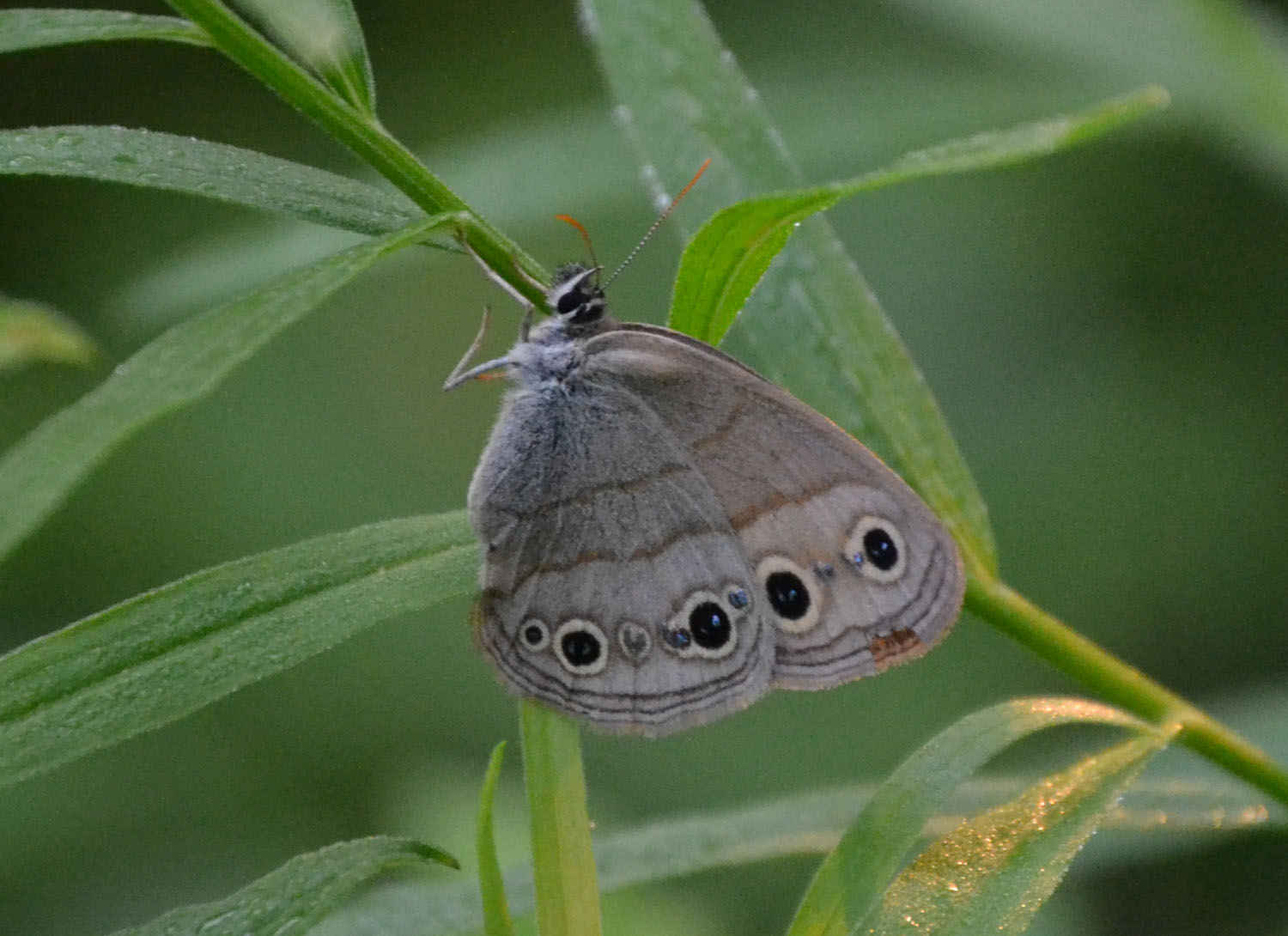
This Little Wood Satyr was showing off its impressive eye-spots (here's a picture of the less-dramatic tops of this butterfly's wings):
I just love the little orange tips on this butterfly's antennae, and is that a horn on its head? "Satyr", indeed.
A plant stem was the stage for this interesting animal behavior:
These ants are tending their herd of aphids. As the aphids suck juices from the plant, they secrete a sweet sticky liquid, called "honeydew," which the ants then eat. So both species benefit from this relationship: the ants get a source of food, and the aphids get watchful protectors. The plants don't really get anything out of the deal, however.
There were all sorts of flowers in bloom, including the brilliantly orange Butterfly Weed that I noticed last week. Here's a closer picture of these blooms, actually even brighter in real life than they look here:
This large Bull Thistle -- introduced from Europe -- was a several-feet-tall mass of sprawling thorns, although its flowers were quite pretty:
The goldenrods were just starting to open their sprays of delicate flowers. I think this might be Early Goldenrod, although I'll be happy if someone corrects me:
Finally, I was entranced by this beautiful yellow flower, but I'm a bit stumped. It looks similar to Black-eyed Susan, but its center isn't particularly dark, and the petals don't look quite right. Does anyone reading this have any ideas as to what it might be?
I'm finding it harder to go for walks with all the intense heat we've been having, and even the early mornings are just barely temperate now. Here's hoping for a break in the weather, and soon!