Showing posts with label starflower. Show all posts

Wednesday, June 30, 2021

May and June, 2021

In the last post, I shared some highlights from our property in March and April of this year, and now it's time to catch up with May and June!

I couldn't have asked for a better start to May than this close-up view of a male Chestnut-sided Warbler (I love these birds!) who was foraging and singing in the back corner of our meadow on May 2:

Swelling apple blossoms made a pretty stage for this Song Sparrow on May 10:


Eastern Phoebes started this season the same way as last year, with a successful nest in the rafters of an old, barely-weather-proof shed on our property. The phoebes' first egg appeared on April 30, and the five babies fledged by June 7. (I don't have any pictures of that brood to share, because the light in that shed is so poor.) Hooray for more phoebes in the world! Meanwhile, an American Robin built her nest just outside the same shed, on top of a broken picnic table we had leaned up against the shed wall. Here's the robin on her neat mud-rimmed nest on May 13:


Robin babies aren't exactly pretty! Here are the little monsters on May 20:


By May 26, the young robins were covered with mottled feathers and looking just about ready to leave the nest. How nice of a parent to pose here for a family portrait:


I was careful to give these robins plenty of space, but as I walked into the meadow to avoid the very alert robins, I nearly stepped on a Song Sparrow's nest on the ground! I never would have seen the hidden nest if the adult sparrow hadn't rocketed up suddenly when I got close. I took a quick picture of the lovely speckled eggs (as best as I could get without touching the surrounding plants), and then I moved on.... I have no idea how this nest fared after our close encounter. And then a week or two later, I accidentally startled another Song Sparrow from her nest in the opposite end of the meadow. I've learned that I need to avoid straying from the paths in the meadow as much as possible during nesting season! In any case, here's a glimpse of the first Song Sparrow nest from May 26:

This Gray Catbird was putting on quite a concert on the edge of our meadow on May 13 -- I absolutely love this bird's pose with his fluffed-out butt:


 Here's the same bird looking somewhat sleeker from a different angle:


The same as last year, we have a family of House Wrens and a family of Tree Swallows in our two nest boxes (although the birds swapped boxes compared to last year). Here's the male House Wren on May 13, bringing a spider egg sac into the box that he'd already stuffed full of twigs and egg sacs (that's a stick overflowing out of the entrance hole):


The House Wrens' nest must have been somewhere deep inside all those twigs, because I heard noisy babies eventually, but I was never able to actually see the eggs or chicks. I'm pretty sure the brood has fledged by now, but the adults are still visiting the box (perhaps gearing up for brood #2?).

The Tree Swallows and House Wrens seem to have been fairly amicable next-door neighbors, although the Tree Swallows were a little pushy sometimes (which is probably a good thing, keeping the House Wrens in their place). Here's the male Tree Swallow keeping watch from the top of the House Wrens' box on May 21:

At the same time, the female Tree Swallow gathered bits of grass for their nest; it was strange to see a swallow perched on the ground, but very cool to get to see this lady at work:

The finished Tree Swallow nest was perfectly padded with a variety of feathers. Here are the eggs in their nest on June 13:


And the very next day, the eggs had turned into a batch of tiny, brand new swallows:


I saw the nestlings peering out of the nest box hole today, which means the whole swallow family will probably leave us soon. The female Tree Swallow has gotten especially defensive in the past few days, and she's been dive-bombing me when she sees me in the garden or meadow. I will very much miss having the Tree Swallows as a constant feature in the yard, but I suppose it will be nice to not have a bird occasionally swooping angrily past my head.

Indigo Buntings are likely nesting somewhere around here, because I hear a male singing fairly frequently. Here's a male Indigo Bunting (here to stay, or passing through?) surrounded by apple blossoms on May 18:


On May 20, I was surprised and thrilled to see a female Hooded Warbler adding large dried leaves onto a nest right near the path in our woods:

Here's the leaf-covered nest, set in a low Multiflora Rose bush -- I never did see eggs or other activity in this nest, so I suppose this placement didn't work out, but it was still very cool to see this delicate nest-building process, and to have proof that Hooded Warblers breed in our woods:


Our woods were practically dripping with Veeries this spring! I hear and see these lovely thrushes in our woods every year, but they have seemed to be especially numerous this year, with multiple birds singing and calling nearly constantly. Fantastically, the fallen log that our trail camera was watching happened to be something of a Veery stage in late May: the camera captured multiple videos of a male Veery perched on the log and singing, and two nearly identical videos (on different days) of Veeries mating! Here's a compiled video with (1) a Veery singing, (2) Veeries mating, (3) a very wobbly baby White-tailed Deer and its mom (oops, sorry about the typo in the video), and (4) an Ovenbird (often heard in our woods but rarely seen) walking along the log:

May was a wonderful time for flowers (of course), and here are a few highlights from May 20 and 21. Here's Red Baneberry (Actaea rubra), a new plant for me, whose flowers appeared along our woods path (the later red berries on this plant helped me confirm this ID and distinguish it from White Baneberry, which also grows in our woods):

Here's a nice pair of Jack-in-the-Pulpit flowers:


And a perfect Starflower bloom, lit up by some sunlight:


And I was so happy to see this thriving patch of Foamflower in our front yard:

On June 4, a somewhat tattered but still beautiful female Promethea Moth appeared on our deck:


On the morning of June 8, the Spicebush Swallowtail chrysalis that I kept over the winter in our unheated mudroom turned into a butterfly! I had neglected to give the creature a suitable perch in its enclosure (I know better now), so I provided myself as a perch and kept watch over this new and very damp butterfly while it worked on expanding its wings:

After about 20 minutes, it was looking pristine and perfect. Soon after this next picture was taken, I transferred the butterfly to a sheltered leaf to finish drying off, and it stayed there for a while and then presumably left when it was ready:


Also on June 8, the largest Brown Snake (Storeria dekayi) I've seen (they're not a very big species) got stuck while trying to fit through the small mesh fence around my garden; I pulled it backward to free it, and then I got to marvel at how soft and docile this lovely creature was:


This Red Eft (a juvenile Red-spotted Newt) was super photogenic in our yard on June 21:


And finally (back to nesting birds again), the Eastern Phoebes are currently well into their second brood in their traditional nesting spot over our front door. I really love having these birds as neighbors, and I'm so glad they decided to nest in this spot again. Here are the eggs in their moss-and-grass nest on June 25:


Here's to a wonderful spring and beginning of summer!

Wednesday, June 5, 2019

Basically All of Spring: Part 2

Here are the rest of my sightings from our house since mid-March, continued from the previous post!

More Birds 
 
We've had a lot of nesting drama this spring. First, pair of Eastern Bluebirds developed a strong interest in one of our nest boxes. Here's a female bluebird visiting the box on March 15; I think she looks very pretty backlit by the morning sun:


The pair eventually went for it, and the female built a large (towering, really) nest with grass and lots of pine needles. Here's the finished nest on April 29:


The male was around, too, chasing off other birds and generally keeping an eye on things. Here he is on April 30:


On May 4, I found a single blue egg in the nest:


And then that was the end of the bluebirds' nesting attempt here! A week later, the nest still only had the one egg, and the adults seemed to have disappeared. Sometime after that, the egg was gone and the nest untidy. I'm not sure what happened or why the bluebirds left, but at least this all happened early in the season, and hopefully one or both of them will still have time to make another go at nesting this year.

The Eastern Phoebes seemed to consider putting a nest over our front door again this year (as they have for at least the past two years), but in a surprise twist, the female phoebe built her nest on some electrical conduit under our back deck instead. The first egg appeared in the nest on May 2, and all seemed well and normal until I peeked into the nest on May 9 and saw an unusually large and speckled egg tucked in among the pearly white phoebe eggs -- a Brown-headed Cowbird had found the nest:


Brown-headed Cowbirds are native birds that don't build any nests of their own, but rather lay their eggs in the nests of other bird species, usually to the detriment of their hosts' actual brood. My first reaction on seeing this egg was disappointment, because I love phoebes, and it's been such a joy to see them raise their babies in previous years. But there's really nothing to be done; besides the fact that it's illegal to mess with native birds' eggs (without proper permits), there are all sorts of other reasons why it's a bad idea to remove a cowbird egg (see this site for a bunch of interesting points). So with all that in mind, I decided to view this nest as a chance to watch weird nature at work. I'd never gotten to actually see a cowbird being raised by host parents, after all. And, in the end, everything has worked out rather well (so far), which I suspect is mainly because these two adult phoebes are master hunters and excellent providers for their young dependents. I see the two of them snatching up bugs in our yard and meadow almost constantly. Here's one of the parents in a bush near the nest on May 16:


The cowbird was the first to hatch, on May 20:


I worried for a while that the phoebe eggs wouldn't hatch at all, but on May 25 (with the cowbird baby already six days old), the first phoebe baby appeared (wow, look at that size difference):


By May 29, only two of the phoebe eggs had hatched, and those two nestlings were pretty well dwarfed by the hulking cowbird baby:


And when I checked the nest on May 31 (only 11 days after hatching!), the cowbird had departed, and the two phoebes had the nest to themselves:


When I checked again yesterday, the two phoebe babies were still growing and doing fine. It's true that two phoebes is significantly fewer than the five original eggs, and some of that loss may have been because of the cowbird, but two phoebes is still better than no phoebes (which was another possible outcome), so I call this a win. Overall, I'm super impressed with these phoebe parents, who raised a cowbird nestling to fledging while also incubating and feeding their own babies. They deserve an award.

After a long period of indecision, a pair of Tree Swallows also took up residence in our second nest box, and that nest is going strong, with the first egg appearing in the nest on May 24. I love having these beautiful birds here, making their bubbling sounds and swooping around our meadow. I also appreciate how relatively amiable this particular pair of Tree Swallows is; these birds sit politely at their box while I work in my garden not too far away, whereas I've met Tree Swallows in other places who dive-bombed me for walking by at a further distance. Here's our pair at their box, the female peeking out of the entrance hole, and the male in his typical perch on top of the box:


Other birds are starting to nest in our yard, too, but these attempts are in their earliest stages, so I'll hold off on reporting about them until I know more.

Finally, this spring has brought an exciting bird milestone: We reached 100 species on the list of birds we've seen/heard on our property! Bird #98 was a Double-crested Cormorant who flew overhead (a pretty strange bird for a yard more than 10 miles from the nearest lake). Bird #99 was a group of Common Nighthawks who hunted over our meadow and woods for several evenings at the end of May, making their weird honking calls the whole time (what an awesome sight):


Bird #100 was a Mourning Warbler -- also a totally new bird for me -- who popped into our yard briefly near the end of May. 100 species of birds... wow. And we won't stop there! This place continues to amaze me.

Amphibians

We got to see several amphibians this spring. On the night of April 8, we went in search of the very loud Spring Peepers we were hearing, and after some careful searching we successfully spotted a few of these tiny frogs calling at the small pond (more of a large puddle really) in our woods. And then when we returned to the house, of course, who should be waiting at our front door, out in the open and easy to see, but a Spring Peeper. Oh well! I love these little frogs, regardless of whether we go looking for them or they come to us:
 

The night of April 12 was warm and rainy, and we spent some time shepherding peepers and Spotted Salamanders across our road. Unfortunately, several of these creatures had died trying to cross, but we made sure that at least a few got to the other side safely. Spotted Salamanders are wonderful, and I love getting to see them out and about on these early spring amphibian nights:


On May 16, I was surprised to find a Red-backed Salamander in our basement; it had crawled inside the warm, humid stand where I was starting seedlings for the garden. I find these salamanders fairly frequently in our woods, but transporting this individual outside was a great opportunity to admire it up close. Sooo cute:


Plants

Here are a few wildflower sightings to round out this spring summary. On April 7, eager for any signs of growing things, I admired the tiny new leaves of Wild Lupine (Lupinus perennis) in our meadow; this is second-year growth from seeds we scattered in 2017:
 

By May 26, these plants had become glorious mounds of greenery, with spires of purple/blue flowers:


I expected the lupine blossoms to be beautiful from afar (and they are), but I didn't know that these flowers would also have intricate and subtle markings up close:


The diversity of spring wildflowers in our woods is somewhat limited, but they're out there. I was happy to catch this Early Blue Cohosh (Caulophyllum giganteum) in bloom on May 4:


Likewise with this Starflower (Trientalis borealis) on May 24:


An Allegheny Serviceberry (Amelanchier laevis) I planted last year produced beautiful ribbon-y blossoms this sping; here's a picture of these flowers from May 4:


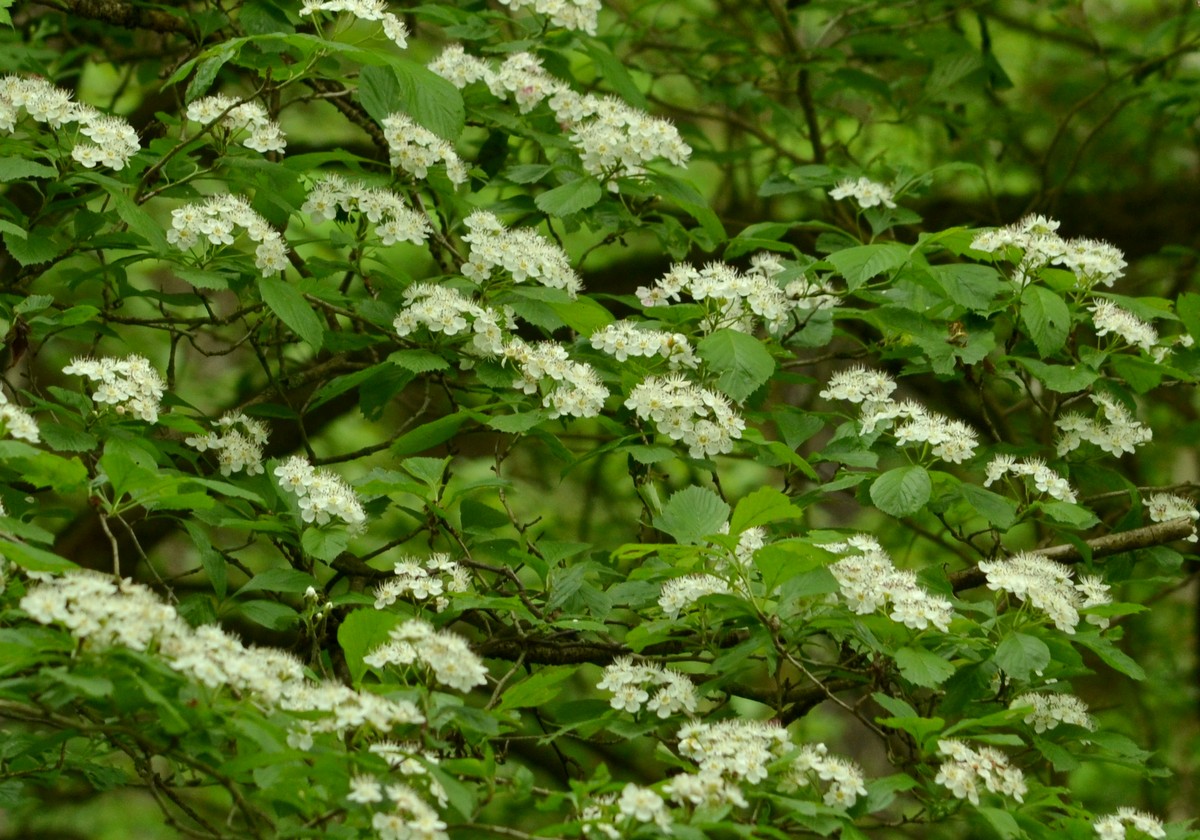
And on May 29, the many hawthorn trees in our woods were covered with blossoms (many more than I saw on these trees last year):


And finally, although it's not a native plant, I can't stop admiring the blossoms on Germander Speedwell (Veronica chamaedrys), which is common in all the spots in our yard where I haven't mowed:


And that's most of spring! There's still a lot of growing (for plants and animals) ahead in the upcoming months, but the wild rush is mainly over. I'm excited to see what happens next!

Saturday, May 20, 2017

Mid-May Birds, Bugs, and Flowers

Happy May! I've been doing a lot of wandering outside recently, and there's been so much to see. It certainly is a lively time of year! Here are some assorted sights from the past couple of weeks.

On May 10, during a visit to the Cornell Lab of Ornithology's Sapsucker Woods, I was happy to see a Brown Creeper alternately foraging along tree trunks and singing his sweet song:


And an Ovenbird was singing (loudly!) from his perch close to the path:


The following day (May 11), I spent some time exploring the paths along fields near our house. This is quickly becoming one of my favorite places to wander, because it's so close and it seems to always have interesting creatures around. (Bobolinks! Orioles! Warblers singing in the woods!) Plus, the scenery is amazing; I love all the spring colors on the surrounding hillsides:


This male Baltimore Oriole spent several minutes busily feeding among apple blossoms:


I'm still super impressed by the deep orange breast on this fellow:


And the view from underneath was brilliant indeed!


I also love the orange-glowing-through-black effect on the back of this guy's neck when he stretched:


Several Cabbage White butterflies were flying after each other in a nearby field, making a weird swirling swarm that looked more like the result of a computer algorithm than anything I'm used to seeing in nature:


A brilliant Six-spotted Tiger Beetle was hanging out on a bare patch in the path:


When I looked at this beetle from the front, I thought at first that it was munching on something; but no, the bulging white and brown things on the front if its face are just its huge mandibles. I definitely wouldn't want to be a smaller bug with this fast and powerful hunter around:


A few days later (May 14), I was in Maryland visiting my family for a few days, and the wonderfully colorful wildlife sightings continued with a male Scarlet Tanager (a female was nearby as well, but she was even less willing to pose for pictures than the male was):


Back home in Central New York, I went for a walk at the Roy H. Park Preserve late yesterday afternoon, where the fields are filling out with new-spring-green leaves:
 

And the dark coniferous woods are now speckled with pale green as well:


I wandered down into a small gorge to find the loveliest little stream:


All sorts of wildflowers were blooming in these woods, including dainty Starflower (Lysimachia borealis):
 

Tufts of floating Foamflower (Tiarella cordifolia):
 

And several Painted Trillium (Trillium undulatum), which I don't think I've ever seen in person before; this flower was such a wonderful surprise:
 

Lady slipper leaves were sprouting up nearby. I didn't see any flower buds, but I'll be sure to come back and visit these plants in a few weeks in case any blossoms do make an appearance:


It's been quite an eventful spring so far. And it's not over yet!