These past few weeks have been warm and (often) sunny, and definitely summer. July has been a time of incredible firefly shows (especially earlier in the month), lots of fledgling birds, and quickly-growing gardens. There's been a lot to see so far this summer!
On July 1, the baby Black-capped Chickadees in one of our nest boxes were starting to look a bit more like birds, but still quite alien-like with those huge pale beaks:
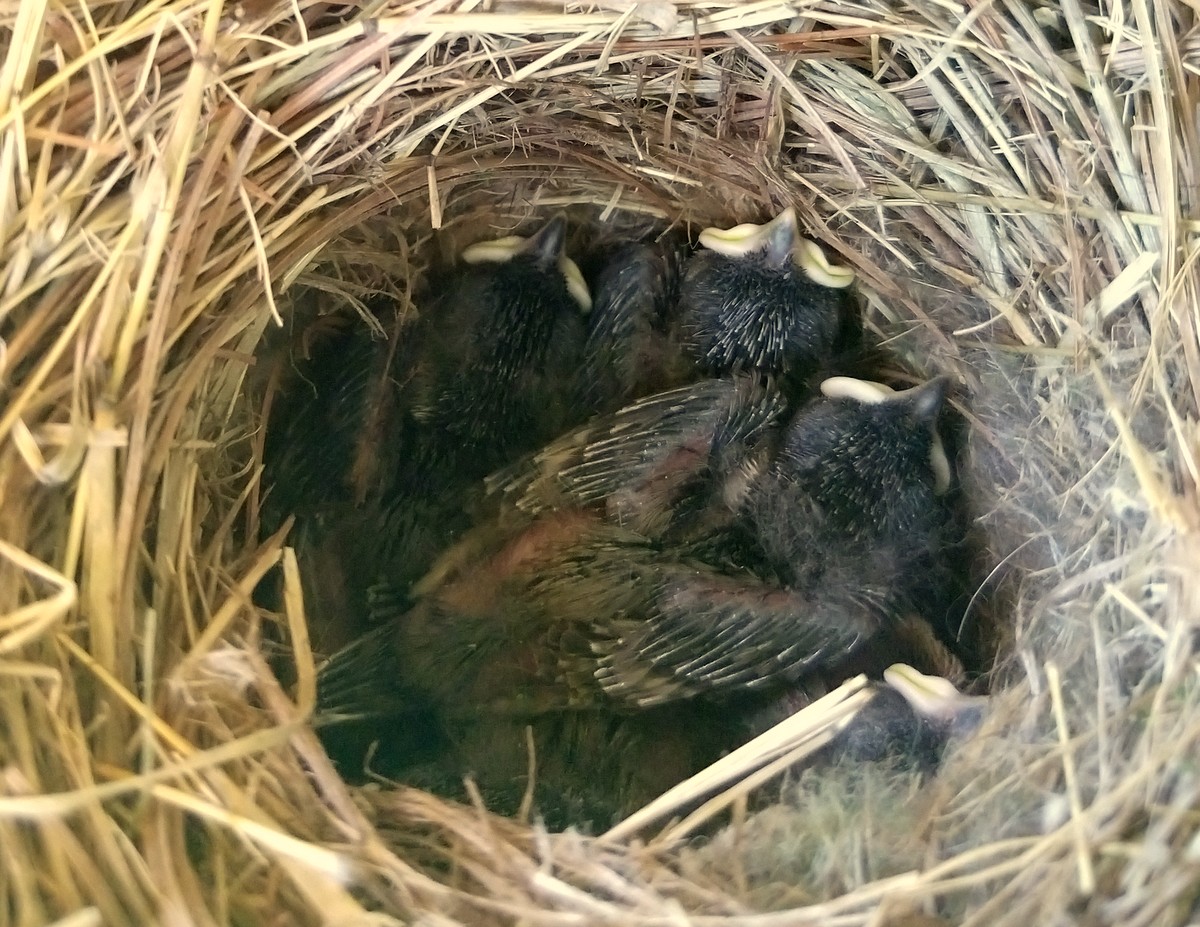
I didn't peek in on the chickadees after that, but they seem to have successfully fledged, and hopefully all is well! The Eastern Phoebe family has had great success with their second nest of the season, above our front door. The eggs started hatching on July 1, and by July 2 there were five larval phoebes in the nest:
On July 8, the babies were already looking pretty crowded:
Throughout all this, the adult phoebes continued to be just the best parents. The mother stood guard over the nest at night, even while we turned on the porch light and took the dog out for his nighttime business (I took this picture from a distance, doing my best not to disturb her any more than we already were):
By July 15, the phoebe babies were alert and moving around (and so very crowded), and we switched to using the back door so we wouldn't startle them out of their nest too early:
Here's another view of these frumpy babies trying very hard to look like just more moss and mud:
And when they were 18 days old, the babies left the nest. Wonderfully, they've stuck around, so we still get to see phoebes fairly frequently. A few days ago, I watched all five babies line up in a row on a branch, mouths open, while one of the parents came by with a tasty dragonfly. And earlier today I saw the family foraging in the yard -- some of the youngsters were even making a few hunting attempts themselves, although it still looked like the adults were doing most of the work.
Lots of other baby birds have been around, too. Here's a juvenile Chipping Sparrow on July 13, perched on a trellis we put in the vegetable garden this year and which has become a surprisingly popular spot for young birds to sit and preen and forage:
I saw this rather scruffy-looking baby Chestnut-sided Warbler on July 15:
I love these little birds, and I'm sure this young one will be very handsome one day:
The mother Chestnut-sided Warbler was also foraging nearby, her costume providing surprisingly good camouflage among the already-fading leaves of this apple tree:
A family of Indigo Buntings (with at least two youngsters) has been hanging around the meadow and yard, and while I haven't yet managed to get a picture of the babies or female, I did catch the male singing from a goldenrod perch in the meadow on July 18:
And a Common Yellowthroat family has been hanging around as well. I've almost gotten used to hearing these birds' chirps as they forage in the brushy areas of the yard while I work in the garden, which is amazing. Here's one of the juveniles on July 18:
And here's another angle on the same young bird, with its definitely yellow throat:
This year has also been especially good for our local Brown-headed Cowbirds, since it seems that these birds were able to successfully parasitize several nests on and around our property. In addition to our Eastern Phoebe's first nest of the season (which produced two phoebes and one cowbird), this summer I've also seen juvenile cowbirds being fed by a Chestnut-sided Warbler, a Veery, and a Red-eyed Vireo. These cowbirds sure seem to have their tricky child-rearing methods figured out!
July has brought many other interesting sights as well, besides baby birds. I was happy to see an American Goldfinch feeding on Lance-leaved Coreopsis seeds in the meadow on July 23:
Wild Bergamot (Monarda fistulosa) is blooming in the meadow for the first time this year (we scattered this plant's seeds in late fall of 2017), and these mounds of pale purple flowers are set off so nicely by the sea of Black-eyed Susans that are the most numerous flowers in this part of the meadow:
These blossoms are so fancy up close, with so many frills and fringes and curls:
And these flowers are definitely living up to their other common name, Bee Balm, since I almost always see bees on these plants; here's a fuzzy bumblebee visiting these equally fuzzy flowers:
At the edges of the meadow and yard, I've been happy to see lots of Fringed Loosestrife plants with their bright yellow flowers:
The small flower bed I planted with Purple Coneflower (and other things) in 2017 has become a hotspot for flying pollinators, as well as creatures who hunt those insects. A Goldenrod Crab Spider (Misumena vatia, I think) was staking out the coneflowers for a few days, and I like how well this spiky white-and pink creature fits in with the spiky pink-and-white flowers (seen here on July 26):
Here's another scene with this spider on July 24 -- sharp, secretive, and now that I'm looking at it again, almost dance-like:
Here's a new butterfly for me, a Milbert's Tortoiseshell, who visited the marigolds at this same flower bed on July 24 before flying away surprisingly well on its very damaged wings:
On July 23, I nearly dismissed what looked like a dried leaf on our deck -- all curled and discolored, with its stem sticking up into the air -- until I looked through binoculars and realized it was a Mourning Cloak butterfly:
I don't know that I've ever seen a more perfect Mourning Cloak before, and I was able to get a better (and more recognizably butterfly-ish) view of this beautiful creature from above:
I planted two Spicebush plants in our yard a couple of years ago, and on July 24 I was excited to find our first tiny Spicebush Swallowtail caterpillars! Many of the leaves had little folded-over leaf tents, and this caterpillar inhabitant had come out to browse on the leaf:
The caterpillar doesn't look like much here, but I'm already enjoying seeing these little creatures grow into their larger and more fantastical forms -- no more pictures yet, but I will share more at some point. This July has also been a great time for dragonflies. Since I learned to identify Blue Dasher dragonflies earlier this year, I've seen these handsome creatures all over. I know I already shared a picture of a female (or possibly young male) Blue Dasher, but I just love this dragonfly's stripes and its rainbow of muted colors, so here's another individual in the meadow on July 18:
Several male Common Whitetails were perching on rocks in the meadow on July 23, and this one let me come quite close for a picture:
And this Eastern Pondhawk (a female or young male) in the yard on July 24 impressed me with its bright green colors:
Yesterday afternoon, I wandered around the fields and ponds near our house to check in on our wildlife neighbors. And to admire the scenery, of course:
Yellow seems to be a very popular color around here. There are all those yellow hawkweed flowers that have just recently burst into bloom in the fields (I haven't looked closely enough to identify the species). An Eastern Meadowlark with his bright yellow breast was singing from the top of a tree near the field:
And a female Yellow Warbler was carrying soft nesting material to some secret location:
A couple of White-tailed Deer sauntered out of the woods at one point and took hardly any notice of me before continuing on their way:
I've guessed that Red-winged Blackbirds are nesting at the ponds in our neighborhood, because walks by these ponds in recent weeks have been accompanied by hovering/yelling blackbirds, often at close range. On this walk, I actually spotted one of the reasons why the adult blackbirds are so protective of this area: Look at the little fuzzy babies in their nest, hidden so well among the cattails!
I didn't stay long, especially since a male Red-winged Blackbird made it very clear that I wasn't welcome:
He did a lot of yelling:
But he also interspersed his yelling with grooming, stretching himself into all sorts of shapes:
Then a female showed up and added her voice, and OK, I'm going, I'm going:
When I got back to the house, another interesting creature was watching me from a daylily leaf near the front door:
A large jumping spider (probably the appropriately named Bold Jumper, Phidippus audax) had snagged an equally large fly from among the insects feeding on the chive blossoms nearby. Wow, what a catch:
Here's one more picture of this creature, so you can appreciate its fuzzy legs and beautiful iridescent mouthparts; I think jumping spiders are really cute and cool, and I'm happy to have this big creature for a neighbor:
Spring is starting to wind to a close, but much of the activity out there is just getting started!
On Thursday, I saw an ant walking around on a houseplant in our kitchen. Ants are not generally welcome in my house, so I carried the plant outside to deposit the ant there, and somewhere during the walk from the kitchen to the door I realized... that's not an ant:
The mimicry was really excellent, but it was definitely mimicry. Not an ant, a spider! This is an ant-mimic jumping spider, Myrmarachne formicaria:
This is actually a non-native species, first introduced and observed in Ohio a decade or so ago, and its range is gradually expanding (it's obviously made it as far as central New York by now). And I don't know for sure what benefits this spider gets from looking so much like an ant; perhaps this disguise helps protect it from predators, or perhaps it lets the spider get closer to the creatures it hunts. Either way, I'm super impressed. Only the large quasi-iridescent mouthparts gave it away as not-ant:
And oh yeah, spider eyes!
Here's a brief video of this spider, because it was so amazingly ant-like in its movements, even waving its front legs around like a pair of antennae, completing the illusion:
So that was a cool surprise! How many more mimics can I find around my house?
The area around Ithaca is so amazingly full of public green spaces -- between state parks and forests, Nature Conservancy land, Cornell land, and more -- it's hard to know where to even start! Yesterday morning, I decided to explore a small local nature preserve managed by the Finger Lakes Land Trust: the Roy H. Park Preserve. The preserve itself is only a couple hundred acres in size, but it borders much larger state forests and Cornell-protected land, so it's basically a slice in a rather huge expanse of natural area.
Before I even left for the preserve, I got to hang out with two Cedar Waxwings perched in a tree near my driveway; what a great start to the day!
When I arrived at the preserve, the parking area was serving as a concert hall for a Gray Catbird. I've missed these funny/loud birds!
The preserve itself turned out to be really wonderful. I saw no other people the whole time I was there, and there were so, so many animals around. The trail took me through fields and woods, including a lovely Quaking Aspen grove:
And a dark forest of conifers:
At one point, I stopped to watch an Indigo Bunting family -- I don't think I've ever seen baby buntings before! The female was dashing around feeding her rather large but still very demanding fledglings; the male kept flashing past, but I didn't see him contribute much to the proceedings. Here's one of the babies, posing for a quiet moment in between its cries for food:
And then while I was watching the buntings, warblers started showing up. I'd already heard Prairie Warblers calling somewhere out of sight, and Common Yellowthroats had been popping up at various points along the trail, but those are warblers I've met as summer breeders before, during my years exploring southern Connecticut, so they weren't totally unexpected. Now, though, warblers I think of as exclusively spring migrants came practically streaming in. A female Blackburnian Warbler! A female Chestnut-sided Warbler!
(Pardon the poor pictures, but I feel like I need something to prove that this weird summer warbler parade actually happened!)
A male Black-throated Green Warbler zoomed in out of nowhere (and I heard two males calling in the forest later on):
And then a male Magnolia Warbler!
So basically, this is a magical fairy-tale land where many of the beautiful little birds I think of as passing visitors (and therefore special/lucky encounters) actually come to live. And now I live here, too! Why yes, I'll take my May avian sights all summer long, thank you!
Later in the morning as I passed again through the same area, the bird activity had mostly calmed down, except that now the male Indigo Bunting was singing from the very highest perch possible. Tiny blue bird and big blue sky:
Butterflies and dragonflies were now flying all over the place, and I watched a bulky -- and very pink -- orb weaver spider manipulate a recent catch (I think this is a female Shamrock Orbweaver, Araneus trifolium):
Mmm, bugs:
Another spider (a male of the same species, if my ID is correct) crept around on a neighboring stem; I've never noticed spiders quite like this before, but they seem to have a thriving population in these fields:
What a wonderful morning walk. Have I mentioned that I really like it here? :D