Showing posts with label black-throated green warbler. Show all posts

Saturday, December 31, 2022

The Rest of 2022, Part III: More Birds

We're continuing an account of sightings on our property in 2022. In addition to the birds who took up residence and raised families here this year -- which I wrote about in a previous post -- we had several other birds visiting our property. Here's a sampling!

This bright male Yellow-rumped Warbler stopped by the small pond in our woods on April 30, presumably on his way to northern breeding areas:


I enjoyed watching these American Goldfinches munching on Daisy Fleabane flowers near the house on July 7:


On August 18, an especially unusual bird showed up in the yard. I'd never seen a Blue-winged Warbler x Golden-winged Warbler hybrid before, but this bird's combination of yellow cap, black eyeline, pale throat and breast, and yellow wingbars were all the right marks; this particular hybrid is apparently common enough to have its own name -- Brewster's Warbler -- although it's not a distinct species. Here are a couple of very poor (but identifiable) pictures of this fancy bird:


Also on August 18, some young Rose-breasted Grosbeaks perched on plant stakes on the deck:
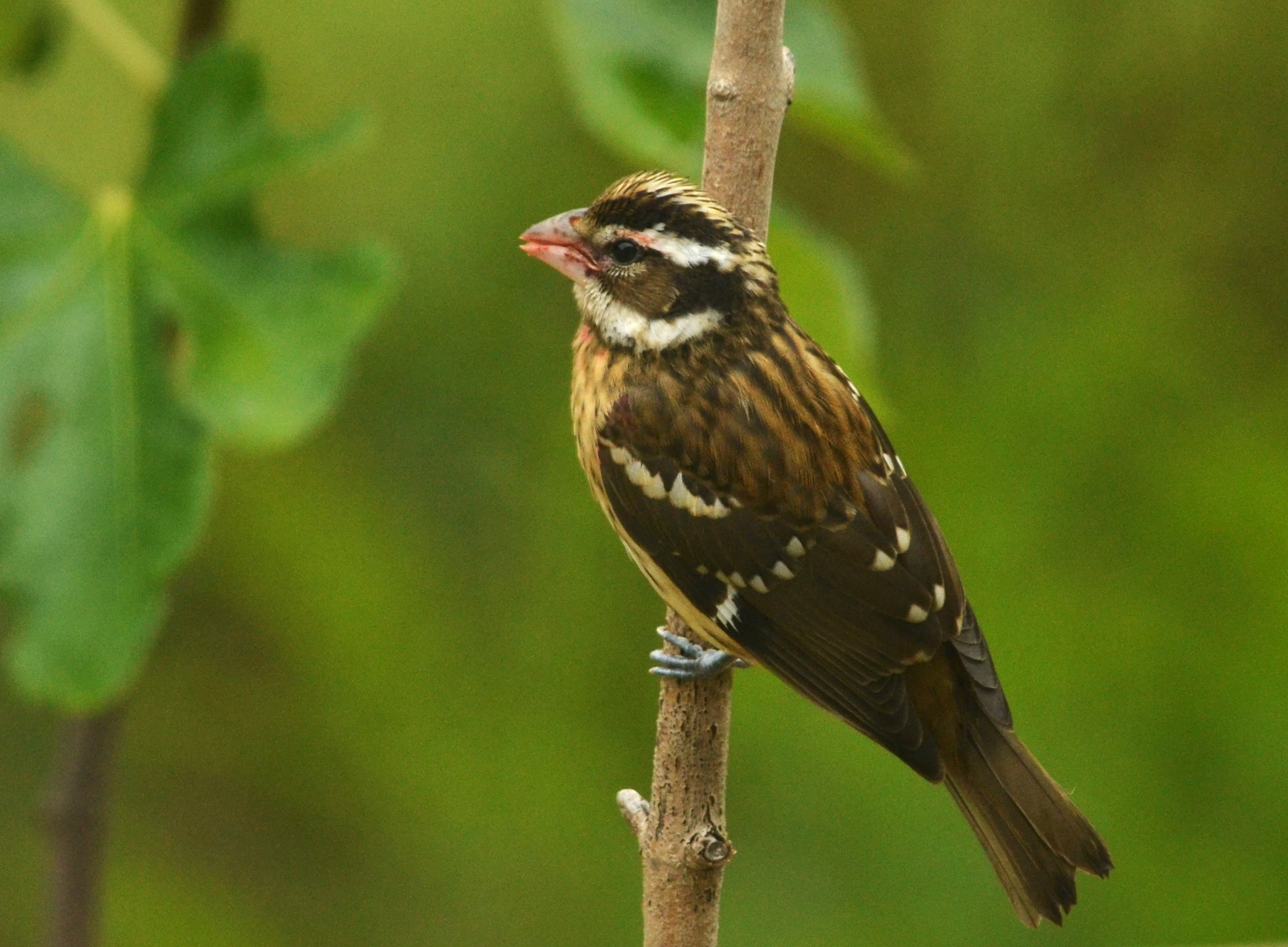

Although this next picture is very blurry, I'm sharing it because I love seeing the fancy marks on these birds' wings, including surprising rosy patches:


This Chestnut-sided Warbler looked adorable under a Purple-flowering Raspberry leaf on September 3:


A bunch of young and/or female Ruby-throated Hummingbirds visited the potted zinnias on our deck in late August and early September. Here's one of these handsome birds perching on a stake on September 4:


I love that these flowers are big enough for the hummingbirds to put a little of their weight on the petals:


Here's another hummingbird practically perching on the petals as it drank on September 7:


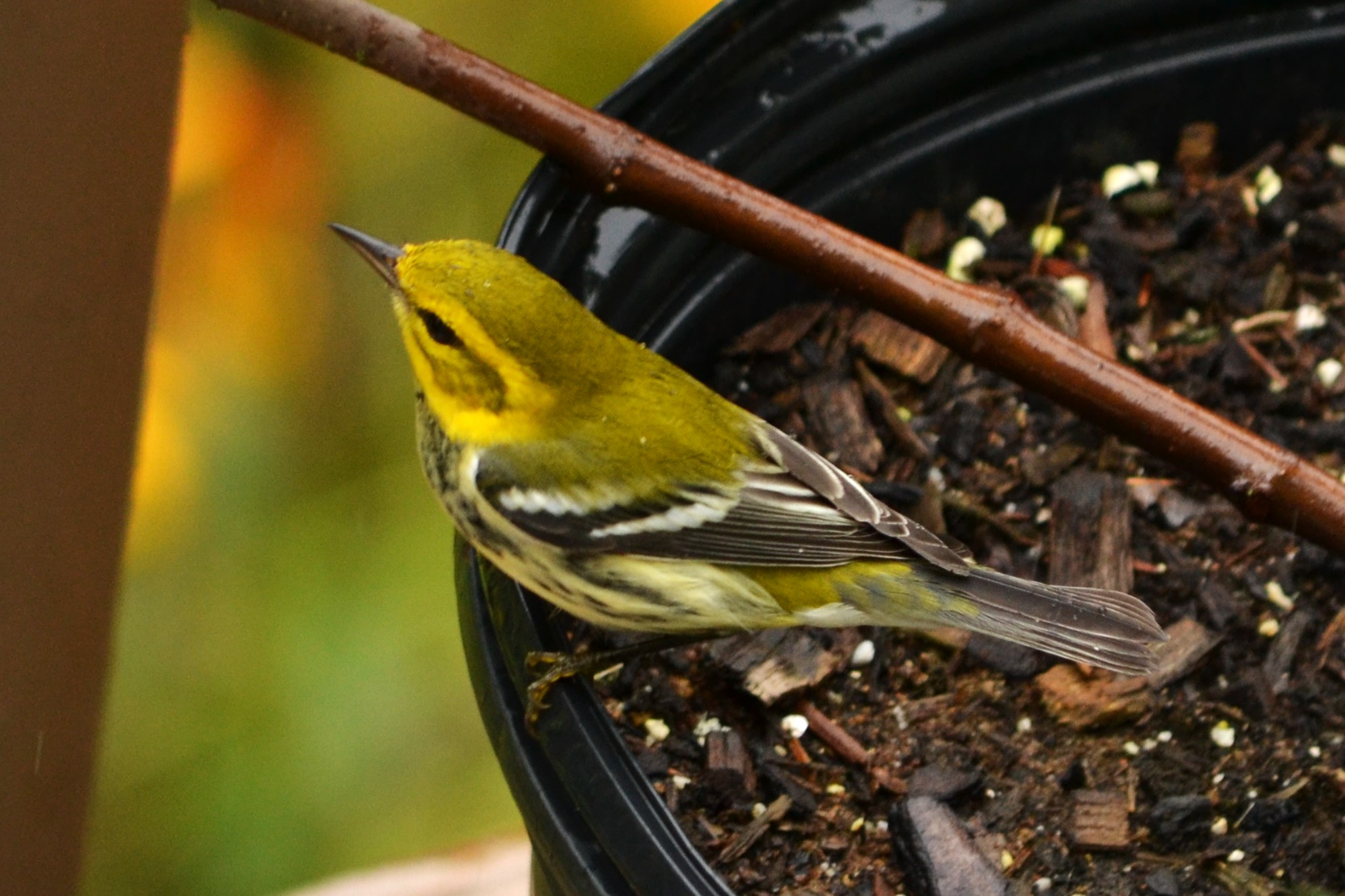
 This Black-throated Green Warbler stopped on our deck on September 11:

And I love seeing Gray Catbirds (perhaps one of our residents or else another bird passing through) with Pokeweed berries; this picture is also from September 11:


On September 18, I happened to be outside while a bunch of hawks were wheeling overhead, flying together in numbers and heading south. This one picture includes three Broad-winged Hawks and what I think is a Cooper's Hawk; there were at least a dozen more hawks in the air, and soon they all moved on:


Other bird highlights this year -- without pictures -- included two new bird species for the yard: #112 was a female Common Merganser who flew overhead on May 15; #113 was a Green Heron who perched in one of the trees next to the meadow on July 16. Also, thanks to help from the amazing Merlin app's Sound ID feature, I was able to learn that I frequently hear a Northern Waterthrush calling during the summer at the back edge of our woods, which means this species probably breeds somewhere near our property.

It's always exciting to see and learn new things! I have one more batch of sights to share from 2022 before this year is over. Up next: flowers and insects!

Friday, July 22, 2016

Summer Warblers and More at the Roy H. Park Preserve

The area around Ithaca is so amazingly full of public green spaces -- between state parks and forests, Nature Conservancy land, Cornell land, and more -- it's hard to know where to even start! Yesterday morning, I decided to explore a small local nature preserve managed by the Finger Lakes Land Trust: the Roy H. Park Preserve. The preserve itself is only a couple hundred acres in size, but it borders much larger state forests and Cornell-protected land, so it's basically a slice in a rather huge expanse of natural area.

Before I even left for the preserve, I got to hang out with two Cedar Waxwings perched in a tree near my driveway; what a great start to the day!
 

When I arrived at the preserve, the parking area was serving as a concert hall for a Gray Catbird. I've missed these funny/loud birds!
 

The preserve itself turned out to be really wonderful. I saw no other people the whole time I was there, and there were so, so many animals around. The trail took me through fields and woods, including a lovely Quaking Aspen grove:
 

And a dark forest of conifers:


At one point, I stopped to watch an Indigo Bunting family -- I don't think I've ever seen baby buntings before! The female was dashing around feeding her rather large but still very demanding fledglings; the male kept flashing past, but I didn't see him contribute much to the proceedings. Here's one of the babies, posing for a quiet moment in between its cries for food:
 

And then while I was watching the buntings, warblers started showing up. I'd already heard Prairie Warblers calling somewhere out of sight, and Common Yellowthroats had been popping up at various points along the trail, but those are warblers I've met as summer breeders before, during my years exploring southern Connecticut, so they weren't totally unexpected. Now, though, warblers I think of as exclusively spring migrants came practically streaming in. A female Blackburnian Warbler! A female Chestnut-sided Warbler!


(Pardon the poor pictures, but I feel like I need something to prove that this weird summer warbler parade actually happened!)

A male Black-throated Green Warbler zoomed in out of nowhere (and I heard two males calling in the forest later on):
 

And then a male Magnolia Warbler!


So basically, this is a magical fairy-tale land where many of the beautiful little birds I think of as passing visitors (and therefore special/lucky encounters) actually come to live. And now I live here, too! Why yes, I'll take my May avian sights all summer long, thank you!

Later in the morning as I passed again through the same area, the bird activity had mostly calmed down, except that now the male Indigo Bunting was singing from the very highest perch possible. Tiny blue bird and big blue sky:
 

Butterflies and dragonflies were now flying all over the place, and I watched a bulky -- and very pink -- orb weaver spider manipulate a recent catch (I think this is a female Shamrock Orbweaver, Araneus trifolium):
 

Mmm, bugs:
 

Another spider (a male of the same species, if my ID is correct) crept around on a neighboring stem; I've never noticed spiders quite like this before, but they seem to have a thriving population in these fields:
 

What a wonderful morning walk. Have I mentioned that I really like it here? :D

Sunday, September 15, 2013

A Week of Warblers

Fall migration brings an ever-changing cast of characters through the trees outside our apartment's windows, and I love it! In the past week, we've had several cool and unusual visitors stop by, many of them warblers that I only rarely get to see. Here are some highlights!

A few American Redstarts (a species of warbler) have appeared to flutter and forage in our trees, including one fancy black-and-orange male (who was too quick for a picture). Mostly, these birds have been females and young males in their more subdued (but still quite pretty) outfits:


A camera-shy Northern Parula (another warbler) has stopped by a couple of times, sporting patches of yellow/green both on its chest and on its back:


And a dainty Black-throated Green Warbler brought some bright color to one of our recent gray days:
 

(Male Black-throated Green Warblers have black throats in the spring, although I'm not sure where the "green" part of the name comes from.)

My favorite warbler so far, though, has been this lovely Cape May Warbler (a totally new bird for me):


How pretty is this bird? (So pretty.) The subtle brown/gray/yellow patterning on its face makes me think of fall (the leaves are starting to change now!), and its yellow-and-black chest is just too cool:


That's one bright yellow chin!


Along with the warblers, a Red-eyed Vireo has come through as well:


And even though they're not new or fancy, I still can't help admiring our local Black-capped Chickadees. This one had an intense grooming session near our window recently, cleaning its fluffy underarms:


And preening each of its long primary feathers, one at a time:
 

(You seem to be standing on your wing feathers there, bird. Does that help with the grooming process?)

There's been so much variety already, and there's still a lot of migration to come! I wonder what the next week will bring. :)