On Friday afternoon, I went to check out the O.D. von Engeln Preserve. This Nature Conservancy property has some interesting glacial formations and a variety of habitats, including a bog, which as I understand it is pretty unusual for this area. I don't get many chances to explore bogs, and I very much enjoyed the path through this part of the preserve:
The bog was filled with big and beautiful flowers from the Purple Pitcher Plant (Sarracenia purpurea). How does one plant get to eat bugs and have such amazing blooms?
These are some weird flower structures -- fitting, I suppose, for a plant as strange as a pitcher plant:
In another part of the preserve, this small Garter Snake was basking in a sunny patch on the forest floor:
I'm hoping to return to this place in the coming months to see what other interesting flowers might show up. Bogs are fun!
This morning, Paul and I went for a walk at the Roy H. Park Preserve, where we met this creature on the path:
A little Common Snapping Turtle! It's got the long tail and spiked shell of a snapper, but it's just a baby monster as yet:
Hello, little monster, you are very cute:
This morning's walk also featured a singing Blackburnian Warbler and Indigo Bunting (both too far away for my camera), and a small American Toad crossing the path:
I love that it's the time of year when reptiles and amphibians are common, and new wildflowers are appearing seemingly all the time. Summer is on its way!
Yesterday afternoon, I wandered around the fields and ponds near our house to check in on our wildlife neighbors. And to admire the scenery, of course:
Yellow seems to be a very popular color around here. There are all those yellow hawkweed flowers that have just recently burst into bloom in the fields (I haven't looked closely enough to identify the species). An Eastern Meadowlark with his bright yellow breast was singing from the top of a tree near the field:
And a female Yellow Warbler was carrying soft nesting material to some secret location:
A couple of White-tailed Deer sauntered out of the woods at one point and took hardly any notice of me before continuing on their way:
I've guessed that Red-winged Blackbirds are nesting at the ponds in our neighborhood, because walks by these ponds in recent weeks have been accompanied by hovering/yelling blackbirds, often at close range. On this walk, I actually spotted one of the reasons why the adult blackbirds are so protective of this area: Look at the little fuzzy babies in their nest, hidden so well among the cattails!
I didn't stay long, especially since a male Red-winged Blackbird made it very clear that I wasn't welcome:
He did a lot of yelling:
But he also interspersed his yelling with grooming, stretching himself into all sorts of shapes:
Then a female showed up and added her voice, and OK, I'm going, I'm going:
When I got back to the house, another interesting creature was watching me from a daylily leaf near the front door:
A large jumping spider (probably the appropriately named Bold Jumper, Phidippus audax) had snagged an equally large fly from among the insects feeding on the chive blossoms nearby. Wow, what a catch:
Here's one more picture of this creature, so you can appreciate its fuzzy legs and beautiful iridescent mouthparts; I think jumping spiders are really cute and cool, and I'm happy to have this big creature for a neighbor:
Spring is starting to wind to a close, but much of the activity out there is just getting started!
There's an arching, clematis-covered trellis near our house. Actually, this trellis is along a route with pretty regular foot-traffic, since the pathway between the parking area and our house (and some other peoples' houses, too) goes under this arch:
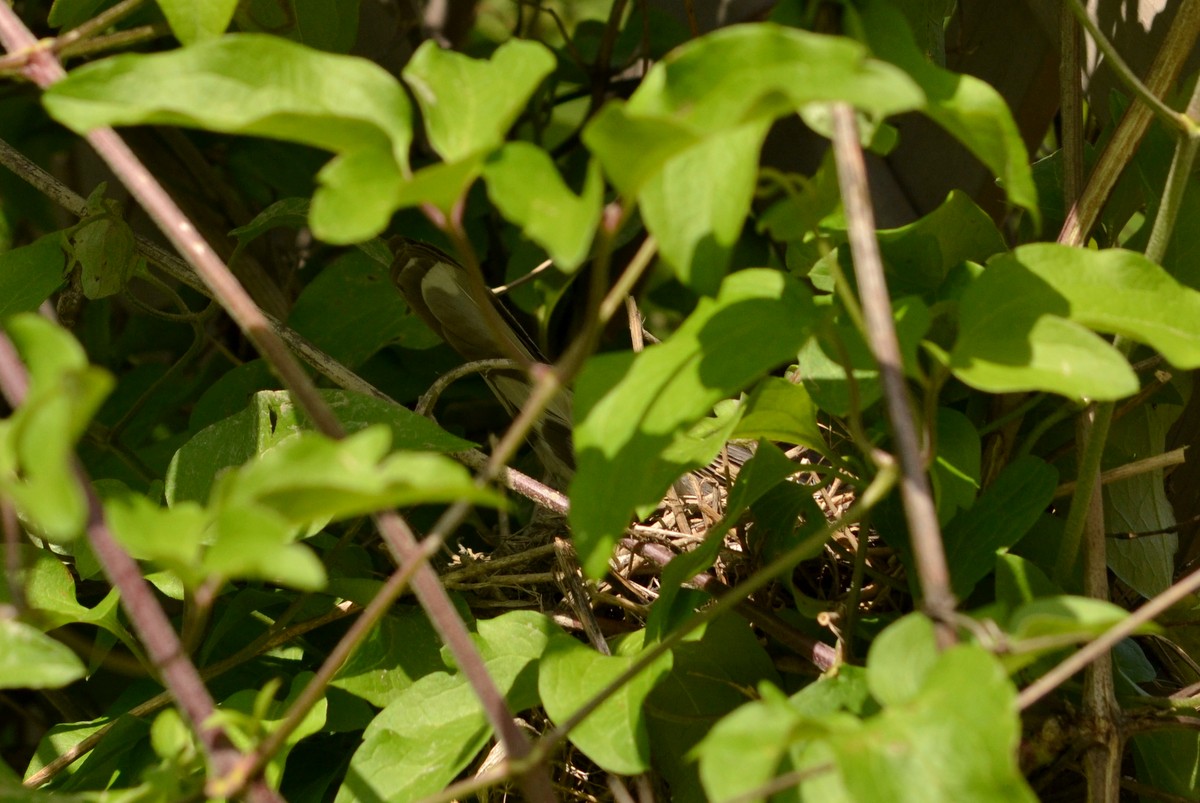
Well, this afternoon I watched an American Robin fly over to the trellis with a worm in its beak, and then fly away again without the worm. So I looked a little closer, and wouldn't you know it, the robins have a nest in the trellis, tucked behind clematis leaves and up against the wood, right at eye level. Do you see the female robin watching me through her wooden window?
And inside the archway, here's her tail sticking out from among the leaves:
I kept my distance so I wouldn't disturb Mother Robin on her nest. But a few hours later I saw that she was away, so I snuck over and peered inside the nest with my phone's camera to find one perfect egg:
What a place to put a nest. I wonder if this is the same pair of robins that a few weeks ago built and abandoned a nest in the branches of a nearby tree, and then later spent a few rainy and windy days testing out porch lights at our house and our neighbors' house as possible nest platforms. If so, these robins have been though quite a lot already this spring. I hope their hidden trellis nest will finally be a success!
Goodness, it's just Red Efts all over the place around here. And I'm not complaining! When I went for a walk at Hammond Hill State Forest yesterday, I crossed paths with six of these juvenile newts, and among them was the tiniest eft I've ever seen (pictured here with a dime for scale):
I didn't know they came so small! Look at this wonderful animal:
I moved the tiny eft off the path to make way for incoming mountain bikes, and the leaf I used as a mini-eft-elevator then made a great stage for one last adorable portrait:
Here's a bigger and bulkier eft I met during the same walk; all efts are beautiful, and it's so cool to get to compare individuals of such different sizes:
It was also great to see Red Columbine blooming next to the path (although I only found the one plant):
A small patch of Indian Cucumber Root (Medeola virginiana) made a cool sight with those tiers of whorled leaves:
The small flowers dangling from the top tiers of these plants are lovely, and quite strangely shaped:
I'm so happy to live in a place where Chestnut-sided Warblers are fairly common; they're my favorite warbler species, mostly because of the male's eccentric costume. This male Chestnut-sided Warbler gave me a nice view of his bright yellow cap (one of his best and strangest features):
I also got to admire this female Chestnut-sided Warbler's more muted yellow hat, along with her beautiful striped back:
We really do have lots of cool animals and plants around here!
This past Tuesday morning, I was back at the Roy H. Park Preserve to walk through dew-covered meadows and woods. It must have been a good day for a walk, because I crossed paths with three Red Efts who were also out and strolling across the damp ground. Efts are the land-walking juvenile phase of the Red-spotted Newt, and they're wonderful:
Hello darling eft, I love your newty face:
And your delicate feet:
This eft was framed by symmetrical cinquefoil leaves:
Happy wandering, little efts!
Some brightly colored creatures were moving around in the trees as well. A pair of Common Yellowthroats stuck close together as they foraged:
A male Chestnut-sided Warbler was singing near the entrance to the preserve when I arrived, and he was still singing when I left a couple of hours later:
It was a lovely damp-morning walk indeed. Yay spring!