Showing posts with label mammals. Show all posts

Thursday, December 31, 2020

Catching Up with 2020, Part I: Trail Camera Mammals and Birds

Wow, what a blur these last few months have been. I've had very little time for outdoor wanderings since September, let alone time to share sights here. Sigh. But I have indeed been watching out for nature around our house over the last few months as best as I could, and the holiday break means I can finally catch up with sharing 2020 wildlife happenings here. Hooray!

Our trusty trail camera captured plenty of interesting animal activity in our woods even while I was stuck inside (mostly tethered to my computer), so we'll start there! Throughout most of August, the trail camera was watching a tree trunk that had long ago fallen across our woods path, and this turned out to be an incredibly productive viewpoint. A large variety of birds and (mostly small) mammals made an appearance on these mossy logs during that time. Here's a compilation of some of the best videos from this spot, featuring:
  1. A Raccoon (one of several that wandered along this path in August, usually stopping to sniff the logs).
  2. An Eastern Chipmunk perching on the log for a thorough grooming session.
  3. The Ruffed Grouse family who showed up on the trail camera several times this summer. Here, the adult female keeps watch while the two now-nearly-grown chicks snatch up nearby seeds. I can't believe I get to see grouse foraging in our woods, and I love the soft sounds they make here!
  4. A Long-tailed Weasel -- the first one we've seen on our property! -- slithering along the log in what I feel certain must be scent-marking behavior. (Mmm, weasel-scented log!)
  5. A White-footed Mouse (or Deer Mouse) with its tail held high, possibly also scent-marking?
  6. A White-tailed Deer munching on nearby shrubs.
  7. A Virginia Opossum moving across the logs and stopping to scratch an itch.


At the end of August, I moved the trail camera among a few other locations in the woods, which resulted in some other interesting animal videos, including our first sightings of Flying Squirrels! (These could be Northern or Southern Flying Squirrels, but I'm not sure which.) I already knew we had Flying Squirrels on our property because I found the remains of someone's Flying-Squirrel meal in September of 2018... but this is the first time we've seen these fancy arboreal rodents whole and alive. :) White-tailed Deer were (as expected) the most frequent visitors on the trail camera during the last couple of months. This last compilation video shows a brief Flying Squirrel clip, and then three clips of deer -- a male with tiny antler spikes, a male with impressively big antlers, and some deer foraging in deep snow on Christmas Eve:


I have a bunch more sights to share over the past few months, beyond these trail camera videos -- Part II is up next!

Sunday, March 1, 2020

Trail Camera at the Frozen Woods Pool

For the past week, my trail camera has been watching a corner of the small pool in our woods. The water was frozen over, and I had noticed some tracks on the ice, so I set up the trail camera there, thinking it was possible that a creature could pass that way again. I didn't actually think the camera would see much of anything, but I figured it was worth a try at least. So I was pretty well surprised when I checked the camera today and found several videos of furry passersby, and quite close up, too. I had no idea the ice on this small pool would make for such a popular pathway!

The video compilation here shows: (1) a cautious Eastern Cottontail Rabbit; (2) a Raccoon reaching into the water -- and is it making sounds? (3) two Raccoons, one after the other; (4) a brief appearance by a sleek Red Fox; and (5) a Gray Fox. Judging from how many times they've shown up on the trail camera in these past couple of months, Gray Foxes seem to be especially frequent visitors in our woods. I'd never seen a Gray Fox at all before moving to this house, and I'm very happy to have these beautiful creatures around.


The ice on the pool is now melted, but I'll leave the camera at this spot for a little while longer to see whether any animals still pass this way. I'm very much enjoying these glimpses of the wildlife in our woods!

Monday, February 24, 2020

Deep Winter

January and February this year have brought a few new discoveries in our yard and woods, but mostly this has been a time of familiar sights amid snowy landscapes and gradually lengthening days. I love being in a place long enough to build a sense of the familiar, to be able to feel that, yes, this is what winter is like here. And then when new creatures show up, or when I see something familiar in a new way, there's a basis for comparison -- it's nice, and quite different from a couple of winters ago when everything in this place was brand new to me.

I finally set up the trail camera that I bought about a year ago, and I've been moving it among a few spots in our woods and at the edge of the meadow. Even in just the past two months, this trail camera has already given us a greatly expanded view of our wildlife neighbors, especially carnivores who I've only rarely glimpsed before now. Here's a collection of some of my favorite videos from the trail camera so far: a young male White-tailed Deer in the snowy woods, a Coyote loping along our woods trail, a Gray Fox moving more cautiously down the same trail, a Gray Fox in the meadow (this spot turned out to be part of a particularly frequent fox trail), and what I'm pretty sure is a Red Fox passing through the meadow carrying a captured meal.


On January 7, a group of Black-capped Chickadees let me stand close by while they foraged in a fallen sumac tree:


I will always take the opportunity to hang out with chickadees. This picture looks like it's sideways, but the chickadee was just working at an angle:


A storm on February 7 left a thick layer of ice on everything. The Silver Maple buds in our front yard turned into glass-like globes:


On February 9, the ice had only just started to melt, and shockingly bright sunlight made all the trees sparkle with multi-colored lights -- I couldn't quite get my camera to capture the effect, but this photo at least gives an idea:


On February 15, an American Goldfinch posed on snow-covered fir branches:


The edge of the meadow hosted an impressive network of rabbit tracks (this is the area where the trail camera saw so many foxes go by -- watch out, bunnies):


And I admired the now mostly ice-free Silver Maple buds against a blue sky:


Another perfectly blue sky on February 22 made a striking backdrop for the bare Virginia-Creeper-covered trees at the edge of the woods:


And the sunlight lit up a few remaining seeds dangling from a nearby Basswood tree:


The more I think about it, I think February may be one of my favorite months, for its combination of snow and lengthening days. I love sunny, crisp, blue-sky February days, with a good blanket of white snow on the ground.... And February holds the first, tiniest hints of spring. In the past few days, cardinals have started singing in our yard, and a pair of bluebirds have stopped by to check out our nest boxes. I'm clearly not the only one starting to think about spring. Winter is long, but spring will come. And in the meantime, there's still the rest of February to enjoy!


Monday, February 25, 2019

Assorted Winter Yard Sights

Winter is so quiet and static, compared to the riotous diversity and quick change of the other seasons. It's nice, really, to have a couple of months of white-brown-green landscapes, bare branches, and just the core wildlife regulars, so I can enjoy the silence and consistency, notice details in my environment that I've never noticed before, appreciate surprises when they show up, and celebrate even gradual change. My chart of eBird checklists on our property over the the past three months (December through February) shows only 23 species, which is fewer bird species than I might find during a single walk around our meadow and woods on any given day in May. And of those 23 species, only about 14 have appeared on our property with any regularity during that time. (If you're curious, here are the regulars: Mourning Dove, Red-bellied Woodpecker, Downy Woodpecker, Hairy Woodpecker, Blue Jay, American Crow, Black-capped Chickadee, Tufted Titmouse, White-breasted Nuthatch, Carolina Wren, House Finch, American Goldfinch, Dark-eyed Junco, Northern Cardinal.) Our regular winter non-bird creatures (the ones we've seen, anyway) are the White-tailed Deer, Eastern Cottontail rabbits, Red Squirrels, White-footed Mice (or possibly Deer Mice), and Meadow Voles. And that's it. Winter is comparatively simple, but even so, these past couple of months have brought plenty of interesting sights.

I've already posted about the flock of Evening Grosbeaks that visited our feeders in early December. Those fantastic birds stayed around for four days, and then they moved on for good. (I wonder how many years it will be before I see another Evening Grosbeak.) Just a week later, though, on December 13, we had another surprise at our feeders when a single Common Redpoll showed up:


I haven't seen a Common Redpoll since I came across a small flock of these little finches at the Connecticut shore in 2013. These birds certainly aren't common around here, and my understanding is that it's quite special to have one visit your feeder. Either way, I was delighted to meet this streaky brown-and-white creature, with its pointy yellow beak and perfect little red cap:


The redpoll seemed to thoroughly enjoy the nyjer seeds at our feeder:


While I watched the redpoll, I also had the opportunity to see one of the Meadow Voles that had taken to boldly foraging under the feeders around that time (I haven't seen these creatures outside of their burrows beneath the snow in a while, but there was a span of a couple of weeks when we saw them frequently in the open and munching on dropped seeds) -- look at this cute little rodent face:


The redpoll stayed around for a few hours and then moved on. I'm happy to host these rare northern visitors in our yard, even if only for a little while!

On the morning of January 14, a layer of ice on twigs and branches made for some amazing sights in our meadow:


By around 9:45 AM, clear sunlight (in January! amazing!) lit up the icy trees and created all sorts of interesting textures and patterns:


Perfectly ice-coated treetops made for quite a view through a telephoto lens:


Even an old spider web outside our kitchen window was beautifully highlighted by frost and sunlight:


By a couple of hours later, the sun had melted much of the ice, and this male Red-bellied Woodpecker looked very pretty in his sunlit apple tree:


The half-melted landscape was in some ways even more interesting than the fully iced version of two hours earlier:


I don't know how the sunlight melted the treetop ice on the hillside into these distinct lines, but I think the result is amazing, like wave-shaped sand on a beach:


On January 27, I wandered through our snow-covered meadow and admired the intricate patterns of dead flower stems -- many of them from seeds we planted -- against the pristine snow:


These Black-eyed Susan blooms were strangely pretty from above:


I love the graceful shape (and reddish color) of this Little Bluestem stalk:


And these Common Yarrow stalks made interesting shapes against the snow:


While walking in our woods on February 2, I came across the signs of what seemed to be a rabbit festival, with more rabbit droppings than I think I've ever seen in one area, as well as -- this is new to me -- spots of shockingly red pee:


The next day (February 3), a walk in the woods turned up a spider -- what a robust creature this must be, to be out and about in February, with snow still on the ground:


On February 17, I wandered outside under an amazingly blue sky; I love sunny February days:


This Blue Jay perfectly matched its gray-branch and blue-sky surroundings:


A Dark-eyed Junco sang quietly from within a sun-lit bush (practicing its song for breeding season?) and then emerged long enough to have its portrait taken:


An American Tree Sparrow also made an appearance:


This is such a handsome sparrow, especially against the clear blue sky:


I stopped to admire (as I do every time I pass by) the fuzz-tipped buds of this Allegheny Serviceberry tree I planted last year:


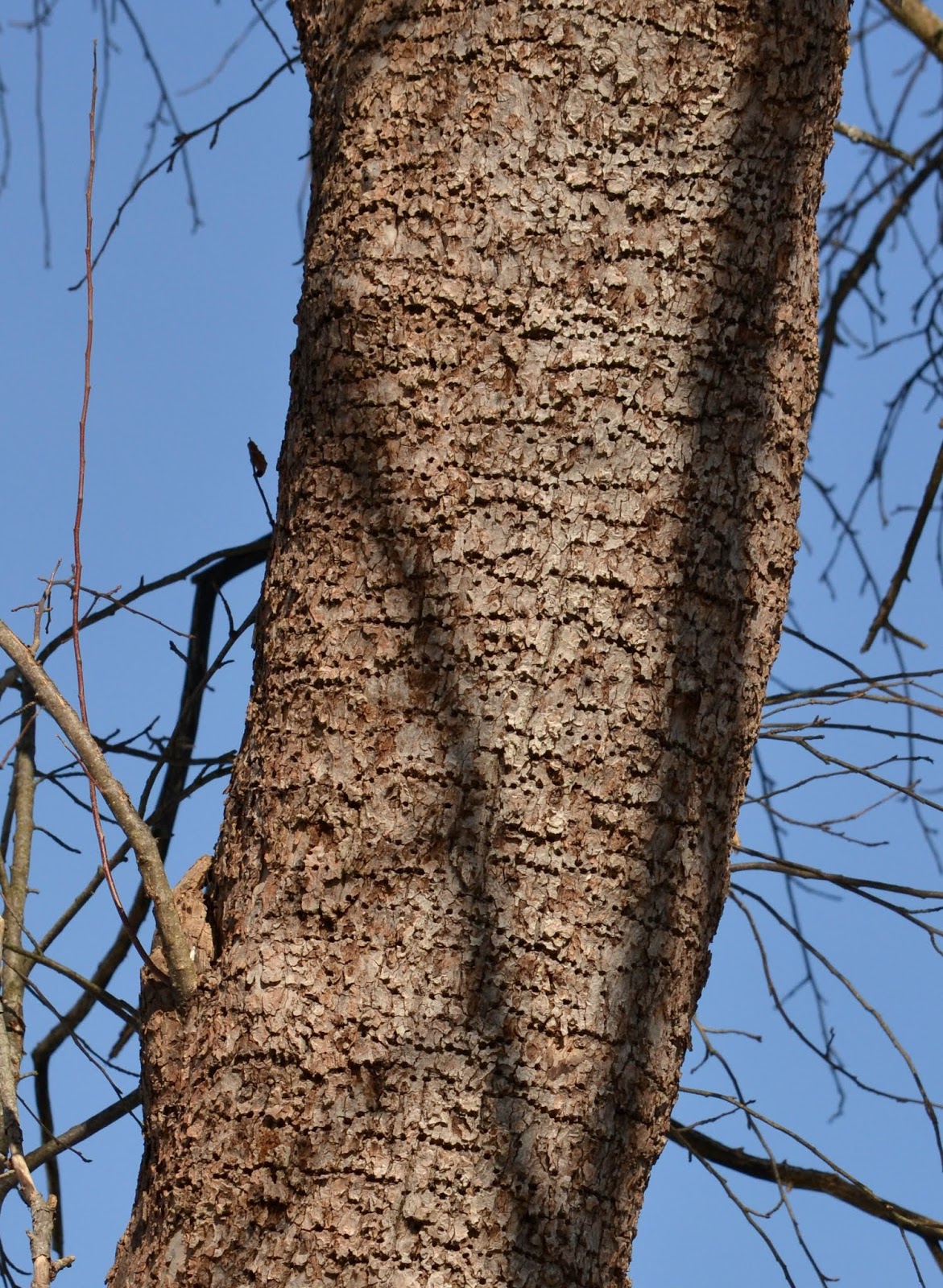
At another edge of the meadow, I was surprised to see the incredible amount of old Yellow-bellied Sapsucker holes on this very old apple tree, and just as surprised that I'd never noticed all these holes before now:


The afternoon light perfectly set off some big pine trees on the wooded ridge across the street from our house:


On February 21, a temporary thaw and bright sunlight brought out a cobweb-like tracing of snowy remnants on the hills across the valley:


As I write this on February 25, we're getting frigid winds and fresh snow, and it certainly still feels like winter. But changes are happening: the daylight is getting noticeably stronger and longer, the cardinals and chickadees have started singing in recent weeks, and I even spotted some crocus leaves emerging from the ground way back on February 10. I know that March will bring more tantalizing signs of the coming spring, and I'm excited to see what will happen during this year's more active seasons.

Wednesday, January 16, 2019

Trail Camera in 2018

Back in January of 2018, I set up our trail camera along the trail we made in our woods. The trail itself was an enlarged deer trail, and the many hoof-prints in the snow at the time suggested that the trail was still in heavy use, so I figured it would make for an interesting spot for a camera. And it definitely was! Over the past year, the camera has made many, many videos of creatures walking on and across our trail -- mostly lots and lots of deer, but some other creatures, too -- at both day and night (except for a couple of months at the end of the year when the batteries ran out sooner than I expected and I neglected to check it). 

So here are a bunch of video clips of animals in our woods from the past year!

The first few months of videos were all of deer. Even though deer are super common around here, and we see them frequently from a distance in our meadow and woods, it's still very cool to get to see these big animals up close. This first video compiles some of my favorite clips from the beginning of the year: a deer lying down on the path in the snow, a deer walking up the path during heavy snowfall, a daytime grooming session, a snowy portrait, a very fuzzy little deer (the previous year's fawn?) in very early spring, and a heavily molting deer up close in May.


Suddenly, in April and May, the camera started showing a whole slew of other creatures besides deer; I don't know what was going on here, but there was a greater variety of animals in these two months than we saw on the camera all year. The next video compiles clips of April and May's diversity, most of the clips at night: a rabbit taking a stroll in the woods, a raccoon searching for a meal among the leaves along the path, incredibly a Gray Fox (the first Gray Fox I've ever seen) with its bushy black tail and low/long body, a glimpse of a larger canid that surely must be a Coyote, and a flock of turkeys (I find that last turkey really funny).


During the rest of the year, the camera went back to mainly producing a ton of deer videos. Lots of interesting things happen with deer in the summer and fall, though, and some of these videos were especially amazing. Here's one last compilation of clips: a mother deer with the tiniest twin fawns I've ever seen, so tiny and unsteady that I think they must have been no more than a day old; another mother with her slightly older fawn, stopping in front of the camera for an extremely sweet grooming session; fawn zoomies!; at some point, the twins' mother got a very bad looking leg injury, but she and the twins continued to show up on the camera through the rest of the summer (the last time I saw her was in September, but the camera's battery also died soon after that); and the final clip shows a buck with an impressive set of antlers (I wonder if he made it through hunting season).


I'll be moving the trail camera to a new location this year, as soon as I figure out another likely place to try. The first year of trail camera footage was definitely a success, and I'm curious to see what creatures show up this year in other areas of our property!

Friday, June 29, 2018

Following Up With Families, and Other Assorted June Sights

Spring is such an amazing time of year, and this June has been full of interesting sights. The best part has been seeing so many nesting birds and growing baby animals in our yard! As far as I can tell, practically every corner of our property has had some sort of breeding activity so far this year.

Unfortunately, not all of the breeding attempts have been successful.... Of the five bird nests I've actually seen in our yard, three have failed: I mentioned the raided Dark-eyed Junco and American Robin nests in my last post, and unfortunately I have to add the Chipping Sparrow's nest to that list. So, sorry, I'll tell this sad story first. I never got a good look at the Chipping Sparrow babies (or possibly just one baby) in that little nest hidden in a small shrub right next to our house. But I got to watch the very bold mother bringing food to her nest. Here are some pictures of this lady on June 11 (I know she's a female because her mate is the male Chipping Sparrow with the distinctive white forehead):


She wasn't about to visit the nest while I was there, but she went as far as the garden hose next to the nest's shrub:


And then a few days after I took these pictures, I found the Chipping Sparrows' nest on the ground along with several pieces of some very adult-looking feathers and... a foot. I don't think the female sparrow survived, and I can't think of many things more horrifying than being on your nest while a giant monster (cat? racoon?) approaches, and staying there through the attack.... I also find this outcome particularly upsetting because this is the opposite of how breeding is supposed to work. Ideally, I imagine, you want to come out of the whole thing with more birds than when you started, and of course sometimes the nest is lost and you break even and have to start again, but losing an adult along with the nest is such a bad setback. Ugh, poor birds. I've seen the white-browed Chipping Sparrow since then (and other Chipping Sparrows, too), so all is not lost. But still.

OK, that's the only sad part of this post, I promise. There have been a lot of wonderful successes this month, too!

On June 6, the Eastern Phoebe babies were looking especially fluffy and cozy in their nest above our front door:
 

And on June 11, a pile of nearly-grown phoebes looked out at the world (I can't believe how quickly baby birds grow); I snuck a picture of the babies from a little ways away, because they were getting close to fledging age:
 

One of the adult phoebes (with a meal in its beak) kept a careful eye on me from a nearby tree:
 

And in the next day or so, the baby phoebes left their nest! (Last year, the phoebes in this spot fledged in early July; I wonder whether this year was an early schedule or last year was late.) And wonderfully, the babies have stuck around. I've seen the three awkward baby phoebes several times over the past few weeks, often calling plaintively while watching the adults hunt. Don't worry, babies, you'll get there. Here's one of the fledglings in the shade of our Tulip Tree on June 19:
 

The Tree Swallows also had great success (and hooray, the nest box we put up this spring seems to have worked really well)! On June 7, the baby Tree Swallows were still mostly naked, and so perfectly tucked into their feather-lined nest:


Just two days later, on June 9, they were looking much darker and prickly:


And on June 11, they were downright fuzzy (also, look at the mess they made on the walls of their nice new box, sigh):
 

Seeing the baby Tree Swallows up close and growing was wonderful, and I also loved getting to see the adult swallows tending to the nest. As it turned out, these birds were comfortable enough visiting the nest even when I was standing 10 feet or so away with my camera (they took a couple of cautious passes before landing, but still, they mostly went about their business as usual). On June 13, I watched the male Tree Swallow swoop up to the box entrance with a small meal in his beak (the babies always made lots of noise whenever a parent showed up):


Heading inside -- look at those wings!
 

And he was out again a few seconds later, carrying waste for disposal:
 

After just a couple of minutes, he was back with an impressive catch; I wonder how he managed to divide up this dragonfly among the hungry youngsters:


When he emerged from the box this time there wasn't any new waste to remove, and he paused long enough at the entrance for another portrait:
 

I kept away from the nest box in the following days, because the babies were getting old enough that they might fledge too early if I startled them. So I watched from a distance on June 20 as a young Tree Swallow peered out of the box:


And sometime in the few days after that, the swallows left the box, and that was that! They've been gone for a week or so now, with only fleeting appearances by a hunting adult or two in that time. I miss them very much. And now I just need to clean out the box and get it ready for any future potential tenants. :)

So, between the phoebes and swallows, only two out of five bird nests that I knew about were actually successful. That doesn't seem like a great ratio. But there must have been many more nests out there, hidden on and around our property, because I've seen a lot of baby birds in the last few weeks!

On June 7, a female Wild Turkey brought her group of chicks right through our back yard; these aren't the best pictures (I was aiming through deck railing and windows), but... baby turkeys!


I think I see at least five (six?) babies in this next picture:


On June 13, I saw an adult Black-and-White Warbler feeding a recently-fledged baby in the brush at the edge of our meadow. These warblers must have gotten started with nesting right away, as soon as they arrived here in May, to have a baby out of the nest so quickly. Also, I can't believe I live in a place with breeding Black-and-White Warblers!
 
Other sightings of babies have been more frequent and obvious: Some very whiny baby American Crows have been a big presence in the woods and meadow in recent weeks. Common Grackles and House Finches have brought their awkward and begging babies to our feeders. And still other birds have given me reason to think that they have nests hidden somewhere, even if I haven't seen the babies yet. I heard lots of cheeping and saw two very agitated adult Song Sparrows whenever I walked past a particular spot at the edge of the meadow for a span of time. At one especially brushy back corner of our meadow, I've encountered agitated pairs of both Indigo Buntings and Common Yellowthroats. A Blue-winged Warbler was foraging and acting pretty worked up around our driveway on June 22... but I haven't seen him or her around since then, so either this bird has gotten much more stealthy, or there isn't really a nest nearby.

So really, the amount of bird breeding that's been going on right here -- just in this relatively small patch of yard and meadow and woods -- is awesome. From everything I've listed here (including the failed nests but not including the questionable Blue-winged Warbler), that's 13 species of breeding birds that I've encountered so far this year. Hooray!

It's not just birds with families here, either. The mother Groundhog with a burrow in our raspberry patch did indeed have babies, and we started seeing the little ones above ground on June 11. Baby Groundhogs are abundantly entertaining, with a wonderful combination of adorableness and mischievousness. We've seen up to three babies at a time, but there's almost always been one or two foraging and/or playing around the yard since they first started showing up. Here's one of the babies trailing after mom on June 13:


A stump near the garden has become a popular lounging spot for baby Groundhogs, with those big pieces of bark on top sometimes acting as additional seats and sometimes serving as an interesting chewing surface:
 

The big rocks below our bird feeders are also popular as what I can only think of as a baby Groundhog playground:
 

This baby seemed quite curious about what could be up that pole:
 

Here's a video of the baby hanging out around the feeder rocks; these actions sure look like play to me:


I've really loved watching all the various animal families that have made their home on our property this spring! There have been so many babies... and there's still time for more babies yet, with the whole rest of the summer to go.

Not every sight in the past few weeks has been about babies, though, and I do have a few other assorted things to share. On June 25, I was in the woods pulling invasive Garlic Mustard (sigh, that's going to be a very long battle) when, incredibly, a Ruffed Grouse flew up and perched right above our trail. I think the grouse was as surprised to see me as I was to see it -- I'd had no hints before this that we had Ruffed Grouse in our woods -- and we had a good several seconds of staring at each other before it flew off again (loudly). Wow!

I was also pleased to discover a couple of Maple-leaved Viburnum plants in our woods; among the more common and invasive honeysuckles and multiflora roses (thankfully these plants haven't invaded our woods too badly, yet), it was nice to find this native shrub with its little white flowers:


On the night of June 4, a Polyphemus Moth -- the first giant silkworm moth I've seen on our property -- showed up at our lights. I love giant moths, and it was such a treat to meet this wonderful creature (pictured here with my hand for scale):
 

That night was chilly, and the moth spent the next drizzly day camped out under a ledge on our deck:
 

I was a bit worried about this fellow (with those huge feathery antennae I think this must be a male), but he flew off again that night; hopefully he was able to find a mate and make more awesome big moths.

A couple of cool moths made daytime appearances in recent weeks as well. Eight-spotted Foresters are particularly striking for a moth:
 

And this creature had me wondering why a wasp was hanging out on my pea flowers for so long, until I noticed the fuzzy antennae and realized that this is a moth doing an extremely convincing wasp impression (I haven't been able to identify the species yet):
 

I can't believe that spring has ended, June is coming to a close, and summer is already in full swing! We've also now officially passed the one-year anniversary of owning this property. This first year here has been so eventful, often tumultuous, and always interesting. I love this place, and I can't wait to see what Year Two has in store!