Friday, February 4, 2022

A Cold and Snowy January

It's winter, all right! This January has been a month of very cold temperatures, and all those signs of life in my previous post have been buried under a secure blanket of snow for weeks now. The landscape is all white and brown and gray, with some dark-green conifers for good measure. Here's our meadow on January 19, for example, but this picture could have just as easily been taken on most days this month:

There's still plenty of life and activity to see above the snow, though!

This flock of House Finches looked quite decorative, arranged as they were at the top of a fir tree in our yard on January 19 (waiting for me to leave so they could come down to the feeders, I think):


Purple Finches are much less common visitors to our yard at any time of the year, but especially in the winter, so I've been happy to see a few stop by this month. I love the colors on this rosy-all-over male who perched in the apple tree outside our windows on January 23:


I've been thrilled to see American Goldfinches making good use of the dried seed heads of the Purple Coneflowers that grow in a flower bed near the house. I snuck open a window on a sunny January 22 to get an unobstructed view of these little birds at work -- I especially like the spiky shadow one of the seed heads is casting on the bird in this picture:

Although the sun was shining, the air was bitterly cold, so I kept the window cracked open only long enough for a few quick pictures; here's one more:

Did I mention that this has been a cold month? When I woke up on January 22, the outside temperature was -13 degrees Fahrenheit (!), and a Blue Jay outside our windows had frost ringing its face -- it's kind of a glamorous look, but spending the night outside in those temperatures doesn't sound fun to me!


This bold American Tree Sparrow came to the feeders on January 19 while I was nearby, so I got to have an especially close look at one of these very handsome birds:


I'd never noticed before how dark this sparrow's feet are, like it's wearing black gloves. And that's a dashing little bow tie on its chest. Here's one more picture of this fancy bird, at an angle where the rusty line behind its eye reminds me of a lightning bolt (I feel like I've just described a superhero's costume):

This past summer, I first noticed what I'm pretty sure is a large Common Barberry (Berberis vulgaris) bush tucked back along an edge of our property; I suppose I'll need to keep an eye on this plant -- and watch out for others -- since it's non-native and can be invasive. In any case, I was surprised to see a Dark-eyed Junco munching on this plant's berries on January 19, since I'm much more used to seeing juncos eating seeds:

Among the flock of Dark-eyed Juncos that's been hanging around our yard this winter, we have one individual with a smattering of white feathers:

I've been thinking of this individual as a female, because her coloring overall is browner and lighter than the starker male juncos, but I don't know for sure. Either way, she's very distinctive, and it's fun to have an easily recognizable individual bird visiting our yard:

I assume she's partially leucistic, which has to do with some patchy absence of pigments. The white feathers on her face look a bit like she's simply dusted with snow:


She even has a little white-edged feather on her wing, and the mostly-white back of her head is especially striking:

Even from a distance, it's easy to recognize this bird:


I hope that bright white patch doesn't make her a target for predators! Good luck out there, little bird, and we'll keep the feeders well stocked.

I don't get to see all the winter activity in our yard myself, but the snow keeps a record of unseen activity (until the next snowfall at least). Here's a neat trail of White-footed Mouse tracks crossing our yard on January 19, for example:

Finally, in our woods on January 5, I noticed this White Ash tree that's missing a great deal of its bark:

After some searching online, my best guess is that this is a sign that Emerald Ash Borers are indeed on our property; apparently woodpeckers will do this type of work on a heavily infested tree to get at the beetle's larvae under the bark. I knew that Emerald Ash Borers have appeared in our county in recent years, and I figured our many ash trees would be victims sooner or later. I suppose we've reached that time. Here's a closer look at this extensive woodpecker work -- I hope the woodpeckers got a good meal at least, and maybe this tree will make a good home for other creatures after it dies:

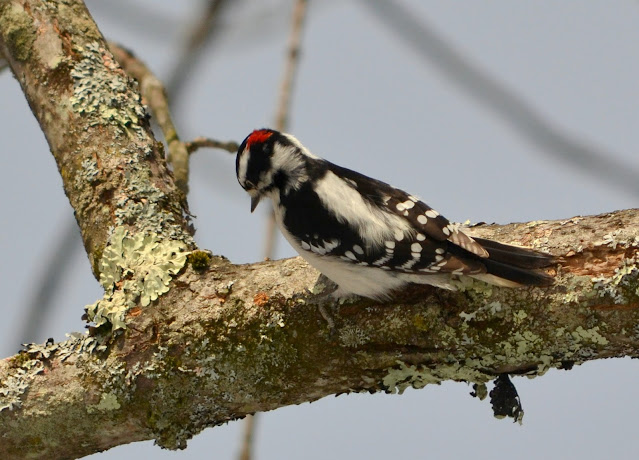
I wonder whether a particular one of our species of woodpeckers is mostly responsible for all that stripped bark, or whether all the woodpecker species contributed. It's hard to imagine our little Downy Woodpeckers (like the fellow below) chiseling away here, but who knows!

Male Downy Woodpecker working on a tree next to the meadow on January 19

The cold temperatures and snowy weather sure seem like they're here to stay for a while yet. Happy winter!
Friday, December 31, 2021

Some Signs of Life at the Beginning of Winter

We've already had a bit of snow and some very cold days this month, but the afternoon of December 16 was relatively warm and sunny, and I took the opportunity that day to wander around outside. With such short days and long nights, and with mainly cold and snowy months ahead, I was especially looking out for signs of life as winter started to settle in.

Plants may be dormant now, but it's really interesting to see how some of the plants around here have gotten ready for next year's growing season. I transplanted Allegheny Monkey Flower (Mimulus ringens) into our front yard this fall, and beneath the dried stems from this year's growth, spiky purple shoots have already appeared:

The neighboring Cardinal Flowers (Lobelia cardinalis) produced several tiny plantlets along their flower stalks this year, and I tucked those stalks into the dirt. Now rows of baby Cardinal Flowers are waiting through these cold and dark times -- with green leaves intact -- to start growing in the spring:


Foamflower (Tiarella cordifolia) also keeps its leaves through the winter, making a carpet with colors ranging from green to rusty orange:

The American Hazelnut shrubs have dangling catkins and little round buds that will grow and flower in the spring:


In the woods, this fern (I don't know the species yet) holds next year's fronds in coppery coverings at its center, looking like a small collection of coins:


These Common Milkweed seeds were ready to float off and start new plants, and after taking this picture I helped them along:

The Shagbark Hickory tree in our yard produced a large number of nuts this year (although strangely, most of the nuts I cracked open were empty) and a bird has stashed a hickory nut inside a crack in the neighboring Tulip Tree:

Because the weather was so warm on this day, I even saw a few insects out and about. This Honey Bee landed on some aster seedheads; I'm sorry, little bee, I don't think there are any flowers blooming around here right now:


A beetle (some sort of soldier beetle?) was climbing along Little Bluestem stalks:

The beetle even opened its wings a few times and flew a bit:


Finally, I watched a small caterpillar make its way up a Pawpaw stem and pause at a bud, where it seemed to nibble on the bud's outer layer:


It's nice to see signs of life in the middle of December, even as winter is settling in.

As I write this, 2021 is coming to a close, and 2022 is in sight. Here's to the new year! Who knows what 2022 will bring!

August-October, 2021

I'm still catching up with 2021! Here are some assorted sights from our yard, meadow, and woods in August through October of this year.

Young Rose-breasted Grosbeaks were a steady presence in our yard in August, and they seemed to especially enjoy tasting a variety of plants in my vegetable garden. I would've preferred it if they didn't munch on the tomato and pepper blossoms -- those plants had a hard enough time already during this very wet summer -- but there were plenty of peas to go around, and I enjoyed seeing these rowdy young birds snacking away at the top of the pea trellis on August 2:

I think this young Rose-breasted Grosbeak may have struck a window on August 6 (a rare occurrence at our house, fortunately), because it sat for a few minutes on our upstairs balcony, allowing for some unusually close views before it flew off:


For the second year in a row, American Robins nested on the front of our house, making close neighbors with the Eastern Phoebes above our front door. On August 3, the stripey robin babies were looking alert and nearly ready to leave the nest:

This is actually the first year I've seen American Robins successfully produce new birds on our property -- the nests I've seen in the previous three years have all failed. And even better, there were a total of three successful American Robin broods on our property this year. Hooray for a productive year for robins!


The House Wrens were also productive this year, with two broods in their chosen nest box. Here's one of those young House Wrens on August 6:


On the morning of August 8, I was shocked to see a really big bird walking around next to our house. What in the world is a Great Blue Heron doing in our yard??

There are ponds and streams a short flight away from here, but we have no aquatic environments in our yard at all.... As it turned out, though, this Great Blue Heron was hunting food of the small furry variety, and our yard has plenty of those. We watched through a window as the heron snatched up a Meadow Vole:

Here's a closer view of the vole's plight (as clear as I could get through the window):


Down it goes:


The heron hunted over quite a bit of the yard. Look, there's a huge bird walking behind the cars (!):

The heron grabbed one more wriggling vole from the bank between the road and the driveway:


And then a passing runner startled the heron and it flew away. What a cool and unexpected visitor! Now I can add Great Blue Heron to the list of predators who sometimes stop by to keep our vole population in check.

We had so much rain this summer that our little pond in the woods kept water in it all year, instead of turning into a big muddy patch as it has done in previous years. On August 6, I was happy to see some Green Frogs hanging out in the water:


On August 8, I saw the cutest little Gray Treefrog (a young individual) in a patch of Orange Jewelweed in our yard:

I hear Gray Treefrogs frequently enough around here that they must be fairly common, but I so rarely get to see them. And this little creature was so adorable! It was climbing among the jewelweed stems, hunting tiny flying insects, and pausing long enough for a picture now and then:


This lovely Black Swallowtail showed up at the zinnias on our back deck on August 28:


While gardening in the front yard on September 3, I came across a couple of fun little creatures (and had only my phone's poor-quality camera to document them). This small Spotted Salamander was burrowed below ground, before I accidentally unearthed it:


And I found a really bizarre larva on Black Walnut leaves -- at first, I assumed this was a caterpillar infected with some sort of fungus, but it turned out to be the normal larva (they're supposed to look like this!) of a species of sawfly, the Butternut Woollyworm (Eriocampa juglandis):


On September 11, I watched a flock of Cedar Waxwings feasting on Pokeweed berries:

These birds looked so fancy surrounded by Pokeweed and blooming goldenrod:


Nearby, an industrious Eastern Chipmunk watched me from one of the many holes in the old apple tree next to our driveway:


Look at those stuffed-full cheeks!


Also on September 11, this European Mantis (Mantis religiosa) was doing its best impression of a grass stem as it staked out a patch of Little Bluestem in the meadow:

This Giant Puffball made an impressive sight in our yard on September 18:


Here's a beautiful Monarch on New England Aster on September 25:


And reddening Virginia Creeper leaves glowing in the sunlit woods:


Furrow Orbweaver spiders (Larinioides cornutus or patagiatus) commonly build webs across the outside of our windows throughout the spring, summer, and fall. This little individual found shelter in a leaf caught against a window in October, and it seems to now be spending the winter curled up in its home; this picture is from October 10:


I didn't get outside much in October and November -- fall is always a busy time. I have a few more sights to share from December 2021, and that will be the next post.