Showing posts with label bees. Show all posts

Friday, December 31, 2021

Some Signs of Life at the Beginning of Winter

We've already had a bit of snow and some very cold days this month, but the afternoon of December 16 was relatively warm and sunny, and I took the opportunity that day to wander around outside. With such short days and long nights, and with mainly cold and snowy months ahead, I was especially looking out for signs of life as winter started to settle in.

Plants may be dormant now, but it's really interesting to see how some of the plants around here have gotten ready for next year's growing season. I transplanted Allegheny Monkey Flower (Mimulus ringens) into our front yard this fall, and beneath the dried stems from this year's growth, spiky purple shoots have already appeared:

The neighboring Cardinal Flowers (Lobelia cardinalis) produced several tiny plantlets along their flower stalks this year, and I tucked those stalks into the dirt. Now rows of baby Cardinal Flowers are waiting through these cold and dark times -- with green leaves intact -- to start growing in the spring:


Foamflower (Tiarella cordifolia) also keeps its leaves through the winter, making a carpet with colors ranging from green to rusty orange:

The American Hazelnut shrubs have dangling catkins and little round buds that will grow and flower in the spring:


In the woods, this fern (I don't know the species yet) holds next year's fronds in coppery coverings at its center, looking like a small collection of coins:


These Common Milkweed seeds were ready to float off and start new plants, and after taking this picture I helped them along:

The Shagbark Hickory tree in our yard produced a large number of nuts this year (although strangely, most of the nuts I cracked open were empty) and a bird has stashed a hickory nut inside a crack in the neighboring Tulip Tree:

Because the weather was so warm on this day, I even saw a few insects out and about. This Honey Bee landed on some aster seedheads; I'm sorry, little bee, I don't think there are any flowers blooming around here right now:


A beetle (some sort of soldier beetle?) was climbing along Little Bluestem stalks:
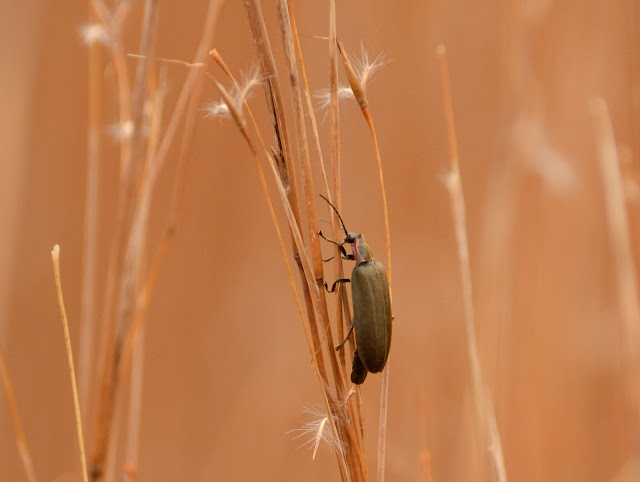
The beetle even opened its wings a few times and flew a bit:


Finally, I watched a small caterpillar make its way up a Pawpaw stem and pause at a bud, where it seemed to nibble on the bud's outer layer:


It's nice to see signs of life in the middle of December, even as winter is settling in.

As I write this, 2021 is coming to a close, and 2022 is in sight. Here's to the new year! Who knows what 2022 will bring!

Sunday, October 22, 2017

Late Summer and Early Fall at the House, Part 2: Amphibians and Insects

Continuing the previous post, here are some more nature sightings at our house from the past two and a half months (from August through mid-October)!

Reptiles and Amphibians

Reptile sightings have continued to be slim; it seems to be mostly Garter Snakes around here, and they haven't been especially common. In August, we had a fire in our yard's existing fire pit, and a young Garter Snake came out to warm itself on the cinder blocks, which was lovely. We also found a couple of baby snakes -- probably Garter Snakes -- in the compost pile in mid-September. Aside from that, and a handful of other sightings, it's been pretty quiet reptile-wise.

By contrast, it's been a really great couple of months for amphibians. Red Efts (juvenile Red-spotted Newts) started showing up more frequently in the yard in mid-August, and in September I was finding really little efts in the yard and woods. Here's a particularly tiny eft on the muddy part of our woods trail, navigating a boot print:
 

At the end of August, we found a small Spotted Salamander under the compost pile. And there appears to be a thriving population of Red-backed Salamanders in the woods; this past Thursday I found one or two of these sleek little salamanders under nearly every rock I checked.

Wood Frogs and especially Pickerel Frogs became more common in the yard in August and September. But Spring Peepers have remained by far the most numerous and easily seen amphibian in our yard, even up through October. I absolutely love that this place is such a haven for Spring Peepers, which I think of as reclusive and rarely-seen frogs. Not here! By August, I was getting used to seeing peepers perched on just about any wide, flat leaf in the yard:
 

There were little peepers like the one above, and there were older, tougher-looking individuals as well; this one was resting on a Common Milkweed leaf in the meadow one mid-August afternoon:
 

I don't think I could ever get tired of seeing these wonderful little frogs (this picture is from early September):
 

Who's that hanging out on a potted plant on the deck in early September? Oh yes, a peeper (with a beautiful pattern on its back):
 

And on the wall at night in early October? Peeper:
 

One night about a week ago, I opened the front door to toss a bug outside, and a peeper was sitting right on the doorstep, looking for all the world like it had been about to knock on the door and ask to come in. And individuals have continued to climb up on our windows on some nights, although not nearly as frequently (or in such numbers) as they did during the summer, when they were also much smaller:
 

I'm very much hoping that every year here will be similarly full of Spring Peepers. If not, though, at least I got to experience their abundance this summer and fall. :)

Insects and Others

These have been some amazing months for insect diversity, especially for butterflies and moths and their caterpillars. I didn't try at all to be comprehensive, but lots of beautiful and weird creatures caught my attention in the past couple of months.

In early and mid August, a big patch of (very fragrant) Garden Phlox flowers turned out to be a great place to see nectar feeders, like this big Spicebush Swallowtail:


A Hummingbird Clearwing Moth (Hemaris thysbe) also spent a great deal of time visiting these blooms. What an adorable creature!


I can't decide which part of this moth is the cutest: its pointy ear-like antennae or its fuzzy tail. It was really enjoying these flowers:
 

I've found a few Common Evening Primrose (Oenothera biennis) plants on the property, and one day in early August I noticed what looked like strangely pink petals mixed in with the yellow blooms. So I touched a petal, and it fluttered! There are three Primrose Moths (Schinia florida) on this one flower, and another on the back-right bloom:
 

This really pretty moth, a Large Tolype (Tolype velleda), showed up at our porch light in mid-September:
 

Also in mid-September, a fantastically bright Eastern Comma (Polygonia comma) hung around our driveway for a day or so:
 

Although not as brightly colored, the bark-patterned undersides of this butterfly's wings are also very pretty:
 

A little later in September, a bunch of Painted Ladies (Vanessa cardui) came through the yard, and they spent a lot of time on the New England Aster blossoms:
 

What a beautiful butterfly, on such beautiful flowers:
 

(This whole place, by the way, was practically carpeted with asters of various species throughout September, but I only ever found two small patches of New England Aster. I'll do my best to help spread this especially showy plant around the property, and in future years I'll be sure to learn what other aster species we have here.)

This sulfur butterfly also made a lovely sight on the small flowers of another aster (perhaps Calico Aster?):


Monarchs have made a surprisingly strong appearance here in the past couple of months. In August and September, a few caterpillars ate some Swamp Milkweed (Asclepias incarnata) I planted (I'm gradually adding to the property's native plant diversity):
 

Monarch caterpillars sure do have a lot of bold stripes:
 

Adult Monarch butterflies started passing through the yard more commonly in late September and early October. Here's one individual taking advantage of asters tucked among grass stems in the meadow:
 

These really are impressive insects:
 

And here's another Monarch filling up on one of the last goldenrod blooms in early October (along with several other insects):
 

Along with the Monarchs, several other interesting caterpillars appeared in the past couple of months. A Beautiful Wood-nymph (Eudryas grata) caterpillar -- so stripey and spotty -- was munching on grape leaves in late August:
 

A few large Hermit Sphinx (Sphinx eremitus) caterpillars made good use of an overgrown bed of mint in mid-September:
 

Wooly Bears (caterpillars of the Isabella Tiger Moth, Pyrrharctia isabella) have been common in the yard throughout late summer and early fall; here's one from this past Thursday, looking a bit lost in especially fall-like surroundings:
 

At the end of September, on a lilac bush, I found perhaps the strangest caterpillar I've ever seen, Harris' Three-spot (Harrisimemna trisignata):
 

In addition to the bird-dropping-like (but strangely hairy) outfit, and the bizarrely contorted posture, this caterpillar also has those weird black clumps dangling from its front end... which upon further reading turn out to be its own discarded head capsules from previous molts, still attached to its body by those white hairs. Ahhhh, what a weird creature!

Had enough strange crawling things yet? Here's another one -- an American Giant Millipede (Narceus americanus) that crossed our front walkway at the end of September:


And finally, as temperatures got colder in late September, I was charmed to find bumblebees sleeping in tiers below late goldenrod blossoms:
 

-------------

It's been quite a full two and a half months. And now I'm all caught up with sharing the goings-on here, and fall is in full swing. This morning was another hugely active and bird-filled morning. I'm so excited to see what will come next!

Wednesday, June 24, 2015

Orange and Blue on the Dunes

I saw lots of bright colors when I was out walking on the Manila dunes on Monday. Little Acmon Blue butterflies (Plebejus acmon) were flashing their blue and orange wings:


Goodness, but those orange bands are pretty:


This Acmon Blue was enjoying some Coast Buckwheat (Eriogonum latifolium) flowers:


Coast Buckwheat seems to be quite popular with the insects around here -- including this unidentified bee -- and the little flowers are really lovely up close:


Speaking of bright colors, I have to share the abundant and phenomenal California Poppy:


And it's hard to find a brighter blue than in this sunny ocean scene:


There are so many bright and beautiful things in the sand! I love discovering these little treats at our new home.

Monday, August 5, 2013

Garden Creatures: Predators, Pollination, and More

I think of my backyard garden as its own little ecosystem, and I'm constantly amazed at the diversity of creatures that choose to make their homes there (usually because they want to eat the flowers or leaves, or because they want to eat the things that eat the flowers or leaves). Here's a small sampling of the creatures (mostly insects) I've noticed in the garden over the past two weeks. It's a jungle out there!

Flowers are a big deal in the garden, and there are always plenty of bees around. This bumblebee has its head buried in a bean flower and the pollen baskets on its legs are brimming full of collected pollen (I just learned about this part of bee anatomy, and I think it's super cool):
 

In addition to the flowering plants I actually put in the garden on purpose, a huge Pokeweed plant has sprung up in one shady corner, and I let it grow because I think it's quite attractive. Lots of flying insects apparently like it, too. This very small wasp is enjoying the Pokeweed's little white blossoms:
 

And this much larger wasp (probably a Four-toothed Mason Wasp, Monobia quadridens) is browsing over the Pokeweed blooms as well:
 

In the leaf-eating camp, several leafhopper-type bugs make their homes here (in small numbers, so I'm not worried about them damaging the plants). This fancy leafhopper (Graphocephala versuta, I think) is very pretty in subtle green/blue/yellow stripes, and as I watched it, it seemed to be exuding some sort of liquid and collecting the droplets with its legs. Weird!
 

I see these Citrus Flatid Planthoppers (Metcalfa pruinosa) pretty frequently, and I quite like their powdery gray outfits:
 

Baby leafhoppers look super strange. This leafhopper nymph was showing off its weird semi-translucent body on a bean leaf:


This stocky planthopper nymph (possibly genus Acanalonia) was eying me warily:
 

This next leaf-eater I am definitely not happy to see, as it takes huge chunks out of my bean leaves. Go away, Japanese Beetle, I don't want you here:
 

A few times now, I've noticed a strangely symmetrical bit of dried leaf, and then realize... oh, it's a moth! This is an Omnivorous Leafroller (Archips purpurana), I believe:
 

And speaking of leaf-like creatures, this Greater Angle-wing Katydid nymph (Microcentrum rhombifolium) does a fantastic job of blending in with these soybean leaves:
 

This creature isn't quite full-grown yet, but it's still pretty big -- about the size of my thumb. I've seen it several days in a row in the same spot, and I have to admire it every time. I love its mottled green skin, and those tiny baby wings are sooo cute:
 

When I saw this katydid most recently (I'm 99% sure it was the same individual, with that same missing leg and the same pattern of dots on its back), its little wings were bigger! Grow, baby katydid, grow:
 

Other cool creatures include this little cricket with antennae so big I couldn't fit them in the frame (they're about two or three times longer than this picture shows):
 

And this tiny adorable jumping spider who couldn't decide whether to focus more on the giant camera lens looming over its head...
 

Or the huge pink blob (i.e., my finger) that had invaded its home leaf:
 

The little spider was probably keeping an eye out for a meal, and there are tons of other predators all over the garden. Long-legged flies are particularly prevalent, little sparkling jewels in green, blue, and orange that cruise around looking for even tinier bugs to eat:
 

Mmm, this one got something!
 

But the long-legged flies can become meals, too.... This one wasn't very lucky, but I bet the spider's happy with its catch!
 

Robber flies are common predators around here, too. This one was hanging from the Pokeweed stem and munching on a nice fat beetle:
 

Finally, speaking of predators, I was very happy to find an American Toad living in the garden. I took this picture with my phone (I clearly need to always have my camera with me) in early July, but I saw the toad again last week, so I'm hoping it's sticking around:
 

This individual has just the most wonderful deep brown/maroon color, the likes of which I don't remember ever seeing on a toad before. I think it's a gorgeous creature, and I love that it's been out there on bug/slug patrol. Eat away, lovely toad!
 

Whew, so many things to see, and I don't even have to leave my yard! Summer is such a lively time, and I'm looking forward to meeting more cool creatures in my garden as the season continues.