Continuing the previous post, here are some more nature sightings at our house from the past two and a half months (from August through mid-October)!
Reptiles and Amphibians
Reptile sightings have continued to be slim; it seems to be mostly Garter Snakes around here, and they haven't been especially common. In August, we had a fire in our yard's existing fire pit, and a young Garter Snake came out to warm itself on the cinder blocks, which was lovely. We also found a couple of baby snakes -- probably Garter Snakes -- in the compost pile in mid-September. Aside from that, and a handful of other sightings, it's been pretty quiet reptile-wise.
By contrast, it's been a really great couple of months for amphibians. Red Efts (juvenile Red-spotted Newts) started showing up more frequently in the yard in mid-August, and in September I was finding really little efts in the yard and woods. Here's a particularly tiny eft on the muddy part of our woods trail, navigating a boot print:
At the end of August, we found a small Spotted Salamander under the compost pile. And there appears to be a thriving population of Red-backed Salamanders in the woods; this past Thursday I found one or two of these sleek little salamanders under nearly every rock I checked.
Wood Frogs and especially Pickerel Frogs became more common in the yard in August and September. But Spring Peepers have remained by far the most numerous and easily seen amphibian in our yard, even up through October. I absolutely love that this place is such a haven for Spring Peepers, which I think of as reclusive and rarely-seen frogs. Not here! By August, I was getting used to seeing peepers perched on just about any wide, flat leaf in the yard:
There were little peepers like the one above, and there were older, tougher-looking individuals as well; this one was resting on a Common Milkweed leaf in the meadow one mid-August afternoon:
I don't think I could ever get tired of seeing these wonderful little frogs (this picture is from early September):
Who's that hanging out on a potted plant on the deck in early September? Oh yes, a peeper (with a beautiful pattern on its back):
And on the wall at night in early October? Peeper:
One night about a week ago, I opened the front door to toss a bug outside, and a peeper was sitting right on the doorstep, looking for all the world like it had been about to knock on the door and ask to come in. And individuals have continued to climb up on our windows on some nights, although not nearly as frequently (or in such numbers) as they did during the summer, when they were also much smaller:
I'm very much hoping that every year here will be similarly full of Spring Peepers. If not, though, at least I got to experience their abundance this summer and fall. :)
Insects and Others
These have been some amazing months for insect diversity, especially for butterflies and moths and their caterpillars. I didn't try at all to be comprehensive, but lots of beautiful and weird creatures caught my attention in the past couple of months. In early and mid August, a big patch of (very fragrant) Garden Phlox flowers turned out to be a great place to see nectar feeders, like this big Spicebush Swallowtail:
A Hummingbird Clearwing Moth (Hemaris thysbe) also spent a great deal of time visiting these blooms. What an adorable creature!
I can't decide which part of this moth is the cutest: its pointy ear-like antennae or its fuzzy tail. It was really enjoying these flowers:
I've found a few Common Evening Primrose (Oenothera biennis) plants on the property, and one day in early August I noticed what looked like strangely pink petals mixed in with the yellow blooms. So I touched a petal, and it fluttered! There are three Primrose Moths (Schinia florida) on this one flower, and another on the back-right bloom:
This really pretty moth, a Large Tolype (Tolype velleda), showed up at our porch light in mid-September:
Also in mid-September, a fantastically bright Eastern Comma (Polygonia comma) hung around our driveway for a day or so:
Although not as brightly colored, the bark-patterned undersides of this butterfly's wings are also very pretty:
A little later in September, a bunch of Painted Ladies (Vanessa cardui) came through the yard, and they spent a lot of time on the New England Aster blossoms:
What a beautiful butterfly, on such beautiful flowers:
(This whole place, by the way, was practically carpeted with asters of various species throughout September, but I only ever found two small patches of New England Aster. I'll do my best to help spread this especially showy plant around the property, and in future years I'll be sure to learn what other aster species we have here.)
This sulfur butterfly also made a lovely sight on the small flowers of another aster (perhaps Calico Aster?):
Monarchs have made a surprisingly strong appearance here in the past couple of months. In August and September, a few caterpillars ate some Swamp Milkweed (Asclepias incarnata) I planted (I'm gradually adding to the property's native plant diversity):
Monarch caterpillars sure do have a lot of bold stripes:
Adult Monarch butterflies started passing through the yard more commonly in late September and early October. Here's one individual taking advantage of asters tucked among grass stems in the meadow:
These really are impressive insects:
And here's another Monarch filling up on one of the last goldenrod blooms in early October (along with several other insects):
Along with the Monarchs, several other interesting caterpillars appeared in the past couple of months. A Beautiful Wood-nymph (Eudryas grata) caterpillar -- so stripey and spotty -- was munching on grape leaves in late August:
A few large Hermit Sphinx (Sphinx eremitus) caterpillars made good use of an overgrown bed of mint in mid-September:
Wooly Bears (caterpillars of the Isabella Tiger Moth, Pyrrharctia isabella) have been common in the yard throughout late summer and early fall; here's one from this past Thursday, looking a bit lost in especially fall-like surroundings:
At the end of September, on a lilac bush, I found perhaps the strangest caterpillar I've ever seen, Harris' Three-spot (Harrisimemna trisignata):
In addition to the bird-dropping-like (but strangely hairy) outfit, and the bizarrely contorted posture, this caterpillar also has those weird black clumps dangling from its front end... which upon further reading turn out to be its own discarded head capsules from previous molts, still attached to its body by those white hairs. Ahhhh, what a weird creature!
Had enough strange crawling things yet? Here's another one -- an American Giant Millipede (Narceus americanus) that crossed our front walkway at the end of September:
And finally, as temperatures got colder in late September, I was charmed to find bumblebees sleeping in tiers below late goldenrod blossoms:
------------- It's been quite a full two and a half months. And now I'm all caught up with sharing the goings-on here, and fall is in full swing. This morning was another hugely active and bird-filled morning. I'm so excited to see what will come next!
Yesterday, Paul and I explored further into the Redwood National and State Parks than we'd yet been. We drove several miles down a winding gravel road, through a locked gate (we had to get the passcode from the visitor's center first), and then hiked to the Tall Trees Grove, where exist -- literally -- the tallest trees in the world. The redwood tree that held the wold record for tallest tree until 1994 is in this grove, and the current world record holder is somewhere in the area, although it's not marked and there's no trail to it. We've seen lots of big trees already, but we figured we had to take a trip to this place while we still live in the area, if only to be able to say we'd done it. Besides, redwoods are awesome, and I'll take any chance I can get to explore these woods.
Here's the area from a nearby overlook:
More tall trees, plus mist (it was an overcast, sometimes-rainy kind of day):
And here's the grove from ground level:
Of course, the trees were huge and impressive -- as redwoods are -- although we couldn't get an especially accurate sense of their height from our lowly position on the ground. We couldn't even see the tops of most of these trees! (I guess that says something in itself.)
So we wandered around these giant trees, just generally being impressed. And in the process, we found lots of interesting things to look at on the forest floor.
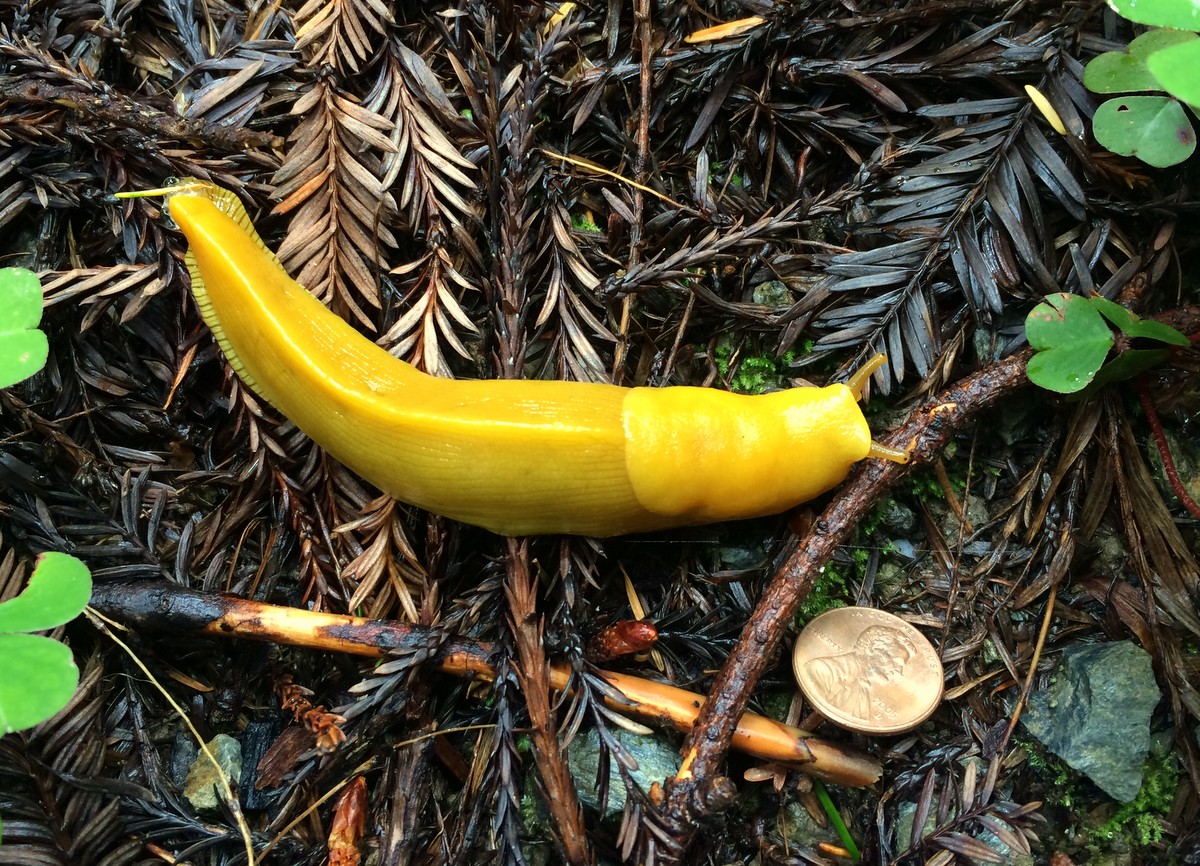
The molluscs were out in force, chief among them that famous denizen of the pacific coastal forest, the Banana Slug. :)
This individual wasn't huge by Banana Slug standards, but it was still pretty darn big; here's a penny for comparison:
We found another Banana Slug in the process of consuming a leaf:
I've never actually thought about how slugs eat before, and this creature's very normal biting action really surprised me! I made this rather shaky video with my iPhone -- it's still weirdly shaky even after YouTube's stabilization process, probably because I was filming the slug so close up -- so watch if you're up for it. You can hear the crunch of each bite; mmm, what a crispy leaf: We kept finding snails all over the place as well, including a bunch of these large and beautiful Pacific Sideband Snails:
And I'm not sure of the exact species of these smaller, ghostly pale snails that kept showing up, but they were also quite cool:
Lots of Yellow-spotted Millipedes were sharing the forest floor with the molluscs, including this pair of millipedes who were on the move despite being otherwise engaged:
A chipmunk (one of a couple of species in this area, but I'm not sure which one) watched us carefully while it worked over an acorn from atop a moss-covered trunk near the path:
And as if these woods weren't already fantastical enough, we found several blooming coralroot orchids sprouting up like little intricate flags next to the path. I'd never seen coralroot blossoms in person before, even though various species of coralroot also exist in the woods in the eastern U.S. These are strange, leafless, parasitic plants that get their nutrients from their host fungi underground. And then they send up these beautiful little flowers; some of the flower spikes we saw were more than a foot (maybe two feet) tall:
Here's a closer view of this Summer Coralroot (Corallorhiza maculata; perhaps this is some particular variety that lacks the usual spots on this flower's lower lip):
We also found Pacific Coralroot (Corallorhiza mertensiana), with its narrower purple-and-yellow flowers:
I love orchids, and finding new members of this diverse and fascinating family in the wild is always extra exciting for me. Yay, orchids!
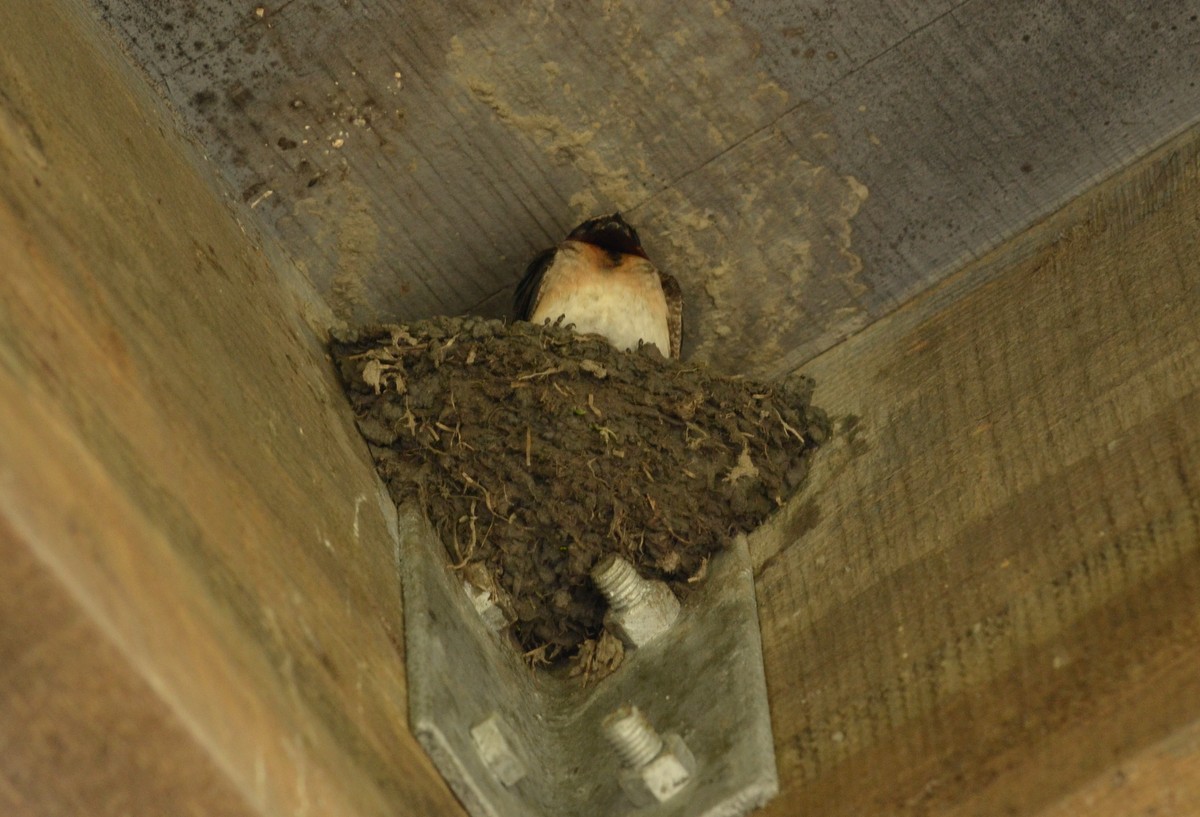
And that about sums up our tall trees adventure: redwoods, molluscs and other crawling critters, and orchids. I'll add that before we even got to the woods, we had a treat in the form of Cliff Swallows nesting under the canopy outside the visitor's center:
It was so cool to see these little birds swooping around and guarding nests-in-progress that ranged from barely a ledge (like in the picture above) to fully enclosed bowls:
There are so many interesting things to see out there!
On Saturday, Paul and I were driving through Pennsylvania on our way back from visiting the place we'll be moving to in August (hint: it's on the other side of Pennsylvania) and we decided to break up our trip with a short walk in the woods. So we stopped at Ricketts Glen State Park, where we found deep old-growth forests, lovely waterfalls, and several cool creatures along the path, including this adorable little Red Eft (photo courtesy of Paul):
Also trundling along the path was this astonishingly large millipede (probably Narceus americanus):
I'm guessing I haven't ever lived within this creatures' range, because I'm sure I would've remembered meeting such a monster in the woods before. And here I thought giant millipedes were tropical things! Of course, after I picked this creature up, I read that it can secrete a fluid that discolors and/or irritates human skin when threatened. Well, we both parted ways unscathed, and I'm certainly glad I got to admire this millipede up close. Look at all those wavy legs! (Again, this next photo is courtesy of Paul.)
At one point on our walk, the liquid calls of several Veeries rang out all around us. These birds are quite handsome with their tawny spotted throats, and their song is amazing. I have no idea why I didn't try to record a video of this fellow, who was obligingly performing right above our heads:
As it turns out, I'm fine with a whole day of driving, as long as there's a rejuvenating woods walk in the middle!
Our two trips to the woods yesterday couldn't really have been more different. The morning trip to Naugatuck State Forest was all about flowers and butterflies and other brightly-colored things. The afternoon trip to Southford Falls State Park turned up many interesting things as well, but all these things were snuggled down in the dirt. Just because they're denizens of decaying leaves and logs, however, that doesn't mean they're not beautiful.
Take, for example, this fantastic creature, whose tail greeted me when I lifted up a small log next to the path:
My best guess is that this is a Blue-spotted Salamander, and a young one at that -- it was only 2 or 3 inches long, whereas adults are supposed to be more on the order of 8 inches. I moved some more leaf litter to try to get a better shot of its whole salamander body, but for some reason my camera was rebelling, and this is the best I ended up with:
I have never seen one of these salamanders before, and I'm in love. So cute!
Incidentally, I'm hedging my bets with my species identification here because apparently Blue-spotted Salamanders frequently hybridize with another species of salamander in Connecticut, the Jefferson Salamander. So without being an expert on these things (and possibly even without DNA tests), it's pretty much impossible for me to tell whether this creature is all Blue-spotted Salamander or some amount of hybrid.... Basically, a guess will have to do! Also, both Blue-spotted and Jefferson Salamander "complexes" (hybrids) are listed as species of special concern in Connecticut, and pure diploid Blue-spotted Salamanders are endangered in the state -- so whatever this little fellow is, I'll consider it a real treat to have met him or her!
(N.B.: The genetics of this particular salamander and its hybrids is really crazy, involving things like all-female populations and "unisexual" reproduction. I definitely don't understand it all, but if you're interested in learning more, here's one place to start.)
So that was the highlight of the trip for me, but there were other fun things on the forest floor as well. Even this little millipede had its own special beauty, glittering like a string of jewels in the dappled sunlight (maybe you just had to be there):
Also scattered along the path was some wonderfully intricate coral fungi. I don't know exactly what species these are, but first there was this fun pointy variety, like a crowd of tiny antlers emerging from the ground:
And then these delicate purple forms -- this really does look like coral, and such a lovely hue:
I love how there's always something interesting to see in the woods, and if I have to get down into the dirt to meet awesome new creatures, then that's fine with me! :D