Showing posts with label american robin. Show all posts

Sunday, November 5, 2023

A Black Raspberry Feast, and Other Early-Mid July 2023 sights

Let's go back to July! (It seems I'm currently four months behind with posting sights from our property -- that's actually not bad for me at this time of year!)

This was an especially great summer for wild berries around here. The Black Raspberry plants produced lots of fruit in first half of July, and in August the Blackberries produced just so many berries, way more than I've seen in previous years on our property. Of course, it helps that we're letting these plants gradually expand from the edges of the woods into the meadow and in a spot near the house; with more plants each year, it makes sense that there would also be more berries. But even the shaded plants in the woods produced many more berries this year than I usually see. In any case, and whatever the reason, this was the summer of berries, and there was plenty of fruit for both people and animals!

Happily, this year I also figured out that the Black Raspberry patch at the north side of our house is perfectly situated for picture-taking through an open window, with our house acting as a big blind. It's nice to be able to watch visiting creatures from nearby without scaring them away. On July 10, this Eastern Chipmunk spent several minutes grabbing and munching on Black Raspberries (what happened to your tail, chipmunk?):


Got one:

Here are some more pictures of this little fuzzy creature enjoying the Black Raspberry feast:


A family of Baltimore Orioles was making good work of these berries, too. This juvenile oriole helpfully posed in the open for a bit, showing off its orange/yellow-splotched breast and berry-stained beak:

This young bird's wings and back are so neat and pretty:


And it looks like this bird even got some sort of insect snack in between berries:


This Rose-breasted Grosbeak (an adult female? or juvenile?) came near the Black Raspberry patch during this photo-shoot, too, but I'm not sure whether it was actually eating the berries. I like how pretty this bird looks perched here among still-green Chokecherry berries and glowing white Common Elderberry blossoms in the background:


On July 13, I spent some more time watching the Black Raspberry patch through the open window, and although I didn't get any more pictures of birds eating berries, I did see this cute Chipping Sparrow very close up as it foraged in the mowed area of our lawn:


And this Tiger Swallowtail made a lovely sight on Purple Coneflower blossoms:


And I couldn't resist taking a picture of the nearby Coral Honeysuckle (Lonicera sempervivens), blooming for the first time after I planted it here last year; what a beautiful plant, and native (and yes, it was a big hit with the hummingbirds this year):


On July 19, this handsome American Robin perched on top of the Coral Honeysuckle's arbor with its beak full of honeysuckle berries, but these from the non-native bushes that grow invasively around here:


Here are a few other assorted sights from early-mid July.

A soaking wet Blue Jay emerging after a rainstorm on July 3:


A mother White-tailed Deer and one of her fawns (the second fawn was also nearby but outside of the frame) munching on the Black Raspberry plants (and maybe berries?) next to the house on the evening of July 6:


A juvenile Rose-breasted Grosbeak in the apple tree near our deck on July 10:


This young grosbeak had a nice grooming session while I was nearby, so here are several pictures of this bird in many interesting poses, showing its lovely yellow underarms and other usually hidden features of its costume:


I love having families of Rose-breasted Grosbeaks around our yard every summer, even though the young birds always take some bites out of the tallest-growing plants in my garden -- especially peas and winter squashes, and sometimes they nibble on other vegetables, too. Actually, I think these birds helped me out with my squashes this year: they nipped off the growing ends of my most vigorous squash plants when they reached the top of the trellis, which made the plants send out a bunch of new growth points, and these plants ended up making way more flowers and fruit than I was expecting. Thanks, young grosbeaks!

Finally, here's a picture of a baby Eastern Phoebe in its nest in our shed on July 13 (there are some more babies hiding down in the nest, too); this was our phoebe pair's third nesting attempt this year, and the only successful one, after the first two attempts were parasitized by Brown-headed Cowbirds:


I'll close this post with some video clips from the trail camera in our woods, taken on July 5-18, and featuring a Blue Jay eating Black Raspberries that were growing next to the trail, a raccoon and three babies, a Virginia Opossum, an adult Ruffed Grouse with excellent camouflage (and I think some babies rustling around in the undergrowth), a Wild Turkey, and a Gray Squirrel also munching on Black Raspberries -- a fitting end to this berry-full post:


It's nice to look back at the height of summer as the days are now getting shorter and colder. And I still have more summer sights to share. More in a future post!

Friday, December 31, 2021

August-October, 2021

I'm still catching up with 2021! Here are some assorted sights from our yard, meadow, and woods in August through October of this year.

Young Rose-breasted Grosbeaks were a steady presence in our yard in August, and they seemed to especially enjoy tasting a variety of plants in my vegetable garden. I would've preferred it if they didn't munch on the tomato and pepper blossoms -- those plants had a hard enough time already during this very wet summer -- but there were plenty of peas to go around, and I enjoyed seeing these rowdy young birds snacking away at the top of the pea trellis on August 2:

I think this young Rose-breasted Grosbeak may have struck a window on August 6 (a rare occurrence at our house, fortunately), because it sat for a few minutes on our upstairs balcony, allowing for some unusually close views before it flew off:


For the second year in a row, American Robins nested on the front of our house, making close neighbors with the Eastern Phoebes above our front door. On August 3, the stripey robin babies were looking alert and nearly ready to leave the nest:

This is actually the first year I've seen American Robins successfully produce new birds on our property -- the nests I've seen in the previous three years have all failed. And even better, there were a total of three successful American Robin broods on our property this year. Hooray for a productive year for robins!


The House Wrens were also productive this year, with two broods in their chosen nest box. Here's one of those young House Wrens on August 6:


On the morning of August 8, I was shocked to see a really big bird walking around next to our house. What in the world is a Great Blue Heron doing in our yard??

There are ponds and streams a short flight away from here, but we have no aquatic environments in our yard at all.... As it turned out, though, this Great Blue Heron was hunting food of the small furry variety, and our yard has plenty of those. We watched through a window as the heron snatched up a Meadow Vole:

Here's a closer view of the vole's plight (as clear as I could get through the window):


Down it goes:


The heron hunted over quite a bit of the yard. Look, there's a huge bird walking behind the cars (!):

The heron grabbed one more wriggling vole from the bank between the road and the driveway:


And then a passing runner startled the heron and it flew away. What a cool and unexpected visitor! Now I can add Great Blue Heron to the list of predators who sometimes stop by to keep our vole population in check.

We had so much rain this summer that our little pond in the woods kept water in it all year, instead of turning into a big muddy patch as it has done in previous years. On August 6, I was happy to see some Green Frogs hanging out in the water:


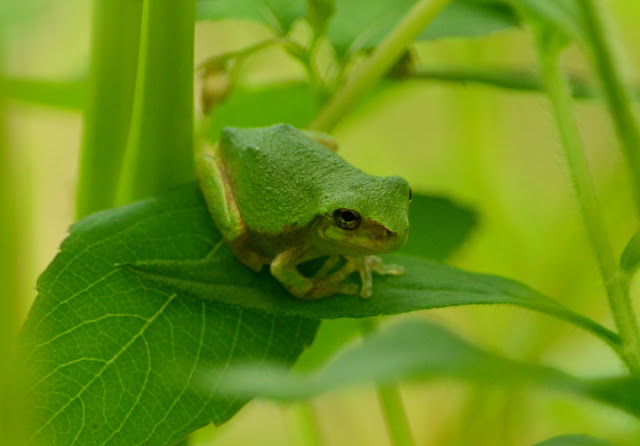
On August 8, I saw the cutest little Gray Treefrog (a young individual) in a patch of Orange Jewelweed in our yard:

I hear Gray Treefrogs frequently enough around here that they must be fairly common, but I so rarely get to see them. And this little creature was so adorable! It was climbing among the jewelweed stems, hunting tiny flying insects, and pausing long enough for a picture now and then:


This lovely Black Swallowtail showed up at the zinnias on our back deck on August 28:


While gardening in the front yard on September 3, I came across a couple of fun little creatures (and had only my phone's poor-quality camera to document them). This small Spotted Salamander was burrowed below ground, before I accidentally unearthed it:


And I found a really bizarre larva on Black Walnut leaves -- at first, I assumed this was a caterpillar infected with some sort of fungus, but it turned out to be the normal larva (they're supposed to look like this!) of a species of sawfly, the Butternut Woollyworm (Eriocampa juglandis):


On September 11, I watched a flock of Cedar Waxwings feasting on Pokeweed berries:

These birds looked so fancy surrounded by Pokeweed and blooming goldenrod:


Nearby, an industrious Eastern Chipmunk watched me from one of the many holes in the old apple tree next to our driveway:


Look at those stuffed-full cheeks!


Also on September 11, this European Mantis (Mantis religiosa) was doing its best impression of a grass stem as it staked out a patch of Little Bluestem in the meadow:

This Giant Puffball made an impressive sight in our yard on September 18:


Here's a beautiful Monarch on New England Aster on September 25:


And reddening Virginia Creeper leaves glowing in the sunlit woods:


Furrow Orbweaver spiders (Larinioides cornutus or patagiatus) commonly build webs across the outside of our windows throughout the spring, summer, and fall. This little individual found shelter in a leaf caught against a window in October, and it seems to now be spending the winter curled up in its home; this picture is from October 10:


I didn't get outside much in October and November -- fall is always a busy time. I have a few more sights to share from December 2021, and that will be the next post.

Wednesday, June 30, 2021

May and June, 2021

In the last post, I shared some highlights from our property in March and April of this year, and now it's time to catch up with May and June!

I couldn't have asked for a better start to May than this close-up view of a male Chestnut-sided Warbler (I love these birds!) who was foraging and singing in the back corner of our meadow on May 2:

Swelling apple blossoms made a pretty stage for this Song Sparrow on May 10:


Eastern Phoebes started this season the same way as last year, with a successful nest in the rafters of an old, barely-weather-proof shed on our property. The phoebes' first egg appeared on April 30, and the five babies fledged by June 7. (I don't have any pictures of that brood to share, because the light in that shed is so poor.) Hooray for more phoebes in the world! Meanwhile, an American Robin built her nest just outside the same shed, on top of a broken picnic table we had leaned up against the shed wall. Here's the robin on her neat mud-rimmed nest on May 13:


Robin babies aren't exactly pretty! Here are the little monsters on May 20:


By May 26, the young robins were covered with mottled feathers and looking just about ready to leave the nest. How nice of a parent to pose here for a family portrait:


I was careful to give these robins plenty of space, but as I walked into the meadow to avoid the very alert robins, I nearly stepped on a Song Sparrow's nest on the ground! I never would have seen the hidden nest if the adult sparrow hadn't rocketed up suddenly when I got close. I took a quick picture of the lovely speckled eggs (as best as I could get without touching the surrounding plants), and then I moved on.... I have no idea how this nest fared after our close encounter. And then a week or two later, I accidentally startled another Song Sparrow from her nest in the opposite end of the meadow. I've learned that I need to avoid straying from the paths in the meadow as much as possible during nesting season! In any case, here's a glimpse of the first Song Sparrow nest from May 26:

This Gray Catbird was putting on quite a concert on the edge of our meadow on May 13 -- I absolutely love this bird's pose with his fluffed-out butt:


 Here's the same bird looking somewhat sleeker from a different angle:


The same as last year, we have a family of House Wrens and a family of Tree Swallows in our two nest boxes (although the birds swapped boxes compared to last year). Here's the male House Wren on May 13, bringing a spider egg sac into the box that he'd already stuffed full of twigs and egg sacs (that's a stick overflowing out of the entrance hole):


The House Wrens' nest must have been somewhere deep inside all those twigs, because I heard noisy babies eventually, but I was never able to actually see the eggs or chicks. I'm pretty sure the brood has fledged by now, but the adults are still visiting the box (perhaps gearing up for brood #2?).

The Tree Swallows and House Wrens seem to have been fairly amicable next-door neighbors, although the Tree Swallows were a little pushy sometimes (which is probably a good thing, keeping the House Wrens in their place). Here's the male Tree Swallow keeping watch from the top of the House Wrens' box on May 21:

At the same time, the female Tree Swallow gathered bits of grass for their nest; it was strange to see a swallow perched on the ground, but very cool to get to see this lady at work:

The finished Tree Swallow nest was perfectly padded with a variety of feathers. Here are the eggs in their nest on June 13:


And the very next day, the eggs had turned into a batch of tiny, brand new swallows:


I saw the nestlings peering out of the nest box hole today, which means the whole swallow family will probably leave us soon. The female Tree Swallow has gotten especially defensive in the past few days, and she's been dive-bombing me when she sees me in the garden or meadow. I will very much miss having the Tree Swallows as a constant feature in the yard, but I suppose it will be nice to not have a bird occasionally swooping angrily past my head.

Indigo Buntings are likely nesting somewhere around here, because I hear a male singing fairly frequently. Here's a male Indigo Bunting (here to stay, or passing through?) surrounded by apple blossoms on May 18:


On May 20, I was surprised and thrilled to see a female Hooded Warbler adding large dried leaves onto a nest right near the path in our woods:

Here's the leaf-covered nest, set in a low Multiflora Rose bush -- I never did see eggs or other activity in this nest, so I suppose this placement didn't work out, but it was still very cool to see this delicate nest-building process, and to have proof that Hooded Warblers breed in our woods:


Our woods were practically dripping with Veeries this spring! I hear and see these lovely thrushes in our woods every year, but they have seemed to be especially numerous this year, with multiple birds singing and calling nearly constantly. Fantastically, the fallen log that our trail camera was watching happened to be something of a Veery stage in late May: the camera captured multiple videos of a male Veery perched on the log and singing, and two nearly identical videos (on different days) of Veeries mating! Here's a compiled video with (1) a Veery singing, (2) Veeries mating, (3) a very wobbly baby White-tailed Deer and its mom (oops, sorry about the typo in the video), and (4) an Ovenbird (often heard in our woods but rarely seen) walking along the log:

May was a wonderful time for flowers (of course), and here are a few highlights from May 20 and 21. Here's Red Baneberry (Actaea rubra), a new plant for me, whose flowers appeared along our woods path (the later red berries on this plant helped me confirm this ID and distinguish it from White Baneberry, which also grows in our woods):

Here's a nice pair of Jack-in-the-Pulpit flowers:


And a perfect Starflower bloom, lit up by some sunlight:


And I was so happy to see this thriving patch of Foamflower in our front yard:

On June 4, a somewhat tattered but still beautiful female Promethea Moth appeared on our deck:


On the morning of June 8, the Spicebush Swallowtail chrysalis that I kept over the winter in our unheated mudroom turned into a butterfly! I had neglected to give the creature a suitable perch in its enclosure (I know better now), so I provided myself as a perch and kept watch over this new and very damp butterfly while it worked on expanding its wings:

After about 20 minutes, it was looking pristine and perfect. Soon after this next picture was taken, I transferred the butterfly to a sheltered leaf to finish drying off, and it stayed there for a while and then presumably left when it was ready:


Also on June 8, the largest Brown Snake (Storeria dekayi) I've seen (they're not a very big species) got stuck while trying to fit through the small mesh fence around my garden; I pulled it backward to free it, and then I got to marvel at how soft and docile this lovely creature was:


This Red Eft (a juvenile Red-spotted Newt) was super photogenic in our yard on June 21:


And finally (back to nesting birds again), the Eastern Phoebes are currently well into their second brood in their traditional nesting spot over our front door. I really love having these birds as neighbors, and I'm so glad they decided to nest in this spot again. Here are the eggs in their moss-and-grass nest on June 25:


Here's to a wonderful spring and beginning of summer!