I visited the Arcata Marsh last Saturday (May 7) and again on Monday, curious to see how the place is changing as spring progresses. I am sorely missing my familiar eastern spring migration, and I haven't found anything so dramatic here, but there is certainly seasonal change. And there were plenty of May-ish things to see at the marsh!
Big purple lupine blooms (I'm not entirely sure of the species) filled big patches of field near the paths:
On Sunday, I saw a Green Heron keeping watch over a rather precarious-looking nest:
And I watched an adult Orange-crowned Warbler gathering caterpillars and other goodies:
While its frumpy fledgling waited in the bushes (look at that stump of a tail!):
Monday afternoon was sunny and warm, and a Red Admiral was out and about:
These two dragonflies were gearing up to produce the next generation; they flew around a lot while interlocked like this, which strikes me as quite a feat:
Dozens of Cliff Swallows were swarming around and under the eaves of a building near the bay. This must be a good nesting place! I love watching swallows in any situation, but it was especially cool to see all these birds in one place, and to watch the patterns of their shadows on the bright wall:
Here's a video of the Cliff Swallows swooping and swarming:
Great Egrets adorned rocks in the bay:
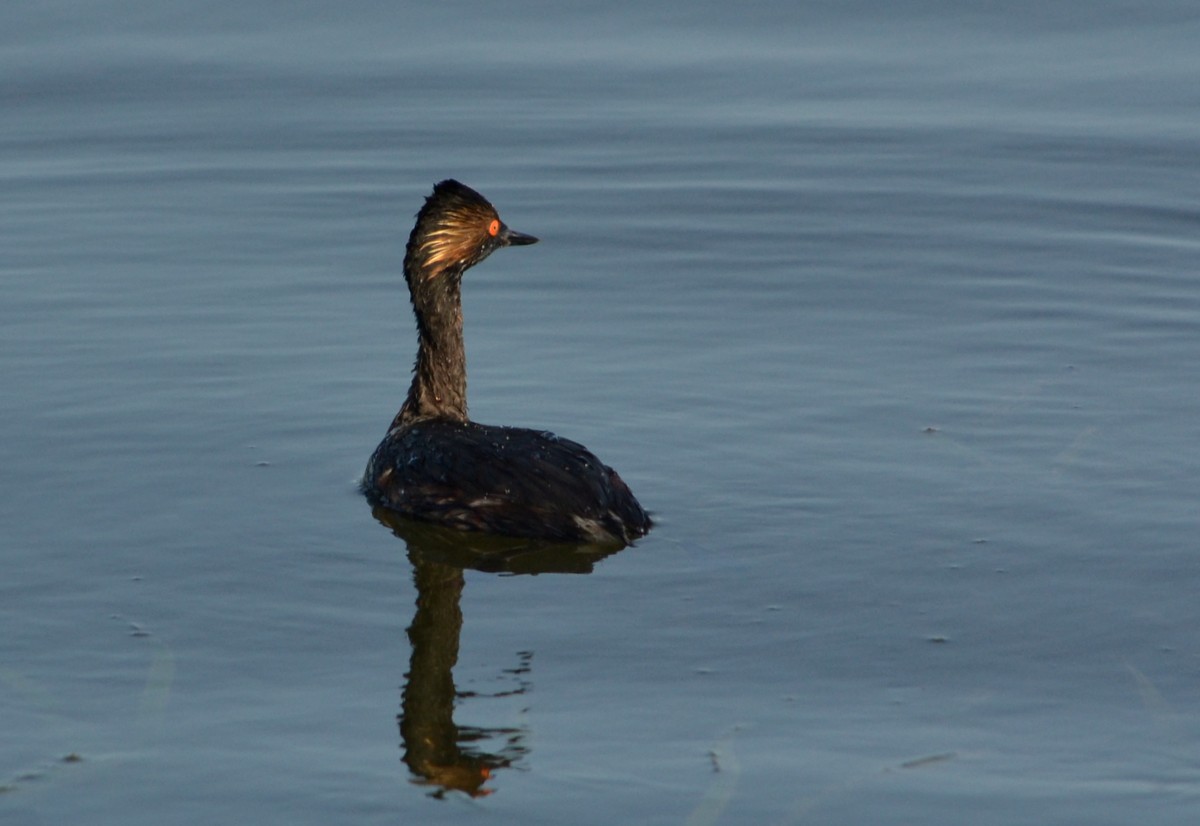
In a nearby pool, an Eared Grebe hunted over (I think) an eelgrass bed:
I've only seen Eared Grebes before in their plainer winter costumes, and I'm really liking this individual's fancy bronze face-tufts:
The coolest part, though, was seeing what the grebe brought up from underwater. I'm not sure what this little morsel is, but it looks soft and shiny:
At one point the grebe brought up a pipefish, a fish in the same family as seahorses, and certainly not a creature I've ever seen in the wild before:
I think I can see the seahorse resemblance from this angle:
The pipefish was quite a big catch for a little grebe, and it took some struggling, but the grebe finally worked the pipefish down, head first and tail waving:
Toward the end of the afternoon, I watched a male Allen's Hummingbird doing his absolute best to impress a female. Here's the male (I'm identifying him as an Allen's Hummingbird because of the green feathers on his back, although it's not impossible that he's actually a similar looking Rufous Hummingbird, since those birds are also in this area now):
And here's the discerning female:
The male would alternate between perching, feeding, and performing aerial acrobatics that involved swoops and dives and whistlesof air through his feathers. At one point I watched him dance back and forth in the air right in front of the female's face, dazzling her with his fancy feathers and fancy moves. (I really should have thought to take a video.) All of this took place in the middle of a huge and blooming blackberry patch; the plentiful flowers clearly made this an attractive spot for the hummingbird pair:
Here's the male again:
I only got to see the full effect of his costume a few times, but those moments made quite an impression!
While I was watching the hummingbirds, a male Common Yellowthroat popped out for what is surely the closest and clearest view I've had of these usually secretive birds:
I'm sure it wasn't a coincidence that I was standing in a blind at the time. What a gorgeous creature!
Nests, courtship, flowers, babies.... That sounds like May to me!
Silver Sands State Park was lovely when I went there this morning. Now that the recent heat wave has passed, it's just really nice to be able to walk outside comfortably again. :)
Lots of cool creatures showed up as I made my way around this park's marshes and beaches. At least three Northern Flickers were flying around and chattering to each other in a group of trees near a marsh, and this scruffy fellow paused for a quick picture:
(I love these fancy birds.)
Near the flickers' trees, a Halloween Pennant dragonfly (Celithemis eponina) perched on a grass stem:
I don't think I've ever seen this type of dragonfly before, and I have to say, it's a pretty stunning creature. Those dark splotches and orange wings are awesome, of course, but my favorite part has to be the bright pink spots at its wingtips. You are so cool, little bug!
Four Ospreys were busy fishing offshore, and this one flew overhead with a very strange-looking catch! (Is that a flounder?)
I was surprised to see a Great Egret perched at the top of an old pole in the middle of one of the marshes:
It stayed up there for quite a while, preening its gloriously frilly feathers:
Are you showing off, bird? Well, I'm certainly impressed!
I'm glad I got to visit the shore again after a few weeks away. Also, hooray for fancy winged creatures!
Paul and I have been to Silver Sands State Park in Milford a few times now, and we always have a great time there. Recently, we made it our goal to get out to Charles Island, which is connected to the park's shore by a half-mile-long sandbar that appears only at low tide. The island is closed to visitors during the summer, to protect the herons and other birds that nest there, but it re-opened in mid-September. So I learned how to read tide charts, and this past Sunday afternoon (a couple of days before the New Moon, when low tide is at its lowest), we set out on our adventure! We started seeing interesting things before we even got down to the beach. This gorgeous Green Heron, for instance, was hunting tiny silver fish in the marsh right next to the boardwalk:
It's been many years since I last saw a Green Heron, and I'd forgotten how small they are. Compared to the Great Blue Herons I'm used to seeing, this creature was positively dainty, and he/she moved slowly and carefully through the water on those long legs.
At another part of the boardwalk, we leaned over to watch a colony of Fiddler Crabs (I don't know the exact species) moving in and out of their holes and feeding in the mud. This male crab seems to be waving up at us with his giant claw (or perhaps he was warning us to keep away from the nearby female):
We got down to the beach just as the final sliver of the sandbar was surfacing above the water, about an hour before low tide:
And by the time we were half-way out, the water had receded enough to leave a nice wide path to the island:
There were lots of gulls around, but not a lot of other shore birds. Picking among rocks along the sandbar's shoreline, however, was maybe one of the most adorable sandpipers I've ever seen:
It was so tiny -- think of a sparrow with a long beak and long legs -- and it was so intent on foraging for food that it let me sneak up quite close to it. It didn't seem very concerned about my presence at all, really:
My identification skills are still greatly lacking when it comes to shore birds, but between the yellow legs and the very small size, I'm almost certain that this is a Least Sandpiper. I just love that pristine russet pattern on this bird's back:
As the water receded, it revealed rocks positively shaggy with algae, like bright-green mops of hair:
Paul pointed out that this rock seems to be showing signs of male-pattern baldness:
When we made it onto the island, we still had some time before low tide, so we decided to explore. The interior of the island was fenced off to protect the wildlife (with signs telling people to keep out) -- we found several places where the fence had fallen, but we didn't push our way into the path-less tangle of bushes and vines beyond. We saw a few signs of ruined buildings, remnants of old attempts to make the island habitable (attempts that were doomed to failure because of a centuries-old curse, according to some stories I've read online).
We walked through lovely stretches of tall marsh grass as we made our way around the outside of the island, and we kept up a pretty stiff pace. (I was afraid we'd miss the tide if we didn't move....) Cormorants fished from the rocks just off-shore, and small birds flitted in and out of the island's interior. This is the best view I got of a tiny Marsh Wren, as it hid expertly among the waist-high grass:
So we made it all the way around the island and we didn't even get trapped by the tide! (As it turns out, we had plenty of time, but better safe than sorry.) As we finished our loop, we watched several small fish flinging themselves above the surface of the water -- perhaps escaping from something below? By random chance, I happened to get a picture of one of these sea-creatures just as it became airborne:
And then our fun adventure was over, and we made our way back across the sandbar toward more reliable land:
I'm sure we'll be at Silver Sands State Park again sometime in the future, but perhaps not until next spring or summer. And we'll need to do another round of careful planning if we ever want to return to Charles Island. I'm game!