These past few weeks have been warm and (often) sunny, and definitely summer. July has been a time of incredible firefly shows (especially earlier in the month), lots of fledgling birds, and quickly-growing gardens. There's been a lot to see so far this summer!
On July 1, the baby Black-capped Chickadees in one of our nest boxes were starting to look a bit more like birds, but still quite alien-like with those huge pale beaks:
I didn't peek in on the chickadees after that, but they seem to have successfully fledged, and hopefully all is well!
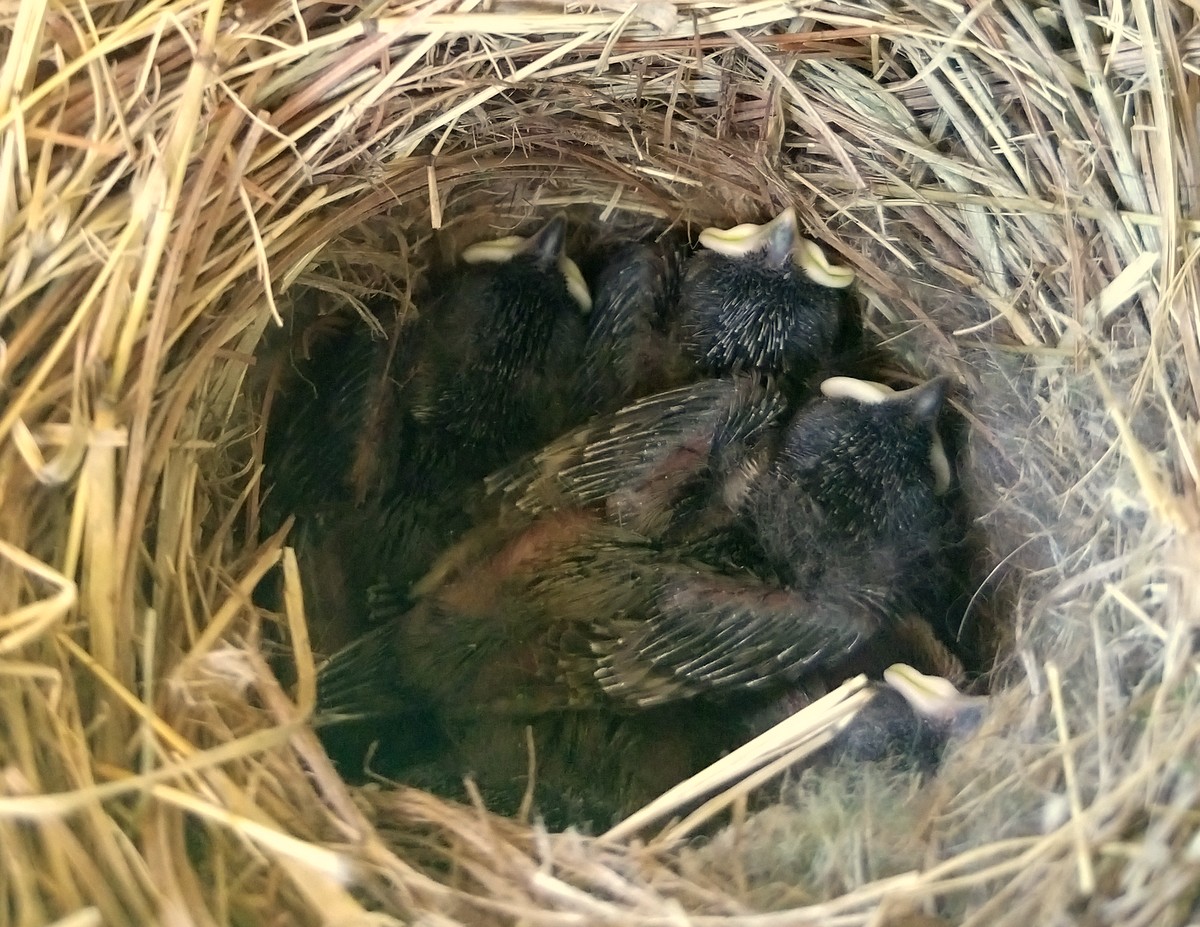
The Eastern Phoebe family has had great success with their second nest of the season, above our front door. The eggs started hatching on July 1, and by July 2 there were five larval phoebes in the nest:
On July 8, the babies were already looking pretty crowded:
Throughout all this, the adult phoebes continued to be just the best parents. The mother stood guard over the nest at night, even while we turned on the porch light and took the dog out for his nighttime business (I took this picture from a distance, doing my best not to disturb her any more than we already were):
By July 15, the phoebe babies were alert and moving around (and so very crowded), and we switched to using the back door so we wouldn't startle them out of their nest too early:
Here's another view of these frumpy babies trying very hard to look like just more moss and mud:
And when they were 18 days old, the babies left the nest. Wonderfully, they've stuck around, so we still get to see phoebes fairly frequently. A few days ago, I watched all five babies line up in a row on a branch, mouths open, while one of the parents came by with a tasty dragonfly. And earlier today I saw the family foraging in the yard -- some of the youngsters were even making a few hunting attempts themselves, although it still looked like the adults were doing most of the work.
Lots of other baby birds have been around, too. Here's a juvenile Chipping Sparrow on July 13, perched on a trellis we put in the vegetable garden this year and which has become a surprisingly popular spot for young birds to sit and preen and forage:
I saw this rather scruffy-looking baby Chestnut-sided Warbler on July 15:
I love these little birds, and I'm sure this young one will be very handsome one day:
The mother Chestnut-sided Warbler was also foraging nearby, her costume providing surprisingly good camouflage among the already-fading leaves of this apple tree:
A family of Indigo Buntings (with at least two youngsters) has been hanging around the meadow and yard, and while I haven't yet managed to get a picture of the babies or female, I did catch the male singing from a goldenrod perch in the meadow on July 18:
And a Common Yellowthroat family has been hanging around as well. I've almost gotten used to hearing these birds' chirps as they forage in the brushy areas of the yard while I work in the garden, which is amazing. Here's one of the juveniles on July 18:
And here's another angle on the same young bird, with its definitely yellow throat:
This year has also been especially good for our local Brown-headed Cowbirds, since it seems that these birds were able to successfully parasitize several nests on and around our property. In addition to our Eastern Phoebe's first nest of the season (which produced two phoebes and one cowbird), this summer I've also seen juvenile cowbirds being fed by a Chestnut-sided Warbler, a Veery, and a Red-eyed Vireo. These cowbirds sure seem to have their tricky child-rearing methods figured out!
July has brought many other interesting sights as well, besides baby birds. I was happy to see an American Goldfinch feeding on Lance-leaved Coreopsis seeds in the meadow on July 23:
Wild Bergamot (Monarda fistulosa) is blooming in the meadow for the first time this year (we scattered this plant's seeds in late fall of 2017), and these mounds of pale purple flowers are set off so nicely by the sea of Black-eyed Susans that are the most numerous flowers in this part of the meadow:
These blossoms are so fancy up close, with so many frills and fringes and curls:
And these flowers are definitely living up to their other common name, Bee Balm, since I almost always see bees on these plants; here's a fuzzy bumblebee visiting these equally fuzzy flowers:
At the edges of the meadow and yard, I've been happy to see lots of Fringed Loosestrife plants with their bright yellow flowers:
The small flower bed I planted with Purple Coneflower (and other things) in 2017 has become a hotspot for flying pollinators, as well as creatures who hunt those insects. A Goldenrod Crab Spider (Misumena vatia, I think) was staking out the coneflowers for a few days, and I like how well this spiky white-and pink creature fits in with the spiky pink-and-white flowers (seen here on July 26):
Here's another scene with this spider on July 24 -- sharp, secretive, and now that I'm looking at it again, almost dance-like:
Here's a new butterfly for me, a Milbert's Tortoiseshell, who visited the marigolds at this same flower bed on July 24 before flying away surprisingly well on its very damaged wings:
On July 23, I nearly dismissed what looked like a dried leaf on our deck -- all curled and discolored, with its stem sticking up into the air -- until I looked through binoculars and realized it was a Mourning Cloak butterfly:
I don't know that I've ever seen a more perfect Mourning Cloak before, and I was able to get a better (and more recognizably butterfly-ish) view of this beautiful creature from above:
I planted two Spicebush plants in our yard a couple of years ago, and on July 24 I was excited to find our first tiny Spicebush Swallowtail caterpillars! Many of the leaves had little folded-over leaf tents, and this caterpillar inhabitant had come out to browse on the leaf:
The caterpillar doesn't look like much here, but I'm already enjoying seeing these little creatures grow into their larger and more fantastical forms -- no more pictures yet, but I will share more at some point.
This July has also been a great time for dragonflies. Since I learned to identify Blue Dasher dragonflies earlier this year, I've seen these handsome creatures all over. I know I already shared a picture of a female (or possibly young male) Blue Dasher, but I just love this dragonfly's stripes and its rainbow of muted colors, so here's another individual in the meadow on July 18:
Several male Common Whitetails were perching on rocks in the meadow on July 23, and this one let me come quite close for a picture:
And this Eastern Pondhawk (a female or young male) in the yard on July 24 impressed me with its bright green colors:
Summer brings so many sights!
So much of June seems to be about babies. Many of my sightings these past few weeks have revolved around nests and eggs and growing creatures, many of them building on processes that started back in May. I have other sights to share, too, but let's start with the babies!
First, to recap where we left off in my last post (on June 5): an Eastern Bluebird pair had built and then abandoned a nest in one of our nest boxes; our Eastern Phoebe pair raised a Brown-headed Cowbird chick and had two of their own babies still in the nest under our back deck; and a pair of Tree Swallows had eggs in our second nest box.
Let's follow up with the phoebes first. I'm so very impressed with these two parents and all they've accomplished so far this year. With the cowbird chick gone but two young phoebes still in the nest and depending on their parents to feed them, on June 6 the mother phoebe started building a second nest in the old spot over our front door (where she's had a nest for at least the past two years)! I imagined her saying to her mate -- about feeding their kids in the back -- "you've got this, right?", as she took on the major project of putting together a new nest. And they did it! The two baby phoebes under the deck got bigger and fledged around June 14, and during that time the female phoebe finished constructing the second nest and started laying eggs. She ended up with five eggs (her second clutch of five eggs this year) in this beautiful moss-covered nest:

Now the female phoebe is focusing on incubation. She typically flies off of the nest when we go through the front door during the day -- we have to walk right underneath her, after all, and with a dog no less -- but she returns to the nest quickly, and she stays steadfast in her spot when we pass underneath at night. Really, I feel like these are just about the best phoebe parents there are, and I hope all continues to go well with this second nest!
The Tree Swallows are also having a great year. On June 18, I peeked into their nest box and found six babies crammed in among all those fancy feathers lining the nest (there are five faces on the right side in this picture, and one more set of wings facing the opposite direction on the left):
And now the nestlings are wide-eyed and (presumably) fully feathered, and they spend their time peering out of the nest box hole while the adult swallows swoop almost constantly above the meadow, scooping bugs out of the air and shuttling them to their waiting kids. The nestlings have been hanging out at the entrance hole for a few days now, and they seem to be in no rush to leave the nest box. Here's one of the young Tree Swallows this afternoon:
And here comes Mom... get ready...
Food! Yum.
These Tree Swallows have taken their time at every stage of the breeding process this year, first in settling on the nest box, then building the nest, and now in actually leaving the box. And I'm not complaining! I love having these beautiful bug-eating birds around, and I know they'll probably become less frequent visitors once the babies finally do leave the nest.
The first nest box -- the one that the Eastern Bluebirds claimed and then left -- has brought a wonderful surprise. On June 11, I looked into the box and found that Black-capped Chickadees had added a soft fur lining into the cup of the bluebirds' abandoned nest, and there were five perfect, tiny, speckled chickadee eggs inside:
I'm very excited that our nest box is helping to make more chickadees! Here are the nestlings (a day or two old?) on June 24 -- I think these little blobs are almost equally gross and adorable, and I suspect the "adorable" part comes almost entirely from the fact that I know they will someday be chickadees:
Yesterday (June 28), the babies were rather spiky, with all those feathers poking out; I'm looking forward to seeing them when they actually start to look more like birds:
The adult chickadees are very stealthy, and I hardly ever see them going to the nest box. (That's probably why I didn't even know they were making a nest in there until I looked and found eggs.) Here's a quick sighting of one of the parents today (while I was taking pictures of the Tree Swallows next door) -- this parent is leaving the nest box carrying a fecal sac, which it will throw away somewhere else:
Several other birds have also been making families in and around our yard. American Robins reused a nest they (or different robins) built under our solar panels last year. Here's an adult on the nest on June 4:
I don't know for sure whether this robin nest was successful, but there were babies, they got bigger, and now the nest is empty again. I hope they made it out safely; this is such an exposed spot for a nest, and the babies would be easy pickings for any flying or climbing predators.
Dark-eyed Juncos must have had a nest somewhere around here, because three young juncos have been hanging around our yard for about a week now. These stripey brown birds don't look much like adult juncos, but they do have that distinctive white-striped tail:

And here's the rest of the nesting activity I know about: Gray Catbirds built a nest in a shrubby area next to our house, but the plants there have grown taller and I can't see the nest anymore, so I don't know whether it's still in use. Mourning Doves built a nest (a pile of twigs, really) in the apple tree next to our driveway, but they moved on after we walked by and startled them too many times. Chipping Sparrows built a nest in a conifer in our back yard, and although I haven't seen any further activity in that particular spot, I did see a Chipping Sparrow carrying food recently, so it must have babies around here somewhere. Some sort of large dark bird -- I suspect American Crow, although I was never able to tell for certain -- was using a nest at the top of a tall White Pine in our woods. A young Common Grackle has been showing up at our feeder in the past couple of days. And a pair of Common Yellowthroats acts upset when I walk past a particular corner of the meadow. All together, that's 12 species of birds that I know have at least tried to breed in or around our property (and with all the birds that are regulars in our yard, I'm sure there are more). It's busy around here!
As for non-bird breeding, baby Groundhogs and their mother have been hanging out in the same area as last year's Groundhog family -- I guess our yard makes a good Groundhog nursery. And I was surprised and delighted on June 26 to see frog tadpoles (I don't know what species) in the shallow pond in our woods for the first time:
The past few weeks have brought many other interesting sights as well. On the morning of June 4, I watched a very puffy Chipping Sparrow trilling from its perch in a tree:
Sing it, sparrow:
On the afternoon of June 14, several very pretty insects were flying in the sunlight along the meadow path. Here's a fancy butterfly, a Little Wood-satyr:
And a male and female of some species of (I think) Azure (genus Celastrina):
And a male Blue Dasher dragonfly (Pachydiplax longipennis):
With a female Blue Dasher not far away:
On June 26, a male Black-and-White Warbler (looking like he could use a fresh molt soon) worked his way through several trees in our yard, singing the whole time:
And almost as much as I loved seeing the purple spikes of Wild Lupine flowers in the meadow, I now love seeing those same spikes with fuzzy gray seed pods:
And now June is coming to a close, and it's fully summer. I'll keep checking on the nests around our house, and I'll keep watching for other new and interesting things in this amazing place!
Well! I've been out and about in the past month and a half, and also working hard, and in that time: Fall happened! The weather report is calling for snow this weekend (!), so this seems like the best and last time to share the pictures of fall in Central New York that have been gathering on my computer since my last post. I missed this season deeply during my year in Northern California, so I tried to absorb as much fall as I could in recent weeks. Here are some sights from all of fall!
Way back on October 11, I was at the Roy H. Park Preserve just as the fall foliage was really getting going. I love seeing the trees make these waves of color:
A pair of White Cabbage Butterflies were feeding at New England Aster blossoms (Aster novae-angliae) while also making the next generation of butterflies. Actually, I guess just the one butterfly was feeding while the other was along for the ride. This whole process looks rather ungainly, but I guess it works:
All sorts of interesting fungi were sprouting up in the damp woods. This one log was home to at least three types of fungi, all with such different shapes and textures:
And this strange fungus looked like it was bubbling out of its tree's trunk:
A lovely little Garter Snake sat on the sunny forest floor near the path, waiting for the humans to move on:
A few days later, on October 14, I was back at another part of the Park Preserve, again marveling at the colors on the trees. Yes, we do fall pretty well here. I'll take it!
This was apparently a good week for snakes, because I nearly stepped on a Northern Water Snake who was basking on the path and looking way too much like a scraggly root:
The snake stayed motionless while we walked around it -- it was a chilly morning after all -- and I got to peek at its face through the grass:
In the woods, bright Canada Mayflower berries looked like little clusters of Christmas ornaments:
An almost-as-red dragonfly (one of the late-flying Meadowhawk species, I think) perched nearby, lacy wings against a lacy fallen leaf:
I'm always impressed that some insects are able to survive into the fall, past frosts and increasing cold. Several big grasshoppers were active in the marshy fields, and this one paused long enough on the boardwalk to have its picture taken:
On October 29, I got to walk in Sapsucker Woods, and the place was wonderful as always. The trees in some parts of these woods were bare by this point:
But other areas of the woods were still full and golden:
Witch Hazel blossoms floated over the path. How cool to see yellow leaves and yellow blossoms in the same day:
The view at the big pond was so still and beautiful:
A few Painted Turtles were out sunning, including this fellow with his impressively long claws:
And then, all of a sudden, it was late fall. On November 8, I was back at the Park Preserve, and the place was wholly different:
I have to say, for all the amazing riot of color in early-to-mid fall, I think I might love the muted colors of late fall around here even more... the floating yellows especially (are those birches?) but also the rusted browns and hazy grays and dark conifer greens. Ah, love:
The fields were filled with goldenrods gone to seed, here backlit for extra drama:
Even at this late date, a showy Meadowhawk dragonfly was still cruising around:
I happened to take a picture of almost the same scene at the Park Preserve nearly a month apart, and I love how these sights are both the same and totally different. Here's October 14:
And now, on November 8:
This place is amazing. :)