Well, it's happening. In one week, I will be moving to northern Ohio and leaving Connecticut behind, probably forever. I was in Connecticut because of graduate school, and now that's done, and it's on to new professional endeavors in new places. Ohio is in fact a temporary location for us -- my job there is just a one-year position -- but the change is a good one. I'm very, very excited about all the new things we'll see, the place where we'll be living (much more on that later), and the job. But, of course, I'll miss many things about Connecticut, which has been my home for the past six years.
I'll be doing a few wrapping-up posts over the next week to properly say goodbye to Connecticut. (Don't worry, the blog is coming with me to Ohio.) One part of Connecticut that I will definitely miss is the shore. So during my final visits to Silver Sands State Park this morning and last Thursday, I was sure to thoroughly appreciate the creatures that I'm not likely to see again for quite a while.
It always feels special to see Clapper Rails in these marshes, and I was very happy to see one preening itself out in the open this morning. I don't know if I will ever again be in a place with Clapper Rails as bold and readily visible as those at Silver Sands State Park, and I will miss these birds for sure:
Snowy Egrets are very common here, and I took the time to admire these gorgeous birds this morning:
As a special shorebird bonus, a couple of American Oystercatchers lit up the shoreline this morning with their flamboyant beaks:
And a lovely Spotted Sandpiper scrambled over rocks at the water's edge last week:
The Piping Plover family has dispersed from their nesting area by now, and I was lucky enough to come across one of the juveniles in this park last week. I know it's one of the fledglings from the nest I was monitoring because of that distinctive injured leg:
This bird was moving and foraging well on just the one leg, and it flew away just fine. I have no idea what happened to this bird when it was a baby, but I'm heartened to know that it's made it this far. The more Piping Plovers surviving out there, the better. Fare well, lovely little bird, and best of luck!
A couple of Killdeer were running around on the beach this morning. I thought these birds might have also been this season's grown hatchlings, withthose brownish (rather than pristine white) bands on their breasts, but I don't know for sure:
A plump Groundhog was munching away in the flower-filled grass last week:
And this marvelous Blue Dasher dragonfly (Pachydiplax longipennis) posed for a picture:
This morning's insect highlight was a supremely blue damselfly (I'm not certain of the species):
I couldn't have asked for better sights on my final visits to the Connecticut shore!
Every week when I visit Silver Sands State Park, I get a little more attached to the place. I love getting to check in with familiar creatures, and there's always something new to see! Here are a few sights (mostly birds) from this morning's visit.
The Piping Plover chicks east of the park are getting even closer to adulthood (including the chick with the injured leg, who's still running around and foraging with its siblings as of this morning). It looks like they just need some longer wing and tail feathers, and then they should be good to go!
While the four chicks foraged in the sand, Dad kept careful watch; he even chased a House Sparrow away at one point. A folded mat makes a convenient lookout perch:
The plovers aren't the only bird family with growing babies around here, of course. I was very happy to see a gangly Clapper Rail chick wander out of the marsh grass; such a cute little dinosaur-like creature:
The Barn Swallows are nesting under the boardwalk, and this adult perched on the railing for a rest between hunting flights:
There were actually dozens of swallows hunting in the air over the marsh, more than I think I've ever seen here at once. The swirling (and chittering) cloud of birds was mostly made of Barn Swallows, but there were also several Tree Swallows in the mix, as well as a few Chimney Swifts, which I've definitely never seen hunting in this spot before. This picture may not look like much, but its quite a busy scene for this airspace:
On the beach, a pair of Great Black-backed Gulls made an imposing sight:
I'm surprised to notice that I've actually never posted about Great Black-backed Gulls before. They show up around here pretty frequently, and they have the distinction of being the largest gull in the world. These two were quite noisy, and they kept striking these odd tilted postures and tossing their heads; I can only think this is some sort of courtship display, but it seems kind of late in the season to be thinking about making a nest:
A Common Loon was floating close to shore. This bird was looking a little less than pristine (it was presumably molting out of its breeding plumage), but it was still such a handsome creature:
A Yellow-crowned Night-Heron was hunting at the water's edge (not quite as elegant as the Black-crowned Night-Heron I saw last week, and I always think that dark mask looks strange):
Although I often see many species of egrets and herons in this park, I don't usually see Great Blue Herons here. It was quite a treat, then, when this huge creature soared by:
I love those wings, and those big legs! This bird circled overhead a few times, so here's another view:
As I was leaving the park, I checked out some Common Milkweed plants to see what sorts of bugs might have been hanging out there. A few of the flower clusters were looking pretty well decimated.... Someone was hungry!
A closer inspection revealed that the orange pollen-like dusting on the plants' stems and leaves was actually tons of tiny bright aphids (probably the species Aphis nerii). These guys were everywhere and they were having a feast:
Fortunately, there were many more milkweed plants without aphids, so there's still plenty of this apparently delicious (for bugs) plant to go around.
Here's to another great day at the beach!
I couldn't find the Piping Plover pair that's been hanging out at Silver Sands State Park when I visited yesterday morning. They may have decided to nest somewhere else, or perhaps they were just particularly well hidden.... I'll continue to keep an eye out for these little birds on future visits. Even without nesting plovers, however -- and despite the occasional drizzle -- there were tons of cool things to see. The park was positively overflowing with activity!
One of the first creatures I saw when I first arrived was also one of the most exciting, because I've only seen them once before, and never before a male in his super strange breeding plumage. Look, a Bobolink!
Make that a whole bush full of male Bobolinks, with their black bellies and yellow caps:
When these birds weren't perched in bushes and singing their weird metallic bubbling songs, they were foraging in the grass. The dandelion heads were apparently particularly interesting:
Bobolinks are pretty uncommon in this part of Connecticut, so I consider this a lucky encounter indeed!
In the marsh, two Willets (large-ish shorebirds with distinctive black and white wings) were preening:
This happy Willet made some cool ripples as it bathed:
Also wandering through the marsh were several Semipalmated Plovers. These birds are small like Piping Plovers but they have brown backs and wings like Killdeer; and, like all plovers, they're adorable:
I've commented many times in this blog on the secretiveness of Clapper Rails, who I often hear calling in these marshes but who typically remain hidden among the grass. The more I visit Silver Sands State Park, however, the more these birds defy my expectations. I've seen them several times now in July and August, after their chicks have hatched. A couple of weeks ago, I actually saw one calling from a slight rise in the marsh landscape. And then yesterday, who should come walking out onto the open mudflats, bold as can be, but a Clapper Rail:
The bird spotted me, but it only ambled (rather than raced) toward cover in the grass, walking right by me in the process. In fact, it seemed to strut and pose as it passed.... Well, sure Mr./Mrs. Rail, I'll gladly take your picture. What a gorgeous bird!
Rail tail!
Clapper Rails have such unusual body shapes. I'm struck by how skinny/compressed this bird looks from behind. It's thin as a... haaaang on.
I've now looked up the phrase "thin as a rail" to try to find out where it comes from. Several online sources say that no, "rail" in this phrase doesn't refer to a man-made bar or post (as I've always assumed), but rather to the bird, which is quite thin and thus better able to move through marsh grass. But then a few other sources say that in fact, no, you had it right the first time: It's not the bird, as some people have recently suggested, but rather the man-made object! So basically, if I say that the Clapper Rail is "thin as a rail," I still have no idea whether I'm being clever, or redundant, or silly. Ah well. Regardless, I'll think of this bird now whenever I hear that phrase.
A second Clapper Rail was even camped out nearby, again in plain view, and the two birds cackled at each other when the first one got close:
Are these birds not actually as secretive as I thought? I'm not complaining! Be as bold as you like, Clapper Rails.
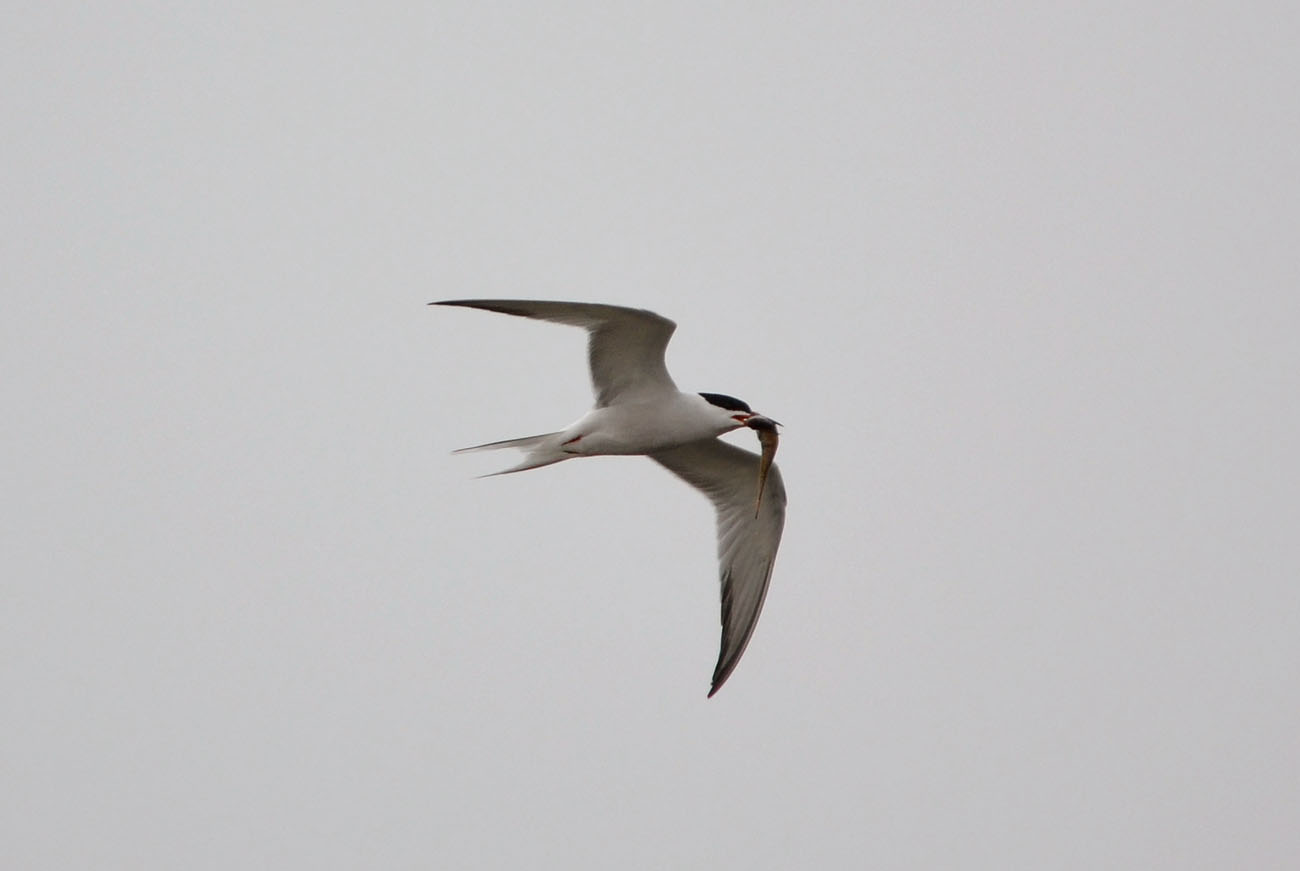
On the beach, a trio of Common Terns were chasing each other across the sky, one of the terns carrying a fish (perhaps for courtship purposes):
There have been so many male Red-winged Blackbirds in this park in recent weeks, it's nice to see the females showing up as well:
Yellow Warblers nest in this park's fields, and a few males were fluttering around and calling during my visit:
These bright little birds make quite a sight, even from a distance:
And this is why people (in North America) don't like European Starlings. I checked on the nesting cavity that the Northern Flickers worked so hard to excavate over the past few weeks, only to find a starling sticking its head out of the hole:
I know it's not the starlings' fault that they're on this continent, and it takes a feisty bird to chase off a powerful Northern Flicker, but... starlings have so many nesting options. Couldn't they have left this cavity to the flickers? Yes, you're very fancy with your spiky throat and triangle wings, but I'm not impressed. Eh, starlings:
In more overall positive nesting happenings, I was happy to see this cool structure hanging from a tree branch:
A Baltimore Oriole nest! The male oriole was singing nearby and keeping another male from his territory, while the female oriole was busy using her excellent weaving skills:
This is such an amazing structure, and I'm curious about the material she's using. Some sort of plant fiber perhaps? Here's a video of the female at work:
Here are a couple more happy sights to close out my visit. This patch of Lance-leaved Violets (Viola lanceolata) made a small field of stars shooting up from the muddy ground:
And I loved seeing this Savannah Sparrow perched near the ground, its yellow eyeshadow so perfectly matching the blooming dandelions:
There are so many amazing things to see right now!
Wednesday was my last regular visit to Silver Sands State Park in my official capacity as a volunteer Piping Plover monitor for the year. No shorebirds nested here this year -- same as last year, unfortunately -- but I've had a lot of fun on my shore-side trips nonetheless. The many active creatures on Wednesday morning made for an awesome beach day to round out the season!
I have lots of things to share, but this hawk definitely stole the show:
I'm not totally confident in my juvenile hawk identification skills, but I'm about 95% sure this is a young Red-shouldered Hawk. (It had pale crescent-shaped patches on the tops of its wings, which is apparently a good indication of that species, and it was missing the dark leading edges under its wings that a Red-tailed Hawk usually has.) Anyway, a few seconds after I noticed the hawk in its tree, it flew down and flopped onto the ground:
I guess wings aren't very useful on the ground among woody stalks, but the hawk soon got its appendages under control. It seemed very interested in something at its feet:
After a brief tussle, the hawk was off into the air again, now with a meal in its talons:
Oh! It's a snake!
I caught up with the hawk again later, and by that time the snake was already half gone:
Poor snake. (I wonder what kind it was.) The hawk seemed happy with its prize, though.
A crow was hopping around and calling nearby, but the hawk didn't share, and the snake was gone pretty quickly anyway:
Well hunted, young hawk!
An American Kestrel -- a much smaller raptor -- was hunting in this part of the park as well:
These little predators are just too cute, with their big eyes and tiny beaks:
In another area of the park, dozens of Barn Swallows made a cool sight as they preened and chittered to each other, all lined up on electrical wires:
A Twelve-spotted Skimmer dragonfly looked especially striking with the sunlight shining through its stained-glass wings:
And of course, now that I've emphasized (in my last post) how unusual it is to see Clapper Rails in the open, I've seen these birds up close on each of my last three visits to the park. Well, I'm not complaining! I guess late summer is just a good time to see these cool, funky-looking birds:
The shore has definitely been a great place to visit this summer. And now that my volunteer duties are finished, I'm hoping there will be more time soon for some woods walks!


+dragonfly.JPG)