Saturday, April 7, 2012

A Pine Warbler Up Close

Have I mentioned recently how much I love the Red Cedar tree right outside our apartment's office window?

This afternoon, a Pine Warbler passed through our yard and gave this tree a good going-over, allowing me to see this bird really up close. It's not the most dazzling of the spring warblers, but a very pretty little bird nonetheless:
 

I love that soft wash of yellow. Most of the pictures of male Palm Warblers I've seen have been brighter in color, so perhaps this was a female bird? She (or he -- I'm still not sure) was flitting quickly from branch to branch, looking all over for a meal. See anything good up there?


Sleek and graceful from some angles, and a little puffball from others -- aren't warblers great?
 

I'm always happy to get visitors in our tree, and it was a joy to have this inquisitive creature around for a few minutes before it moved on. Feel free to come back again any time, little bird!
 

Thursday, April 5, 2012

Herons Abound at Silver Sands State Park

So this year, I decided to do something crazy and new: I volunteered to be a Piping Plover monitor for the US Fish and Wildlife Service!

Piping Plovers are a federally threatened species (not quite endangered, but still, they're in trouble) that nests on sandy beaches scattered along the Connecticut coast, and every year, the USFWS, the Connecticut DEEP, and the Audubon Society get together to ask for volunteers to go out onto the beaches and look for these birds so we can try to protect them (with fences, signs, etc.). About a month ago, I went to a training session and filled out an official government form, they gave me a fancy USFWS hat and ID card, and now on Wednesday afternoons for the rest of the spring and summer, I am in charge of surveying Silver Sands State Park for these little birds. (And I'm supposed to tell the Powers That Be about other species-of-interest that I see as well.) So basically, I get an excuse to go walk on the beach every week and do something that I like to do anyway, and it actually might help our coastal birds. It's kind of a great deal!

Anyway, yesterday was my first afternoon "on the job," and I had a great time and saw lots of cool creatures. No Piping Plovers -- no one's seen them at this park yet this year, actually, and they might not even show up at all -- but now that migration is in full swing, a bunch of interesting birds are streaming back into the area, herons chief among them.

This Yellow-crowned Night Heron -- a new bird for me -- was hunting at the edge of one of the marshes between the parking lot and the beach:


I'm liking that mask! Although I can't help thinking this bird's rat-tail hairdo looks a little silly from the back:


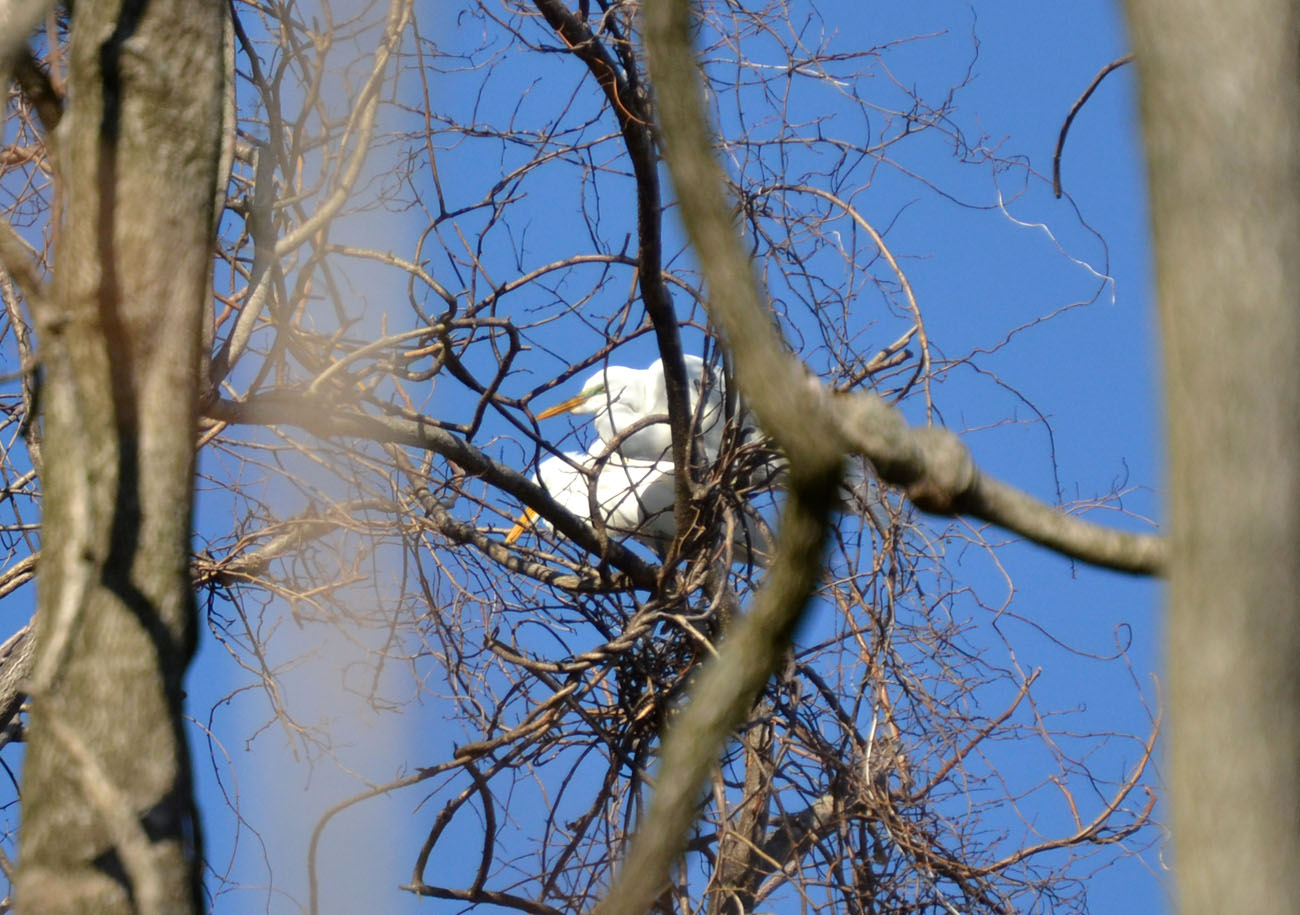
I happened to arrive at the beach as the tide was going out, so I took the chance to walk across the magically-appearing sandbar to Charles Island. In a month, the island will be closed off to the public to protect the herons and egrets that will be nesting there, and some birds were already starting to set up shop! The trees in the center of the island were dotted with big white shapes, like this pair of Great Egrets:


It's difficult to see in this picture (just think how much harder it'll be when the trees leaf out!), but these egrets were decked out in their breeding finery: long flowing feathers and bright green markings on their faces.

I think you can just make out the red eyes of this pair of Black-crowned Night Herons, similarly shrouded in the branches of another tree -- the two were touching beaks and acting all lovey-dovey while I was there:


The herons and egrets weren't the only birds thinking about nesting on Charles Island, either. Several pairs of Canada Geese were honking and flapping (and hissing!) at me, making sure I didn't come too close. (I wasn't about to try!) And one pair of geese had something interesting to show:


I reported my sightings of these two birds at reportband.gov, and I'm waiting to see if I get a response -- people band wild birds for all sorts of studies and things (yay science!), and sometimes, you get to learn the history of the banded bird when you report it. (Or so I've been told.) I'll update this post if I hear anything!

Update (4/7/12): I got two emails yesterday with some information about these birds. C255 is a boy, and C274 is a girl, and they were both banded on the same day right around this same area (near Milford) last summer. I've read that Canada Geese are monogamous, and it's kind of cool to see some evidence for that myself. And I actually think it's sweet that these two are still together (through a banding process and everything). I hope you have a nice family this summer, geese!

Before I move on, I just have to share one more picture of these geese. I just think this picture looks cool, but Paul thinks it looks like a goose with two heads:


I wish all the birds nesting on Charles Island the best of luck this year!

Back on the mainland, there were more birds to see, including two Ospreys (also recently-returned migrants) swooping overhead and calling to each other. One even came low enough for a picture (gosh, what a bird!):


The Herring Gulls were fighting over crabs -- these two youngsters stole a meal from the adult screaming in the back:


And even a regular old American Robin caught my eye yesterday, with its rusty orange breast glowing in the afternoon sun as it foraged with its fellows:


So I'll be back at the beach next week, and every week for the foreseeable future. It'll be an interesting change for me, since I'm still so much more used to woods than ocean. Who knows what will turn up next time!

Sunday, April 1, 2012

Mown Meadows, Many Birds

The meadows at Naugatuck State Forest were looking surprisingly different when I took a trip there this morning:
 

Whenever I've been to this area of the forest before (the last time I was here was a few months ago), these wide meadows have been filled with tall grasses and dotted with sturdy shrubs, but this morning, everything -- bushes and all -- was mown down to a uniform stubble. I'm sure this must be part of the forest's management process -- if the shrubs get too big and turn into trees, then this won't be a field anymore -- but it was still quite a shock. I was starting to wonder, actually, if this meant there would be less bird life here this year, since the birds last year seemed to enjoy the cover of all those low shrubs so much. But if today's abundant winged activity was any indication, I don't think there's anything to worry about. There were birds everywhere this morning, and the low bushes around the edges of the fields still provided plenty of close view of these creatures.

One of the birds I can pretty much count on seeing when I'm in these meadows (and which I don't often see at my other haunts) is the Field Sparrow. I think these little birds are just darling, with their bright white eye-rings and dippy pink beaks:
 

This Field Sparrow was singing his (or her, but probably his) little heart out from his perch near the path -- gosh, I just can't get over the cuteness of that beak!
 

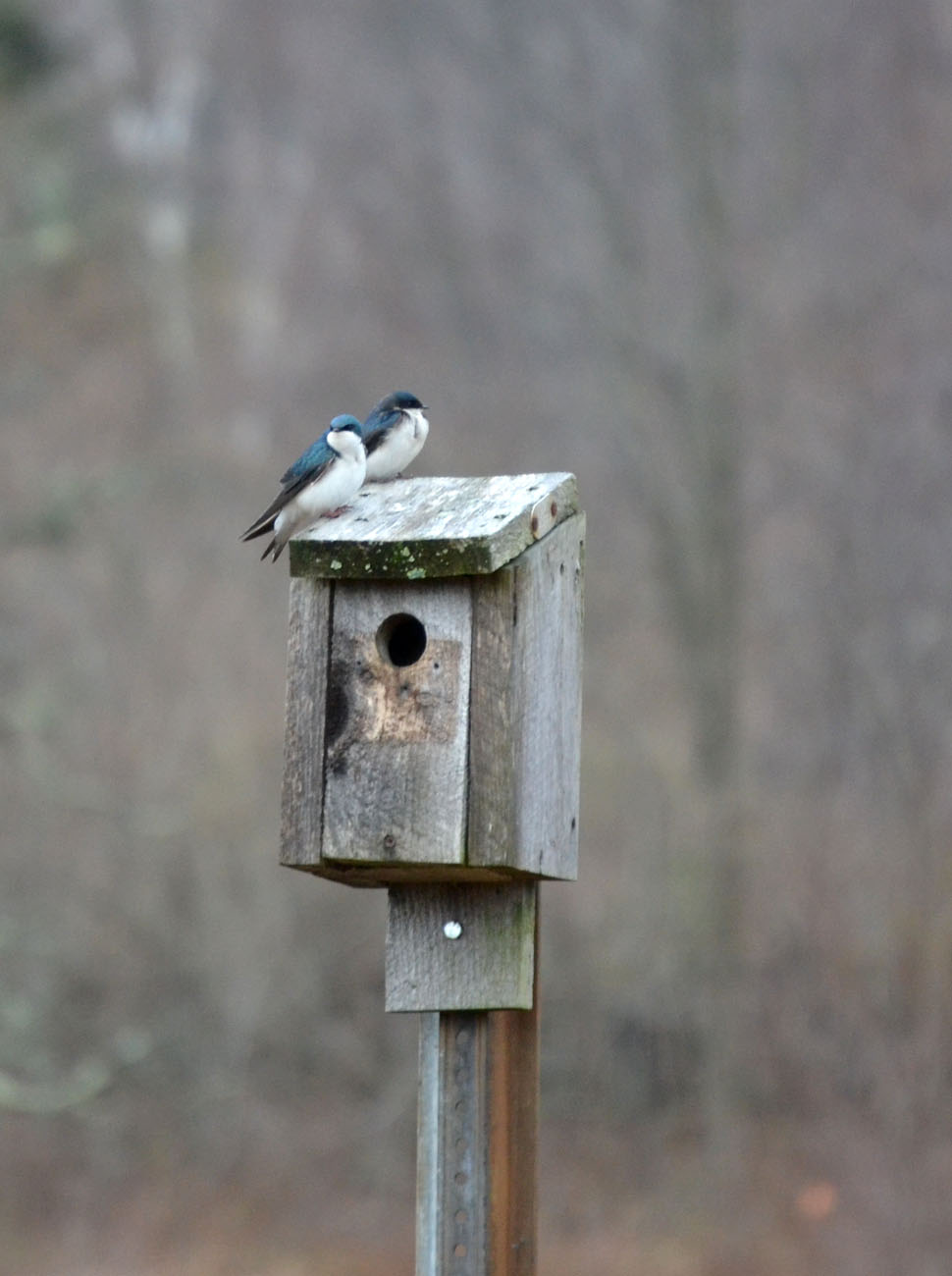
These fields are well-populated with nest boxes, and two pairs of Tree Swallows were checking them out while I was there. Most of the time, these striking birds kept their distance from me, chatting in bubbling tones to each other:
 

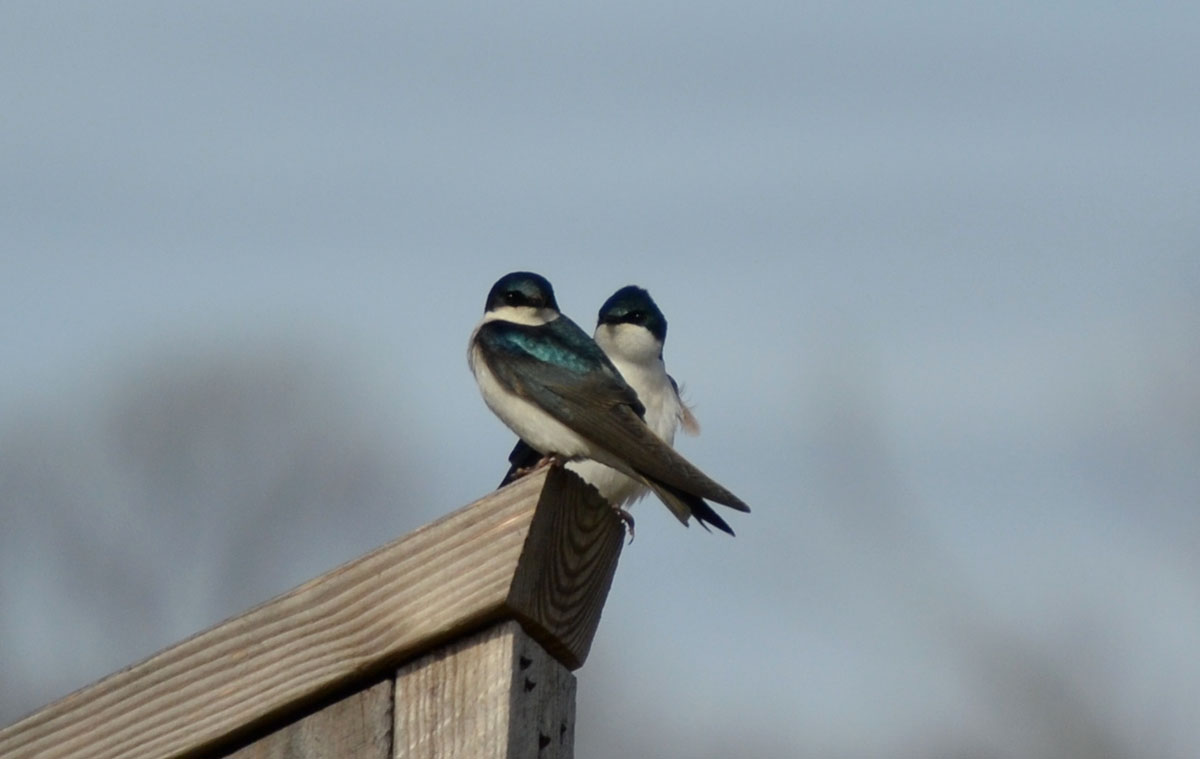
But as I was leaving, one of the pairs swooped up to a box right near me, and I got what I'm pretty sure was my first really good look at these birds, ever. In my opinion, that's just about the most beautiful color of blue/teal there is, and what a wonderful contrast it makes with those luminous white undersides! And I'm really liking those black masks, too:
 

There was a pair of Eastern Bluebirds exploring the boxes as well -- I wonder what the nesting population will look like this year.

A big flock of American Robins was foraging on the ground, and one of the robins looked a little different from the others:


Those white feathers in its wings mark this robin (I'm pretty sure) as partially leucistic. Basically, for whatever reason (probably genetic), this particular bird is missing pigmentation in those feathers. It's not albinism (which Wikipedia tells me specifically has to do with melanin, whereas leucism deals with skin pigments in general), and it's not the whole bird, just a small part. I actually think it's a pretty cool-looking effect on this bird.

Speaking of birds with white spots (although normal this time), this White-throated Sparrow stared me down for a bit:
 

These birds will be heading north to breed in the next month or so, along with the juncos. So I'll enjoy their painted faces while I still can!

I tried to look for wildflowers while I was walking in the meadows and the surrounding woods, but I didn't find much. The only blossoms I saw, in fact, were on this tiny (and cute) sedge (species unknown):
 

I'm sure I'll be back in these meadows again soon -- I'm especially looking forward to visiting in a month or so, when the warblers really start to stream in. In the mean time, I'll continue to explore my other woodsy places whenever I have time. I also have something of a beach adventure coming up later this week.... More details to come!

Wednesday, March 28, 2012

A Pileated Pair, and Growing Things

It’s gotten cold again, but it was sunny and clear yesterday (if a bit chilly), so I decided to visit Naugatuck State Forest to see what’s changed since I was last there a week ago. While there, I saw my first really colorful warbler of the year (a Pine Warbler), tons of tiny plants springing up (but no flowers yet), and a few other cool things as well.

The best part was when a pair of Pileated Woodpeckers (one male and one female, although it’s a little hard to tell who’s who in the picture below) flew right past me and set to work hammering on a nearby tree:


It seems that I’m doomed to always take far-away blurry pictures of these glorious birds, but this one is (I think) at least a tiny bit clearer than photos I’ve posted before. And just look at those crests! I wonder if these two will be setting up a nest cavity somewhere in the area soon....

Here are some more assorted sights from my walk, in no particular order:

A tiny grasshopper (or related creature), probably about half an inch long, was hopping around on a sunny bank:


In profile, the grasshopper actually strikes me as a little on the creepy side (it's something about that mouth...):


A mass of tiny caterpillars (tent caterpillars, I’m guessing, from those webs) was clustered on a twig -- the group as a whole couldn’t have taken up more space than a penny:


And a little Green Frog was resting in a pool:


Plants are popping up everywhere now, including invasive Japanese Knotweed, which has taken over an area next to the entrance:


But there were also more pleasant plants emerging, like these wonderfully fuzzy fiddleheads of a fern species I don’t know:


Big leafed-out Skunk Cabbages:


And patches of mottled Trout Lily leaves scattered over the forest floor:


It was a good walk, overall. :)

Sunday, March 25, 2012

Yellow-rumped Warbler

Yellow-rumped Warblers are one of the few warbler species that hang around in southern Connecticut over the winter, but they also start to become more common when spring migration hits. This afternoon, a female Yellow-rumped Warbler showed up outside our apartment's office window, the first one I've seen this year:
 

I think these little birds are just adorable. I'm assuming this one is a female because the males should by now be getting into their breeding plumage, mostly slate gray and bright yellow and white. On closer inspection, this girl actually looks like she has something wrong with her beak.... I know abnormalities like this can happen sometimes, but I don't know what might've caused it in this case. She seemed to be foraging for food and getting along just fine despite her crooked beak, so I'm not too worried. If nothing else, it makes her unique:
 

She fluttered around our Red Cedar's branches, hunting for insects and plucking off some of the last berry-like cones from last fall, occasionally showing off the yellow spot on top of her head:
 

And yep, there's the characteristic yellow right above her tail, too:
 

Now that I know what she looks like, I'm going to keep an eye out for this girl in case she visits us again someday. Thank, you, little yellow-butt, for stopping by and brightening up an otherwise drizzly-dreary day!