I saw lots of bright colors when I was out walking on the Manila dunes on Monday. Little Acmon Blue butterflies (Plebejus acmon) were flashing their blue and orange wings:
Goodness, but those orange bands are pretty:
This Acmon Blue was enjoying some Coast Buckwheat (Eriogonum latifolium) flowers:
Coast Buckwheat seems to be quite popular with the insects around here -- including this unidentified bee -- and the little flowers are really lovely up close:
Speaking of bright colors, I have to share the abundant and phenomenal California Poppy:
And it's hard to find a brighter blue than in this sunny ocean scene:
There are so many bright and beautiful things in the sand! I love discovering these little treats at our new home.
Wednesday, June 24, 2015
Sunday, June 21, 2015
Welcome to California's North Coast
And here we go! I'm excited to say that for the next year or so, I'll be living and working in Humboldt County, California, all the way up in the northwestern part of the state. Think Pacific Ocean, giant redwoods, moderate temperatures year round.... This is a huge change from anywhere I've lived before, and it's kind of amazing.
In the week and a half since we arrived at our new home, Paul and I (along with my parents, who generously helped us move) have briefly visited a broad range of nearby natural places; our goal has been to get a basic idea of what's around here so we can explore them in more detail in the months to come. Basically, this is the tourist phase. So here's a sampling from our preliminary adventures in this new and exciting place. Consider this a teaser of things to come!
We're living on a peninsula between the Pacific Ocean and Arcata Bay, which means that just a few minutes drive from our house (or a 20-minute walk), we have vast expanses of beach:
We spent some time walking among the dunes and beaches at the Humboldt Coastal Nature Center and the nearby Ma-le'l Dunes, and I was pretty impressed with this alien landscape:
There are so many specialized plants on the dunes, with lovely flowers and interesting growth patterns, and all of them are entirely foreign to me. I'm looking forward to getting more familiar with the plants in my new almost-backyard. Here's some Yellow Sand-verbena (Abronia latifolia) and Purple Owl's Clover (Castilleja exserta) to get things started:
I was happy to meet lots of White-crowned Sparrows who were raising families in the dunes' shrubby growth, since I'm at least passingly familiar with these birds from back east. This adult was chirping through a beakful of caterpillar:
A juvenile White-crowned Sparrow made an appearance as well:
I've never before lived in a place where Common Ravens are actually common, so it's pretty cool that I've already seen these birds several times around here. This raven sat on a tower near the nature center and made a weird gurgling sound that we thought at first might come from some sort of amphibian:
Another raven showed up on the same tower an hour or so later; with those bits of pink skin at the corners of its beak, I'm guessing this is a juvenile:
At the shore, there were even more things to see. Look, waves!
A big flock of Marbled Godwits was working over the wet sand:
I guess there are some tasty critters in there:
This godwit walked along the beach then did a double-take and rushed back to a spot it had just passed:
It pushed its beak deep into the sand and pulled up... I'm not sure what kind of creature:
It was a big prize, whatever it was, and the godwit had a bit of a hard time swallowing it:
But it got it down eventually. I have to say, I'm impressed by these birds' skills at hunting out such buried creatures:
One of the most amazing sights on the beach the day we visited was the hundreds of washed up By-the-wind Sailors (Velella velella), beautiful blue jellyfish-like creatures (actually colonies of hydrozoans) that float across the open ocean with the help of their stiff "sails":
I think I knew such creatures existed, but I'd certainly never seen one before, and apparently they only wash up on shore under certain unusual conditions. What an amazing encounter!
So we've got easiest access to sandy beaches and dunes, which I'm sure will provide us with tons of entertainment. Driving north up the coast, the shoreline becomes more rocky and intense. We explored a bit of Patrick's Point State Park, which features some dramatic cliffs along the ocean:
Big rocks just offshore are obviously popular resting spots for birds (like the assorted cormorants on the left):
There are a lot of ocean birds here that I'll need to learn. Small groups of Common Murres (this group accompanied by a cormorant) flew over the water and fished in the waves:
A family of hyperactive Chestnut-backed Chickadees was busily eating seeds from the conifers in the park:
It's so cool to see chickadees in these new costumes; I think the chestnut vest is very handsome indeed:
And it's nice to see a Turkey Vulture's familiar face (these big birds are all over the place out here):
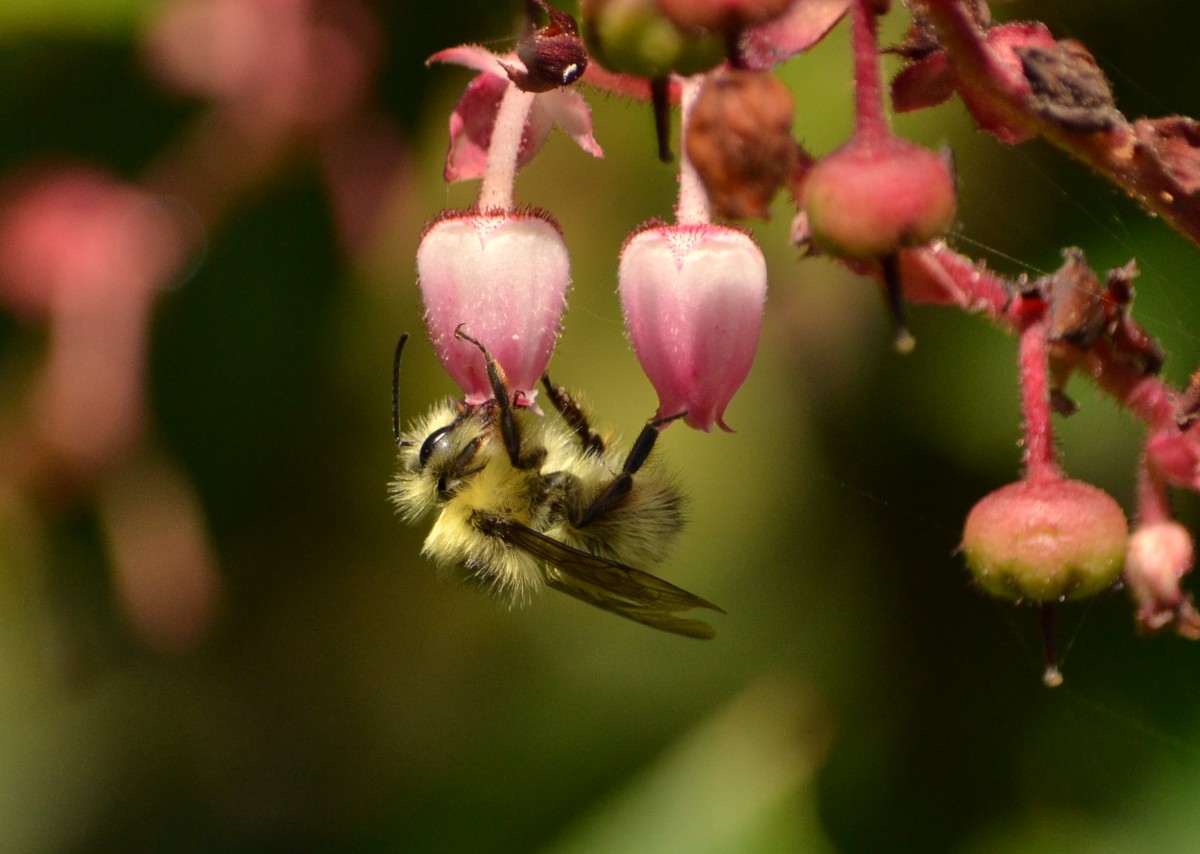
This super fuzzy bee was feeding from almost-as-fuzzy Salal (Gaultheria shallon) blossoms:
And on a stone/sand beach neighboring Patrick's Point, we found a small grasshopper (possibly in the genus Microtes) with some of the best camouflage ever. See it?
How about now?
I especially love the grasshopper's patterning from above:
OK, beaches and dunes and rocky shores are all amazing, but here's maybe the coolest part about our new home: A half hour drive gets us to the Redwood National and State Parks, which protect over 40% of all remaining old-growth Coast Redwood (Sequoia sempervirens) forests. Some of these trees are really ancient (upwards of 2000 years old), and these are the tallest trees in the world. I mean, that's pretty awesome. For our first foray among these ancient trees, we walked the Lady Bird Johnson Grove trail, which features old-growth redwood and Douglas Fir trees; these aren't the biggest examples of these trees (because the trail is at a higher elevation than some other parts of the forest), but they're still pretty darn tall:
We spent a lot of time just looking up and marveling at these giants:
I absolutely loved wandering through this forest:
There were lots of interesting flowers growing on the forest floor. Here's a carpet of Two-leaved Solomon's Seal (Maianthemum dilatatum):
And a lovely mixture of Redwood Violet (Viola sempervirens) and Western Rattlesnake Plantain (Goodyera oblongifolia) -- my first northwestern orchid (although it's not blooming yet):
A warbler (Wilson's Warbler, I suspect, although I didn't get a good enough view to confirm that ID) quickly crossed our path with food for its family:
And that's it so far. I've got tons of new animals and plants to learn about (my Western North America bird book should be arriving any day now) and so many new environments to explore in more detail. I can't wait!
In the week and a half since we arrived at our new home, Paul and I (along with my parents, who generously helped us move) have briefly visited a broad range of nearby natural places; our goal has been to get a basic idea of what's around here so we can explore them in more detail in the months to come. Basically, this is the tourist phase. So here's a sampling from our preliminary adventures in this new and exciting place. Consider this a teaser of things to come!
We're living on a peninsula between the Pacific Ocean and Arcata Bay, which means that just a few minutes drive from our house (or a 20-minute walk), we have vast expanses of beach:
We spent some time walking among the dunes and beaches at the Humboldt Coastal Nature Center and the nearby Ma-le'l Dunes, and I was pretty impressed with this alien landscape:
There are so many specialized plants on the dunes, with lovely flowers and interesting growth patterns, and all of them are entirely foreign to me. I'm looking forward to getting more familiar with the plants in my new almost-backyard. Here's some Yellow Sand-verbena (Abronia latifolia) and Purple Owl's Clover (Castilleja exserta) to get things started:
I was happy to meet lots of White-crowned Sparrows who were raising families in the dunes' shrubby growth, since I'm at least passingly familiar with these birds from back east. This adult was chirping through a beakful of caterpillar:
A juvenile White-crowned Sparrow made an appearance as well:
I've never before lived in a place where Common Ravens are actually common, so it's pretty cool that I've already seen these birds several times around here. This raven sat on a tower near the nature center and made a weird gurgling sound that we thought at first might come from some sort of amphibian:
Another raven showed up on the same tower an hour or so later; with those bits of pink skin at the corners of its beak, I'm guessing this is a juvenile:
At the shore, there were even more things to see. Look, waves!
A big flock of Marbled Godwits was working over the wet sand:
I guess there are some tasty critters in there:
This godwit walked along the beach then did a double-take and rushed back to a spot it had just passed:
It pushed its beak deep into the sand and pulled up... I'm not sure what kind of creature:
It was a big prize, whatever it was, and the godwit had a bit of a hard time swallowing it:
But it got it down eventually. I have to say, I'm impressed by these birds' skills at hunting out such buried creatures:
One of the most amazing sights on the beach the day we visited was the hundreds of washed up By-the-wind Sailors (Velella velella), beautiful blue jellyfish-like creatures (actually colonies of hydrozoans) that float across the open ocean with the help of their stiff "sails":
I think I knew such creatures existed, but I'd certainly never seen one before, and apparently they only wash up on shore under certain unusual conditions. What an amazing encounter!
So we've got easiest access to sandy beaches and dunes, which I'm sure will provide us with tons of entertainment. Driving north up the coast, the shoreline becomes more rocky and intense. We explored a bit of Patrick's Point State Park, which features some dramatic cliffs along the ocean:
Big rocks just offshore are obviously popular resting spots for birds (like the assorted cormorants on the left):
There are a lot of ocean birds here that I'll need to learn. Small groups of Common Murres (this group accompanied by a cormorant) flew over the water and fished in the waves:
It's so cool to see chickadees in these new costumes; I think the chestnut vest is very handsome indeed:
And it's nice to see a Turkey Vulture's familiar face (these big birds are all over the place out here):
This super fuzzy bee was feeding from almost-as-fuzzy Salal (Gaultheria shallon) blossoms:
And on a stone/sand beach neighboring Patrick's Point, we found a small grasshopper (possibly in the genus Microtes) with some of the best camouflage ever. See it?
How about now?
I especially love the grasshopper's patterning from above:
OK, beaches and dunes and rocky shores are all amazing, but here's maybe the coolest part about our new home: A half hour drive gets us to the Redwood National and State Parks, which protect over 40% of all remaining old-growth Coast Redwood (Sequoia sempervirens) forests. Some of these trees are really ancient (upwards of 2000 years old), and these are the tallest trees in the world. I mean, that's pretty awesome. For our first foray among these ancient trees, we walked the Lady Bird Johnson Grove trail, which features old-growth redwood and Douglas Fir trees; these aren't the biggest examples of these trees (because the trail is at a higher elevation than some other parts of the forest), but they're still pretty darn tall:
We spent a lot of time just looking up and marveling at these giants:
I absolutely loved wandering through this forest:
There were lots of interesting flowers growing on the forest floor. Here's a carpet of Two-leaved Solomon's Seal (Maianthemum dilatatum):
And a lovely mixture of Redwood Violet (Viola sempervirens) and Western Rattlesnake Plantain (Goodyera oblongifolia) -- my first northwestern orchid (although it's not blooming yet):
A warbler (Wilson's Warbler, I suspect, although I didn't get a good enough view to confirm that ID) quickly crossed our path with food for its family:
And that's it so far. I've got tons of new animals and plants to learn about (my Western North America bird book should be arriving any day now) and so many new environments to explore in more detail. I can't wait!
Saturday, June 13, 2015
Goodbye Ohio, Goodbye Eastern U.S.
Lots of things have happened in the weeks since I last made a post! I finished up my job in Ohio, got an offer for a new job, and then planned and executed a whirlwind move... across the country. I'm currently settling into my strange and exotic new location (more on that later). All throughout these past few hectic weeks, I was wandering around our wonderful Ohio yard and taking pictures of creatures, but I never got a chance to sit down and say a proper goodbye to this amazing place where I've lived for the past 10 months. More than that, I need to say goodbye (at least for now) to the entire northeastern U.S., which has been my home all my life, and to most of the animals and plants (and seasons and environments) that I've become so familiar with over the years.
So here are some of the creatures I met in our Ohio yard in late May and early June. I guess this is a final hurrah for these fields and woods!
Butterflies were becoming more and more common in the past few weeks. Several Red Admirals were chasing each other around, perhaps staking out territories:
In between the chasing, there was a lot of sunning:
Zabulon Skippers were also chasing each other around and posing on leaves:
A pretty Silver-spotted Skipper was feasting on Red Clover nectar:
And a Question Mark Butterfly chose our house as a sunning spot one afternoon:
When it saw me at the window, it closed its wings, hiding all that orange (but showing the two white spots that give this butterfly its name):
A hefty Green Frog sat at the bottom of the creek, watching lots of little fish swim by:
In the woods, a Groundhog helpfully munched on the Garlic Mustard growing on the slope near its burrow:
After a few minutes of munching, it went on to dig up some more food from the forest floor; I guess I've never seen a Groundhog eating in such a squirrel-like way before:
Almost every day, I'd see this tiny Ruby-throated Hummingbird perched at the top of this bare tree. I kept thinking how weird (and awesome) this little creature looked up there, especially next to a more "normal" perched bird like the Brown-headed Cowbird that also often chose this tree as a lookout point:
A couple of Northern Rough-winged Swallows showed up on a power line above our driveway one afternoon; I love those super long feathers under this bird's tail:
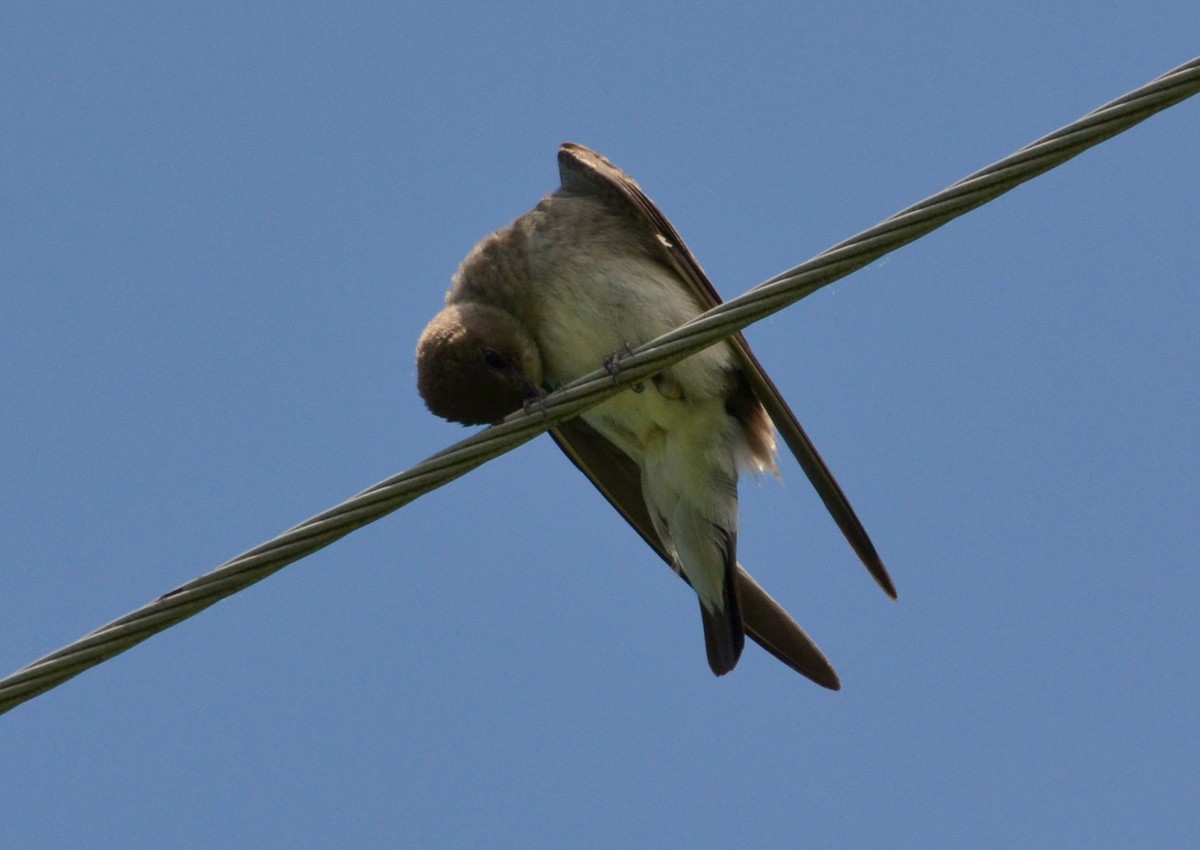
Swallows can make such interesting shapes:
I'm already starting to feel a little homesick for eastern environments (especially deciduous woods). Change is exciting but also disorienting. In any case, I can't believe how lucky we were to get to have this as our home for a little while:
So here are some of the creatures I met in our Ohio yard in late May and early June. I guess this is a final hurrah for these fields and woods!
Butterflies were becoming more and more common in the past few weeks. Several Red Admirals were chasing each other around, perhaps staking out territories:
In between the chasing, there was a lot of sunning:
Zabulon Skippers were also chasing each other around and posing on leaves:
A pretty Silver-spotted Skipper was feasting on Red Clover nectar:
And a Question Mark Butterfly chose our house as a sunning spot one afternoon:
When it saw me at the window, it closed its wings, hiding all that orange (but showing the two white spots that give this butterfly its name):
A hefty Green Frog sat at the bottom of the creek, watching lots of little fish swim by:
In the woods, a Groundhog helpfully munched on the Garlic Mustard growing on the slope near its burrow:
After a few minutes of munching, it went on to dig up some more food from the forest floor; I guess I've never seen a Groundhog eating in such a squirrel-like way before:
Almost every day, I'd see this tiny Ruby-throated Hummingbird perched at the top of this bare tree. I kept thinking how weird (and awesome) this little creature looked up there, especially next to a more "normal" perched bird like the Brown-headed Cowbird that also often chose this tree as a lookout point:
A couple of Northern Rough-winged Swallows showed up on a power line above our driveway one afternoon; I love those super long feathers under this bird's tail:
Swallows can make such interesting shapes:
I'm already starting to feel a little homesick for eastern environments (especially deciduous woods). Change is exciting but also disorienting. In any case, I can't believe how lucky we were to get to have this as our home for a little while:
And now, on to new things. Stay tuned!
Subscribe to:
Posts (Atom)