Today was a beach day, and it was a really lovely one, with perfect weather -- not too hot, not too cool -- and bright sunny skies. I got to spend some time this morning checking out Milford Point, where lots of different types of birds are busy tending nests. A pair of Ospreys have their nest on a platform in the marsh:
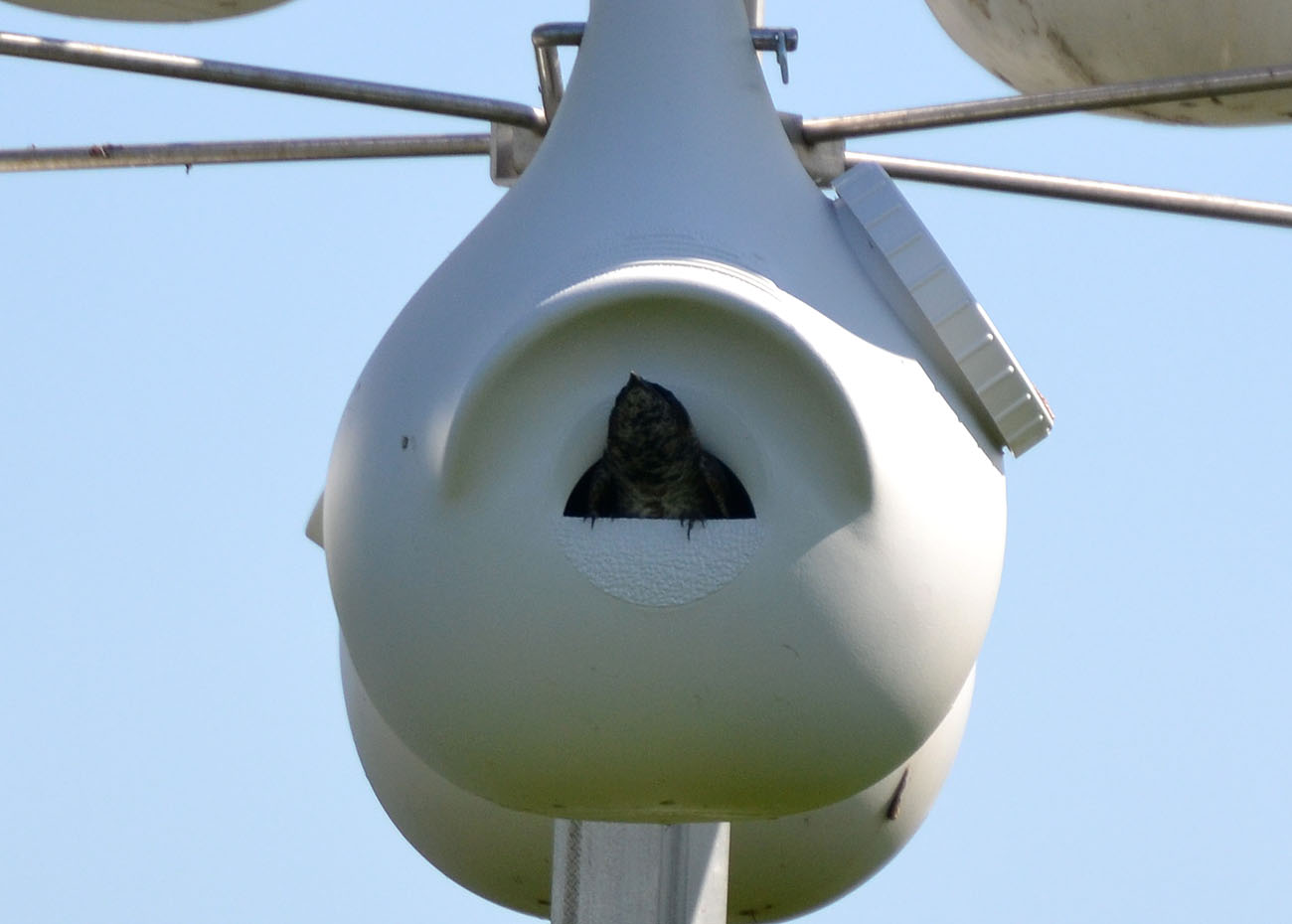
Nearby, there's a colony of Purple Martins, a large species of swallow whose numbers are declining in Connecticut and is listed as a state threatened species. These birds are apparently entirely dependent on human-provided housing in eastern North America, and these guys at a Milford Point have a few housing options. You've got your apartment-style complex (hey, who let that House Sparrow take a room?):
And a bunch of single-family hanging gourds:
These birds were constantly flying around, catching insects and popping in and out of nest box holes. All the activity was a bit overwhelming, but it was a lot of fun to get to see these communal birds just doing their thing:
The males were especially impressive with their deep purple glossy feathers:
But the browner/splotchier females were cool, too. This girl spent some time peering out of her window (watching the neighbors?):
And then she squeeeezed out of that small hole:
And took off:
Most of the martins I saw in this colony were banded, and I'm sure they're closely monitored. Here's hoping these cool birds do well in the years to come. Speaking of birds in trouble, the sandy shoreline at Milford Point happens to be a nesting haven for some more state threatened birds, Least Terns and Piping Plovers (the Piping Plovers are federally threatened as well). This prime nesting area is currently swarming with Least Terns (I counted at least 100), and a few plover pairs have also taken up residence:
This whole area is surrounded by string fencing and signs to keep people away, but that thicker fencing at the left in the above picture is there to protect a single Piping Plover nest. The tiny plovers can wander in and out of the fencing at will, but potential predators can't get through. (Piping Plovers need all the help they can get around here. If I remember correctly, there were only around 50 recorded successful plover nests last year in all of Connecticut.) It's best to stay away from these nesting areas -- to avoid disturbing the birds, or worse, accidentally stepping on a well-camouflaged chick. And that was my plan today... until a large school group strayed too close to the fencing and I felt obligated to put on my volunteer-plover-monitoring hat to go out there and let them know that they should probably move to another part of the beach. I spent as little time as possible near the birds, but I did take a quick picture (from a distance) of one of these very special Piping Plover nests. Can you make out the little plover right in the middle of this fencing?
Their camouflage is really very good, and they're quite small birds. Here's a zoomed-in view -- look for a tiny orange and black beak and a tiny black eye:
It's good to see that these birds are doing the best they can, at least, to increase their population. Good luck, little plover!
Finally, here are a few other assorted sights from today's beach visit. It still surprises me that we have cacti in Connecticut, but yes, here's a wild Prickly Pear, and in bloom no less:
I actually started this morning's trip in nearby Silver Sands State Park, where there were unfortunately no signs of nesting shorebirds, but where I did get to see a bit of drama in the form of a pair of Red-winged Blackbirds who would not stop dive-bombing this Great Egret:
The egret must have been too close to the blackbirds' nest, but surely the blackbirds were also too close to the egret!
So many interesting things to see on this lovely day!
Silver Sands State Park yesterday morning was the busiest I've seen it so far this year. Not people-busy, but extremely active with creatures all over the place, flying or romping or being in love. The sort of weird breeding-time behavior I saw in the woods earlier this week is showing up at the beach, too.
The highlight of the trip was a pair of American Oystercatchers who just could not contain their feelings for each other. These two birds would stand near each other on the beach, prodding the sand with those crazy flaming-poker beaks, and acting pretty normal:
And then all of a sudden, both birds would burst into the air and fly together all up and down the shoreline in close synchronization, calling loudly the entire time:
These birds did this several times while I was there, and it was so extravagant and very entertaining to watch. Plus, it just looked like they were having a ton of fun:
OK, you two, there are some nice stretches of sand here just waiting for a nest. Maybe there will be some oystercatcher eggs someday soon?
A couple of Herring Gulls were acting a little love-struck, too, tossing their heads and touching beaks -- much more subdued behavior than the oystercatchers' antics:
The terns are back in Connecticut now, and I saw two Common Terns resting on some rocks at low tide (just look at those long, long wings):
I had a great time watching several Least Terns zooming around, too. These birds make such amazingly elegant shapes in the air with their perfectly pointed wings and tail:
A Merlin was also haunting the area (not a common bird at this time of year), until it got chased off by some very annoyed Barn Swallows:
Later, the Merlin flew over my head, and I got to admire its speedy falcon shape and the very pretty pattern under its wings:
Snowy Egrets are a constant fixture in this park in the spring and summer, and it's always worth stopping to watch these awesome birds for a bit. This one was snatching little fish from the ocean shallows, looking very dramatic against those dark rocks:
Here's something I'd never seen on these beaches before -- a washed-up jellyfish:
I think this is a Lion's Mane Jellyfish (Cyanea capillata); I'm basing that guess on similar pictures that came up when I searched for "jellyfish in Connecticut." This creature was several inches across, which seemed pretty big to me, but apparently this species can grow to several feet across, and Wikipedia says that makes it the largest known species of jellyfish. So that's pretty crazy and cool!
Finally, White-tailed Deer thrive in this park, and I'm almost guaranteed to see some on any given visit. This time, a herd of several individuals (including a couple males with just-emerging antlers) was grazing in a field above the road, making for a peaceful picture:
May is such an active month, with so many changes in plant and animal life. I'm already itching to get back out into the woods again! But the beach is always a great place to visit, too.
This morning I made my last scheduled visit to Silver Sands State Park for the year in my official capacity as a volunteer shorebird monitor for the U.S. Fish and Wildlife Service. I'm sure I'll be back to the park again at some point (and without my semi-dorky official hat), but the end of these weekly visits makes me feel like summer may actually be coming to a close.
The birds certainly know that summer is ending, and I saw just gobs of shorebirds on their southward fall migration. Whole stretches of the shoreline were packed with Semipalmated Sandpipers (the mottled gray and white birds) and Semipalmated Plovers (the brown and white birds with fancy black bibs), blending expertly in with the rocks:
I counted over 300 sandpipers and 100 plovers in just one area -- hardly the largest gathering of shorebirds ever, but more than I've ever seen at this beach before.
Many of the sandpipers were sleeping, just completely zonked out. We'd had a heavy thunder storm earlier in the day, so I wonder that contributed to the birds' tiredness:
(I know these birds look dead, but I promise, they're just sleeping. Or at least, I think I saw most of them open their eyes while I was there....)
Hanging out with the group of semipalmated creatures (the internet tells me that this adjective refers to the webbing between these birds' toes... who knew!), there was also a sleek Least Tern -- I love the markings on this bird's beak:
And this totally weird-looking shorebird, a Ruddy Turnstone:
That's a nice angry mask you have, bird!
Away from the shore, an immature Cooper's Hawk surveyed the area from its perch on a small tree:
And when it took off, it flew past me, right at eye level -- what an awesome bird:
It was great to see so many creatures, and I definitely enjoyed the cooler breezes on the beach. It's hard for me to believe, but summer really does seem to be winding down!
Silver Sands State Park was extra busy today, with people all over the beach enjoying the holiday. There were plenty of animals out and about, too, and I got totally distracted for a while, watching a dainty little Least Tern fishing in the shallow water right against the beach:
This is the first time I've seen Least Terns in Connecticut and known what to call them -- I learned to identify Least Terns only this past May, during our trip to Florida. (Incidentally, the Least Tern is listed as a threatened species in Connecticut.) This particular Least Tern was completely engaged in its fishing activities, and so I was able to get quite close to it to watch the proceedings. It would hover in the air for a few seconds, scoping out the water below. And then, when it had a target in sight...
Bombs away!
(Note the holiday-goers in the background -- they didn't mind the tern, and the tern didn't mind them! Also note the sudden decrease in picture quality when the bird's doing something as interesting as diving.... My action-shot skills still have a lot of room for improvement!)
Sometimes the tern would resurface from the waves with a small fish in its beak:
And within a few seconds, the fish would be good and swallowed (yum), and then a quick shake-off and it's back to hovering again, preparing for the next dive. I could have watched (and tried to photograph) this active little bird for much longer, but I had left Paul dozing in the sun on the beach, and it was time to wake him up and go get lunch. Aren't holidays fun?
We saw several other awesome creatures in the last couple days of our trip to Florida, including my personal highlight of the trip, manatees. (OMG, manatees!) I'll get to those by the end of this post... but first: some birds!
Ospreys are hardly rare up here in Connecticut, but they were all over the place in Florida. This fellow struck a nice pose for us above a boardwalk on the coast, and I couldn't resist taking a picture of such a magnificent bird:
I also had a lot of fun watching the numerous terns at the shore as they performed their aerial acrobatics and dove into the ocean to snatch fish. There were Least Terns, dinky little birds with quick wings:
And also much bigger Royal Terns:
It was amazing what these agile birds could do in midair -- in addition to the twists and dives, I saw a few terns shake themselves free of water (think of a wet dog with wings), and one even scratched its head with its foot, all while on the wing! It was hard enough just getting pictures of these birds at all, though, let alone while they were doing some of those crazier things, so you'll just have to imagine those sights. :P
Here's one of my favorite birds of the trip:
It's a Wood Stork! These are some big birds, standing a good 3+ feet tall, with a nice big wingspan to match. Wood Storks are federally endangered, and I don't think I'll be south enough to see them again any time soon, so I'm glad we met them here. I know, it's one of those "a face only a mother could love" things. Well, I think they're beautiful:
We saw plenty of other birds as well, including about a dozen species I'd never seen before. Not many of them were keen to have their pictures taken, however, so my avian account will end here. Which leaves just one more creature.... Manatee!
One of the last places we stopped was a small harbor on Merritt Island, where Paul's parents had seen manatees on a previous trip. I admit that I was trying not to get my hopes up, because the internet was telling me that summer is not the best time to see wild manatees in Florida. It's a good thing I didn't listen to the internet! As soon as we got out of the car, we spotted bristly snouts bobbing up in the water:
There are manatees here! Much excited babbling then ensued (from us, not the manatees). West Indian Manatees are endangered, of course, and the only other time I'd seen them in the wild was years ago, and from a very great distance. What an awesome opportunity!
One manatee was even hanging out right near the edge of the dock, and we were treated to some close views of its head as it came up for air:
And its huge paddle-like tail as it lounged in the sun:
(Sadly, I guess it really is true that manatees run into a lot of trouble with boats in the wild -- almost every individual we saw here had some pretty nasty looking scars from past encounters, presumably human.)
So that was cool, but it wasn't even the best part.
A few minutes after we got to the harbor, two wildlife biologists arrived on a manatee rescue mission -- they'd gotten a report of a manatee tangled in some rope, and they needed to look at all the manatees in the harbor to see if one of them was that manatee. So they turned on a couple of hoses and let the fresh water stream into the harbor, and the manatees just came right over to drink the stuff. They loved it! And I loved it too, because we got to see active, excited, happy manatee faces right below our feet, and it was wonderful.
**Note: The biologists wanted me to make it clear that turning on hoses to attract manatees is completely illegal, unless you're a biologist and specifically allowed to do so. The manatees just love it too much and they're too vulnerable. So don't try this at home without authorization.**
OMG manatee faces!
This turned out to be a great opportunity for me to learn (or re-learn) some cool manatee facts. Their eyes are really tiny! Apparently they don't see very well at all, but those bristles on their faces give them a great sense of touch instead (all the better for finding vegetation in murky water, I imagine). Their nostrils have those really cool flaps that close to keep the water out, which seems super handy. And they have no front teeth! They have molars in the backs of their mouths to grind up food, but the actual grabbing and tearing is done with their incredibly mobile lips.
Have you ever wanted to see inside a manatee's mouth? Here you go!
One of the hoses eventually became the site of an adorable three-way snorgle-fest:
In retrospect, I should've been filming this whole thing, but here's a very brief video to try to convey the wonderfulness (and massiveness) of these creatures:
When can I cuddle a manatee?
So anyway, I'd say it was a pretty great trip!! It's back to normal reports of Connecticut wildlife for a while now, at least until the next trip I have planned for July.... Thanks for adventuring in Florida with me!