What a hectic and fully-packed couple of months this has been! When I last posted, on March 23, winter was just barely starting to hint at spring. April turned out to be a wild month, with winter clinging on as long as it could, despite the lengthening days. On April 8, a series of quickly passing storms let me take a picture of basically all of April's weather in one frame -- thickly falling snow on the left, and blue sky on the right:
When spring finally took hold (toward the end of April, and later than last year's spring arrival in this area), the change was solid; we haven't had a snowfall or even a frost (as far as I know) since late April (this area's average last frost is May 15).
I mentioned in my last post that storm-born damage to our house at the beginning of March landed us in a hotel. Well, we were eventually able to move back into our house, but not until April 27. (That's almost two months, you'll notice! The insurance company took their time with our claim.) We visited and worked at the house as much as we could during that time, but it wasn't the same, and I'm sure I missed a lot of things (the first rainy-warm amphibian night of the year, for instance). In between attention to work and house repairs, I also made a big push to get our first vegetable garden going at the house (my first real garden in four years). And then for a big 10-day chunk in May, we took an international trip (where I saw many amazing things, and I hope to post about that adventure here later). Whew! And through all of that, the seasons have changed, new animals and plants have shown up in the yard, and I've done my best to keep up with all of this in what is our first spring on this property.
So here's a summary of the natural goings-on (at least what I saw of them) at our house in the past couple of months!
Mammals
Red Squirrels, Eastern Chipmunks, and White-tailed Deer have continued to be the most commonly seen mammals on our property. An Eastern Cottontail rabbit seems to be living on the edge of our meadow, and Gray Squirrels have shown up a few times as well. On April 6, a beautiful Red Fox wandered through our meadow around dusk and did a bit of hunting (there are plenty of voles and mice here, too). This was the first time we'd seen a fox on the property, although I'd suspected they were around. The fox paused for a moment on top of some rocks we'd left in the meadow, then it moved along:
Toward the end of April, we saw a Groundhog carrying mouthfuls of leaves and grass into a burrow at the edge of our yard. If there are Groundhog babies down there, we haven't seen them yet. On May 16, I watched an adult Groundhog foraging near the bird feeders; here's a picture of the Groundhog on alert, with a dandelion bud hanging from its mouth, listening to Paul doing yard work and getting ready to dive into a nearby burrow in the raspberry patch:
Birds
April and May brought so much change in the bird population around here, and it was especially exciting to welcome back some individual birds who were summer residents last year. A Chipping Sparrow with a uniquely white forehead was a frequent fixture in our yard last summer, and when the Chipping Sparrows started showing up again in April, there he was! Here's a picture of this striking fellow on May 11:
And here he is on April 28, posing in spruce tree with another (more typically outfitted) Chipping Sparrow:
I
was already fairly certain that our white-browed Chipping Sparrow was
a male, because I've seen him singing boisterously from the tops of trees. As it turns out, Chipping Sparrows are not secretive about copulating, and as of this spring I can confirm that yes, he's a male. I love having an easily recognizable individual bird as our neighbor (as I'm writing this, I can see him right now outside my window; that flash of white really is eye-catching).
I took this picture of another Chipping Sparrow under the feeders on May 2nd -- the white-browed sparrow's mate, perhaps?
And just a few days ago, I found out where Mr. white-browed Chipping Sparrow and his mate have their nest. I was working around the garbage cans at the side of our house, and I noticed that a normal-looking Chipping Sparrow (the female, I know now) was chirping and preening on a low branch in a nearby tree. I thought at first that she was being unusually sociable (how nice of this bird to hang out here with me), but after a few minutes it occurred to me that there was probably another reason why this bird wasn't flying away. So I peered into the small shrub near me, and yep, there's a nest in there! Here's the shrub -- it's so small and isolated, I really wouldn't have thought of this as a likely nesting place:
And here's a picture of the nest and the four beautiful brown-speckled-blue eggs, as of June 2 (this is as clear a picture as I could get without touching the branches):
I pass by this shrub frequently, and now I almost always see the female Chipping Sparrow on the nest; she's a stalwart mother. We were also happy to welcome back our Eastern Phoebe neighbor, presumably the same one who nested above our front door last year, because she's built another nest in the same spot. Even before she started building, though, she hung around the prospective spot for a week or so. On April 11, after it got dark outside, we opened the front door to leave the house (to go back to the hotel) and we must've startled the phoebe from her roost because she flew right inside the house! She flew gracefully around our dining room a few times (not hitting anything or even pooping anywhere), and then she flew right back out the front door. (We had to turn off the room lights and turn on the porch light to show her where to go, but she went out on her own.) What an amazing encounter. And more generally, I love seeing a phoebe in our front yard nearly every time I look:
She completed the nest by early May -- it's a lovely construction of plant fiber, mud, and moss, with some pink (synthetic?) stuff worked in as well:
When I peeked into the nest on May 10, I found five perfect eggs inside:
And a visit to the nest on June 1 revealed three quill-covered babies (I guess not all of the eggs hatched):
On April 5, we set up two bluebird nest boxes in our meadow, complete with predator baffles on the poles. It was looking at first like we wouldn't get any tenants in these boxes this year, but after a great deal of waffling a pair of Tree Swallows eventually settled in. Here's the female Tree Swallow sitting on top of the chosen box:
I don't think I realized before this year how subtly beautiful female Tree Swallows are. I love the muted blue feathers on her back and wings:
Here's the brighter male Tree Swallow keeping watch from atop the old Purple Martin house that's still standing in our yard; the Tree Swallow pair seemed to be considering nesting in this old box when they first returned this year -- which is why I haven't taken this box down yet -- but a group of European Starlings pulled out the Tree Swallows' nesting material and moved them along (and then the starlings didn't even try to nest in the box themselves):
I love having Tree Swallows around, and I think the male is one of our prettiest birds:
I also love the sounds that Tree Swallows make, which are something like strange burbling whistles. Here's a video of our male Tree Swallow grooming himself and singing outside our bedroom window on the morning of May 6:
The Tree Swallows were about halfway through building their nest on May 8, and when I checked the box on May 17 there were two tiny white eggs nestled among the feather-lined nest. On June 1, I saw the finished clutch, five eggs in total:
And just two days later, on June 3, the nest was filled with tiny day-old (or less?) babies:
I don't know yet whether that fifth egg has hatched. The other couple of times I've checked the nest box, the female has stayed steadfast on the nest, which makes it hard to see what's going on in there, but it's also awesome to see this beautiful lady eye to eye, with just a sheet of plastic between us:
May brought several other fancy new arrivals to our yard as well. Chestnut-sided Warblers have been hanging around quite a bit, and on May 10, I came across a group of at least three of these handsome birds foraging at eye level along the edge of our woods:
This one found a treat:
Chestnut-sided Warblers are my favorite of the warblers, not least because their outfits are so beautiful and interesting from every angle:
How awesome to have these birds here! (And I'm keeping my fingers crossed that some of them are sticking around to breed.)
Other warblers passed through, too, including a few Tennessee Warblers who spent a good deal of time working over our apple trees and singing almost constantly:
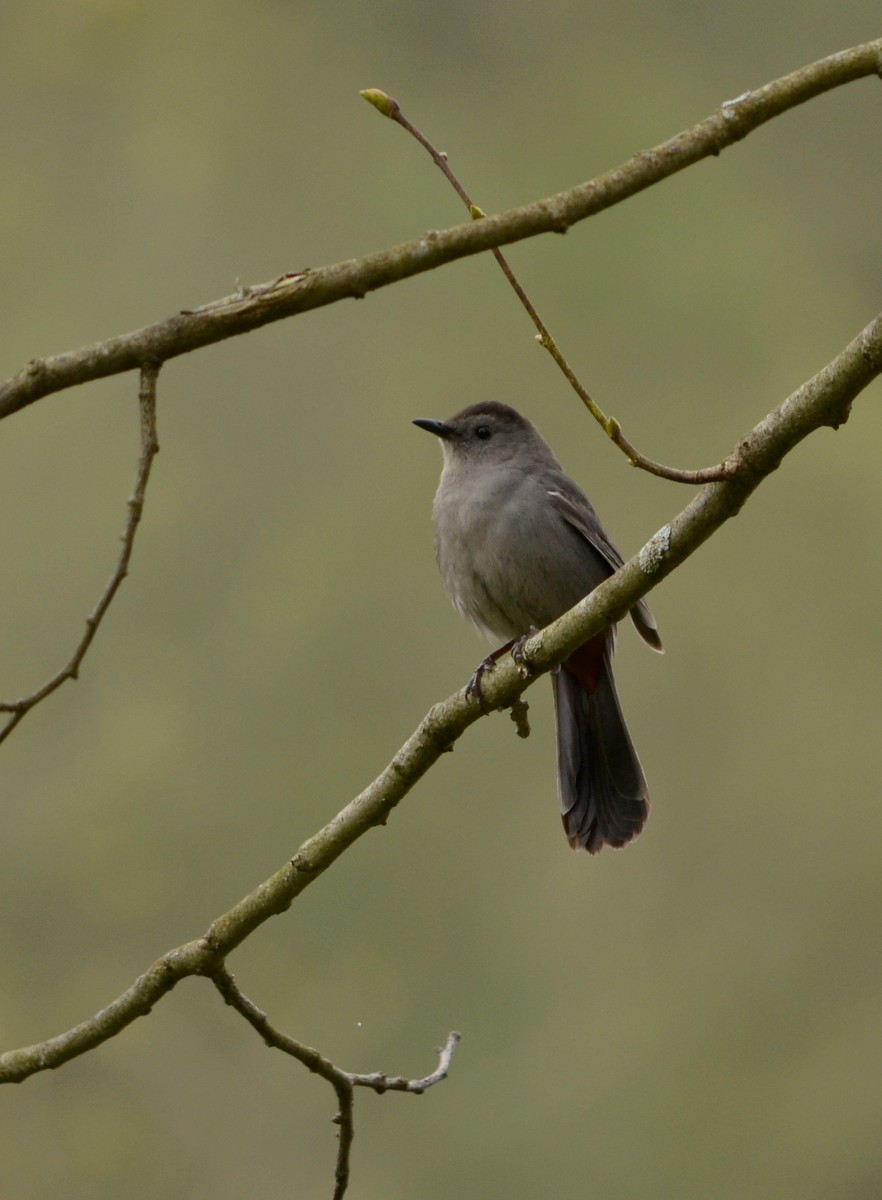
I've been happy to welcome back the Gray Catbirds; I miss their strange cat-like calls and rambling songs when they're not here, and they're such elegant birds:
One of the most surprising arrivals in May was a bunch of Rose-breasted Grosbeaks, surprising because we only saw these birds briefly last summer, and only toward the end of the season. But our feeders were apparently a big hit with these birds this year, and through almost all of May these gregarious birds were a strong presence in the yard. The males are really stunning:
The female Rose-breasted Grosbeaks are very pretty as well:
I never quite got used to looking out at the feeder and seeing black-and-white birds with what looked like a serious wound on their chest (really, what's with that blood-red color?). Overall, the feeders were very popular throughout April and May. Here's one picture of feeder activity on May 10, with a Rose-breasted Grosbeak among American Goldfinches, a Purple Finch in the lower left, and a Pine Siskin on the right:
Indigo Buntings have been another amazing May arrival, and they've been hanging around enough that I've now learned their song. I was surprised to see this male Indigo Bunting hopping around under the feeder one May afternoon, like a bizarrely colored finch or sparrow (I even saw him visit the feeder later, which I've never seen before):
May has also brought back the Ruby-throated Hummingbirds, including this delightful male:
This tiny bird is very flashy, when seen from just the right angle:
Spring is so amazing, and I have much more to share! But this post is getting too long, so consider this the first part of a larger post. Part 2 will be along soon!
March is such a strange month. Or maybe it's just this March that's exceptionally strange! Over the past few weeks, I've seen the signs of spring accumulating -- the change is happening, really! -- but at the same time winter has refused to let go. The mixture of cold weather and persistent snow with shifting wildlife populations and growing greenery is tantalizing and a little frustrating. I'm ready for spring to really get going! But I can wait... it won't be much longer now.
Way back on February 20, I first noticed tiny crocuses pushing up through the barely-thawed ground in our yard -- my first green growing things of the year!
(At least, I think they're crocuses.... They weren't blooming yet when the snow returned, and they've been buried under a snow bank ever since.)
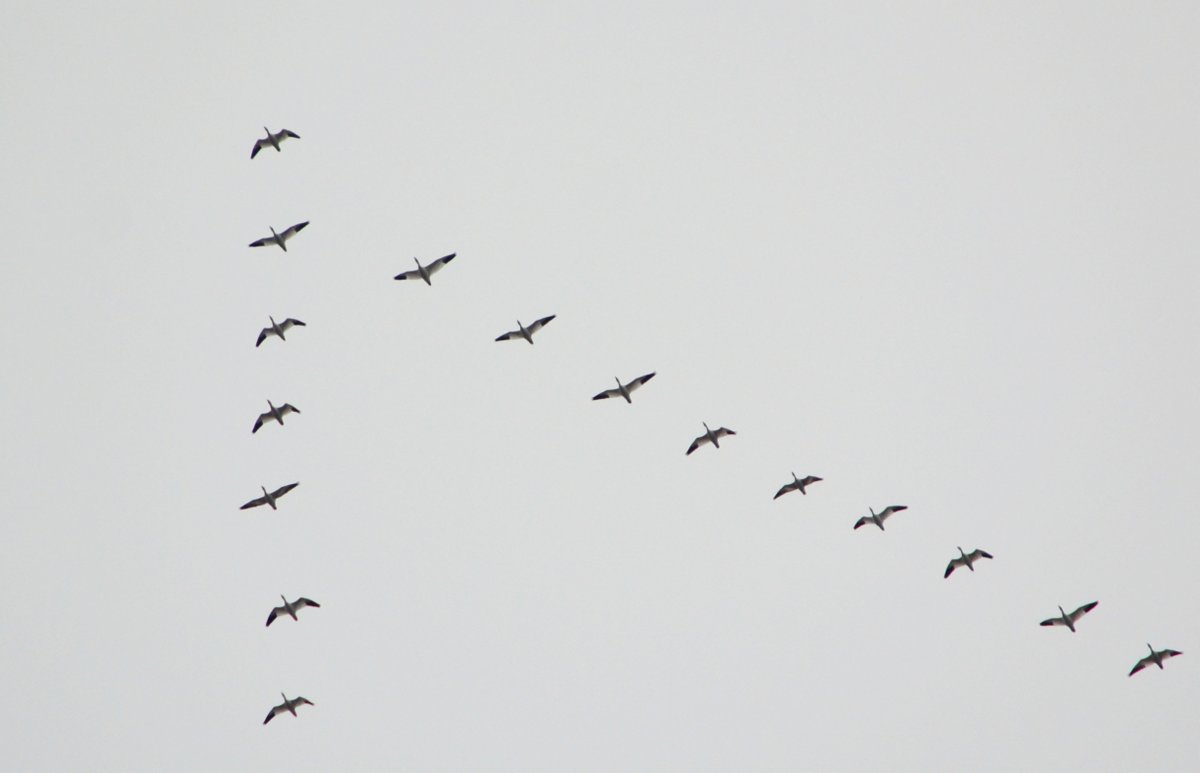
On February 24, I happened to be outside checking the electric meter, when I heard a strange noise overhead. I looked up and saw lines of Snow Geese flying north, right over our house. And not just, like, some Snow Geese. But flocks and flocks of Snow Geese, honestly as far as I could make out both to the north and south, a stream of interlocking lines across the sky. It took several minutes for the entire procession to go by -- calling the whole way -- and as best as I could figure out, there were at least 5,000 birds in the air. It was one of the most fantastic migrations I've yet seen, and all the more wonderful because our home was right in its path. If thousands of birds heading north toward their arctic breeding grounds isn't a sign of spring, I don't know what is! I was able to get at least a few pictures of the event; the Snow Geese were high up, but they were still recognizable with their white bodies and black-tipped wings:
Some of the patterns they made in the air were fairly complex:
Here's the widest view I could get with my camera; it's just a small portion of the whole, but even this is way more birds than I'm used to seeing in the sky at once:
And here's a somewhat shaky video, to give a sense of the geese's wonderful, constantly shifting patterns, and the sound of it all:
Well, that's something I never expected to see from my yard! Wow!
The beginning of March brought a big snow storm and huge wind gusts that ended up causing damage to our house. (Not a fun time!) Since then, we've been staying at a hotel while waiting for the necessary repairs to happen... and who knows what amazing things I'm missing while spending so much time away from the yard. (I'm ready to go back! Can I move back in yet??) On March 14, we were at the house (cleaning up) during a thick snowfall, and a large flock of migrating blackbirds descended on the yard, the first blackbirds we've seen this year. Red-winged Blackbirds on the feeder, with a Northern Cardinal and Blue Jay looking on -- despite all the snow, this is definitely not a normal winter sight:
Most of the dozen or so Red-winged Blackbirds in this flock were sleek black males, but this male (a young bird?) had lovely brown-edged feathers on his back and wings:
And there was at least one female Red-winged Blackbird in the mix (my understanding is that it's more typical for the females to show up after the males). This female didn't look especially happy to be out in the driving snow:
She was a very lovely bird:
The most numerous birds in this big flock of black birds were Common Grackles. Again, this is a pretty strange sight for our feeder:
All those big dark birds made for a different kind of storm along with the snow:
Common Grackles are quite striking birds, maybe even more so with these snow-covered surroundings:
The blackbirds made strange dark ornaments on our hickory tree:
And in flight, they made a stark contrast with the gray/white hills:
Also, now I've had the surreal experience of shoveling snow while listening to Red-winged Blackbirds calling. Winter mixes with spring. But spring will prevail. I'm hoping for many more spring sights, and soon!
OK, time's running out for winter -- I'm starting to see signs of spring! -- so I guess I'd better hurry up and share these various deep-winter sights that have been piling up on my camera for the past couple of months. :)
It's been a very wintry winter, with plenty of persistent snow and cold temperatures. Occasional thaws have meant that we've only had about a foot of snow (at most) on the ground at any one time, but still, the nearly constant blanket of white on trees, hills, and meadow has made for some really beautiful views around our house. Here's the scene looking down our hill and across the valley on January 17 (with bonus blue skies, a rarity):
And here's the view looking up the hill on January 2 (toward the ridge across the street from our house, which I've recently learned is not only protected now, but is slated to become part of a corridor connecting two nearby state forests):
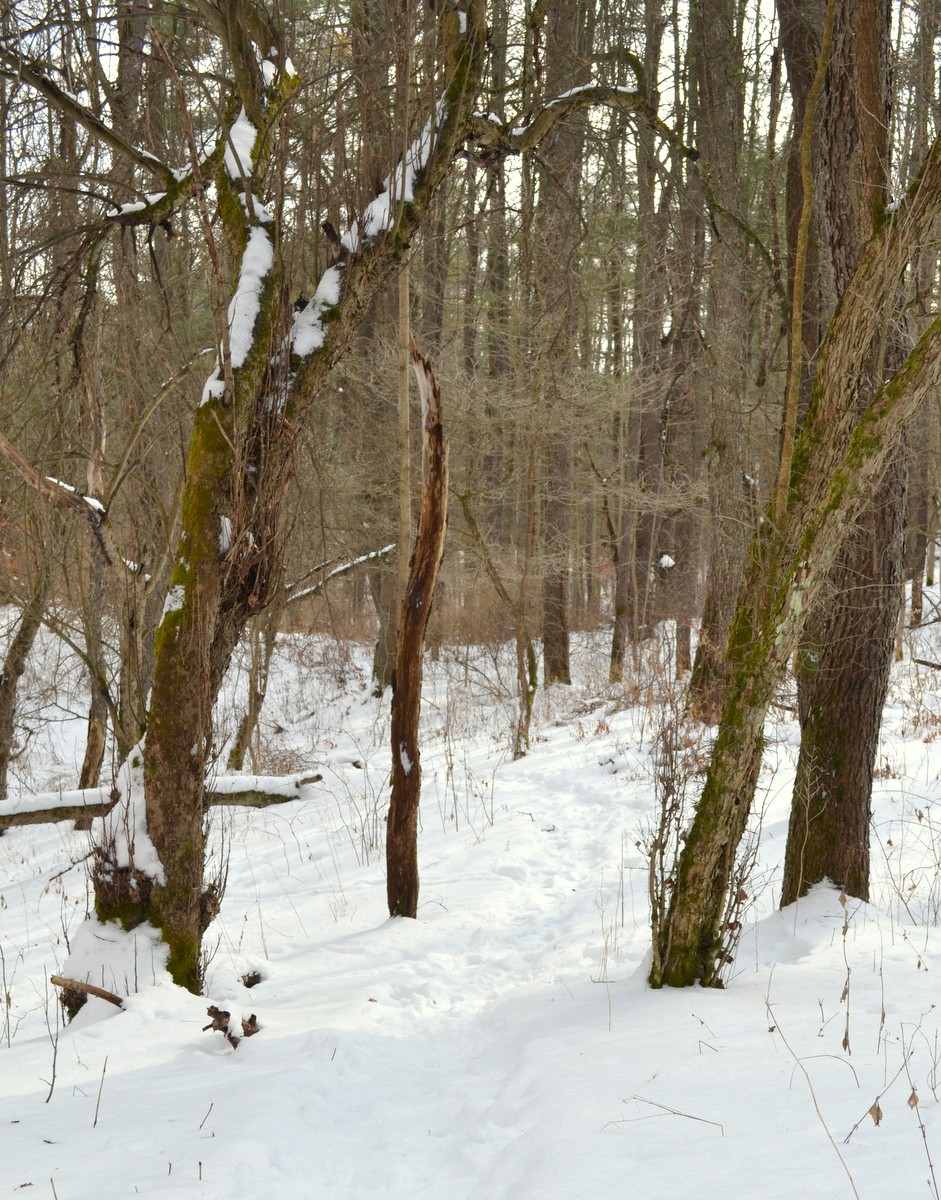
I feel incredibly lucky to be living here and taking care of our modest patch of land within this amazing and expansive landscape. This winter has given us a wonderful variety of views, too. During a walk in our woods on January 17, thick fluffy snow made almost the entire scene white:
The next morning (January 18) added a layer of frost to twigs and branches, which was then illuminated by the early morning light:
I wonder if this Blue Jay was feeling especially cold as it perched on frosted apple branches later that morning:
This hillside across the valley from our house looked very stark with its wintry cross-hatched pattern (the result of trees and their shadows on snow):
Birds foraging on the ground near the feeders left intricate interlocking tracks; I especially like the spiral in the lower left-hand corner of this picture:
And a Virginia Opossum has left its strangely splayed-toed tracks in our snowy yard a few times this winter:
So the snow has been beautiful and awesome, and only a little inconvenient (there has been a lot of shoveling). We've also had plenty of animal activity here over the past couple of months, albeit at winter-appropriate levels (nothing like the hectic activity of other seasons). Eastern Cottontail rabbits and Gray Squirrels have appeared in brief glimpses. Voles and/or mice made extensive networks of tunnels in the snow covering our yard and meadow. White-footed Mice (or Deer Mice -- I'm not quite sure of the species, I just know they're adorable) have shown up in our house a few times, presenting us with the puzzle of figuring out how these little creatures are getting into our living space. We haven't solved the puzzle conclusively yet, but we've at least settled on some temporary measures that will last us until warmer temperatures arrive and the mice (hopefully) go looking elsewhere for food and shelter. I found a dead shrew in the yard in January, with a wound on its back but the exact cause of death unknown. We've heard Coyotes yipping and howling at night -- and at some distance away -- in recent weeks. White-tailed deer continue to be common, and we see them crossing our meadow occasionally (although we more often see the prints and droppings they leave behind).
Red Squirrels have been the strongest and most obvious mammalian presence on the property over the past couple of months. These little creatures are almost always chittering at each other (or me) from various trees around the yard, or else scampering around. The Red Squirrel who cached a bunch of Black Walnuts in the hollow base of one of our apple trees seems to have an especially good setup. Here's the tree in question, a wonderful, twisted old thing (with delicious apples) that grows at the edge of our driveway:
This is such a great tree. And the Red Squirrel has it really good. This past Thursday, I heard the sounds of squirrel teeth scratching away at a nut shell (I've heard this sound quite a lot this winter), and, walking over to the apple tree, I startled the squirrel in the midst of its work:
The little squirrel darted into one of the holes in the tree's hollow trunk, and a second later it reappeared out of another hole higher up, where it proceeded to yell at me around the nut in its mouth:
A multi-story apartment with a central stairwell and a full winter's supply of nuts in the basement? Sounds pretty good to me. (Incidentally, this leaves me with something of a dilemma, because we have been talking about removing the Black Walnut tree that produced these nuts... but now I don't want to mess up this squirrel's wonderful setup. This will require some more thinking.)
The bird activity over the past couple of months has been similarly impressive. Now that we have the feeders up, there are pretty much always birds around, and I've very much enjoyed seeing so many of our winter residents. Black-capped Chickadees, Tufted Titmice, and Blue Jays are the most common visitors in our yard, along with Dark-eyed Juncos:
Among the more occasional visitors are flocks of Mourning Doves, American Goldfinches, Pine Siskins, and a few American Tree Sparrows, Northern Cardinals, White-breasted Nuthatches, and House Finches. A persistent Carolina Wren is often hanging around, and Downy, Hairy, and Red-bellied Woodpeckers show up fairly regularly to work over the trees in our yard. Our house seems to be in the territory of at least one Pileated Woodpecker, who comes over to chisel away at a few assorted trees and stumps on the property:
I am so happy to have Pileated Woodpeckers as neighbords. Here's a video of this guy at work; he's very industrious (and strong!), but I also love that he took brief breaks to groom himself and to peer around behind the tree:
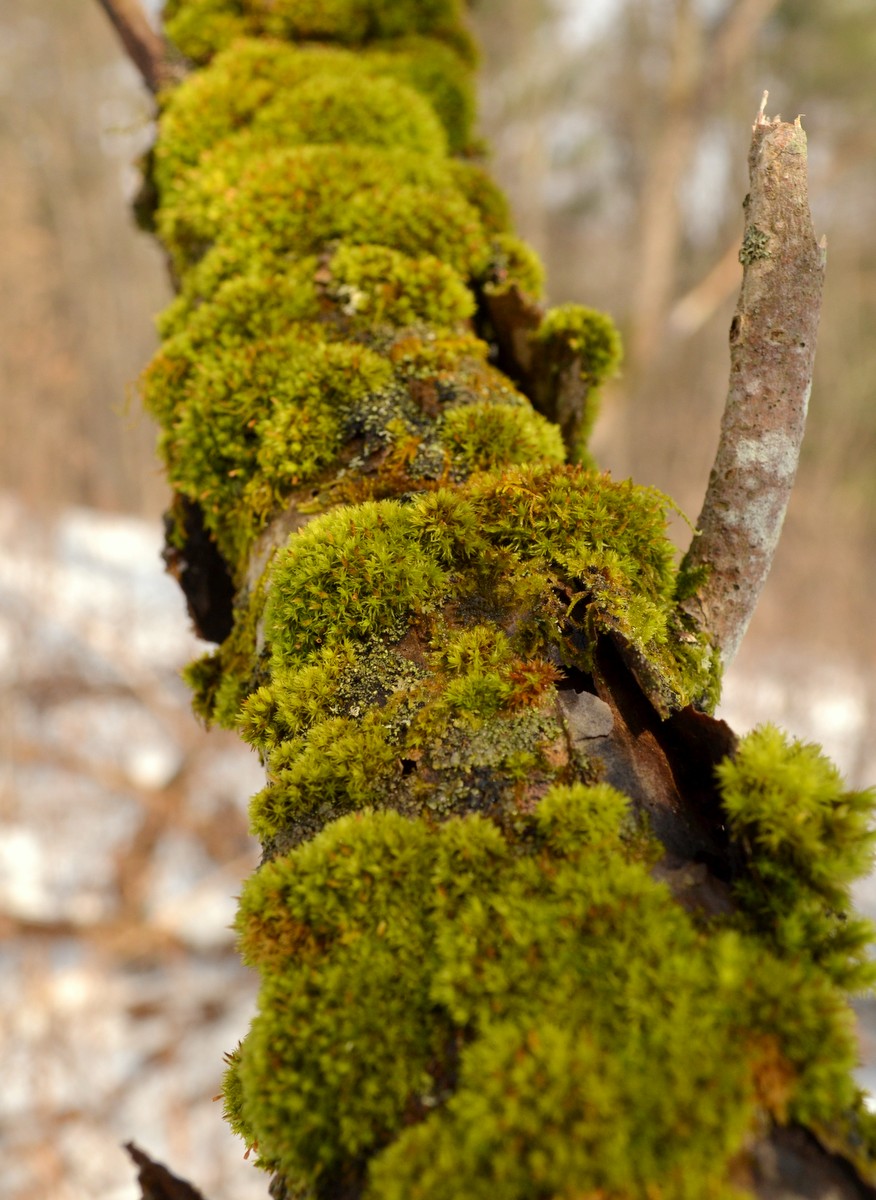
Finally, winter has given me a great opportunity to get to know the dormant guises of some of the plants on our property. On January 20 and 21, I wandered in our woods and yard with my camera to see what interesting plants I could find. An extremely fuzzy, moss-covered branch across the entrance to our forest path was a good start:
The portion of our woods close to the meadow is relatively open and -- I suspect -- fairly young. Most of the tallest trees here are Black Cherry trees, and the trees near the edge of the woods are wrapped almost to capacity with Virginia Creeper vines:
The Black Cherry trees a little further into the woods are pretty much all trunk, with very little in the way of branching until the very top (and some interesting wavering along the way):
Along with young White Ash trees and a few White Pines, the other most common trees in this more open area of the woods are -- strangely enough -- apple and hawthorn trees. These trees have clearly been here for a while (perhaps they were here first?), but they're now totally overshadowed by the cherry, ash, and pine. Even so, the apples and hawthorns did produce fruit last fall, and I'll be very curious to see what these woods look like when blossoms appear in the spring. I love, too, that the path we cut through the woods passes between two of these trees (apple on the left, hawthorn on the right):
These hawthorns are so incredibly spiny:
The deeper portion of our woods seems to be older and more well established, with a thicker canopy and much more diversity in the tree species. It'll take me a while to figure out all the trees we have in these woods, but -- at least as a start -- I've been very happy to discover that we have a few young American Beech trees in residence. These trees are still holding onto their brown and dried leaves from last year, and I think their pointed buds (hiding this year's leaves) are quite charming:
Back in the yard (and out of the woods), I found many more buds to admire. Our remaining Tulip Tree (still standing after what used to be a second nearby Tulip Tree collapsed over the summer) turns out to have strangely paddle-shaped buds:
And I've been especially eager to check on the progress of a few shrubs I planted this past fall, including a blueberry, which was showing lovely maroon-and-gold buds:
American Hazelnut, with tiny globe-shaped buds on hairy stems:
And Spicebush, with its little clusters of buds (which I hope to see swelling and opening in the next month or two):
And while neither a native plant nor my own addition to the landscape, I'm very much drawn to the lilac bushes at the edge of our driveway; these big, plump buds seem to have so much promise for spring, even in the middle of January:
Well, that's winter! And it's been another wonderful first season in this wonderful place. I'm sure there will be more snowy weather and cold temperatures to come, but the seasons are starting to turn.... When you hear from me next, I'll be sharing some early signs of spring. :)
On November 20, I put up my first bird-feeding station in the yard. We already had a couple of our trusty window feeders up, but now we've got a nice big platform feeder and a hopper feeder, all stocked with sunflower seeds. There's plenty of room now for the neighborhood birds to come and get food!
The chickadees and titmice (what great explorers!) found the new feeders less than half an hour after I put them up. And since then, the feeders have become very popular with our local birds. Blue Jays visit in small noisy groups, and I very much enjoy seeing these beautiful birds (especially since they were basically absent from our yard over the summer):
I love all these fancy feathers:
And I didn't know Blue Jays had so many black feathers hidden behind their blue crests:
What a lovely bird:
House Finches, Dark-eyed Juncos, Black-Capped Chickadees, and Tufted Titmice have been the most common and consistent visitors to the feeders so far (along with the Blue Jays), but I've also seen several other birds taking advantage of this new food source: White-breasted Nuthatches, Downy, Hairy, and Red-bellied Woodpeckers, American Goldfinches, and more recently American Tree Sparrows and a single Morning Dove (the dove was picking up dropped seeds on the ground).
All this localized activity also makes for a great opportunity to see these birds up close as they wait in nearby bushes and trees for their turn at the feeder. Here's an obliging Black-capped Chickadee:
And an adorable Tufted Titmouse:
I love these charismatic little birds:
Titmouse, could your head be any pointier?
This Downy Woodpecker might not have actually been heading for the feeder, but I still liked seeing him among the bare branches and old husks on the nearby Shagbark Hickory:
With more frequent and heavier snowfalls in recent weeks, the activity at the feeder has become even more intense. Juncos, especially, are all over the place now. A flock of a dozen or so American Goldfinches came through the yard this past Tuesday (January 2) and provided some competition for the juncos (what a fancy tail the junco in this next picture has):
It turns out that juncos can be rather bossy, though; here's a video of one of our juncos maintaining dominance on the platform feeder against goldfinch intruders:
And the birds were still as active as ever during yesterday's snow storm, despite heavy snow and gusting winds:
Here's one last video from the midst of yesterday's storm, with juncos getting blown all over in the battering wind:
I think our bird feeder setup is off to a great start! A couple of days ago, I added a few handfuls of peanuts, and they're already all gone, carried away one at a time mostly by tiny chickadees, titmice, juncos, and sparrows, to be pecked and nibbled into smaller pieces in the nearby bushes. (The jays and woodpeckers got at least a few of the nuts as well.) I'm looking forward to many more bird-filled days to come in our yard!