I see a Belted Kingfisher almost every time I go to the woods. He (it's usually a male) swoops low over the water, calling loudly, and is always on the other side of the lake from wherever I am. Today, however, was different: I saw a kingfisher, but a female this time, and sitting not too far away. And strangely enough, she actually sat still long enough for me to take a few pictures.
This is probably the best picture I'm ever likely to get of such a high-strung bird. You can tell this is a female Belted Kingfisher because she has that orange-y coloring on her sides -- this is one of the few species of bird (and the only one that I know of) where the female is actually more colorful than the male. Isn't she pretty, with her wild stand-up hairdo and gigantic beak perfect for catching fish? :)
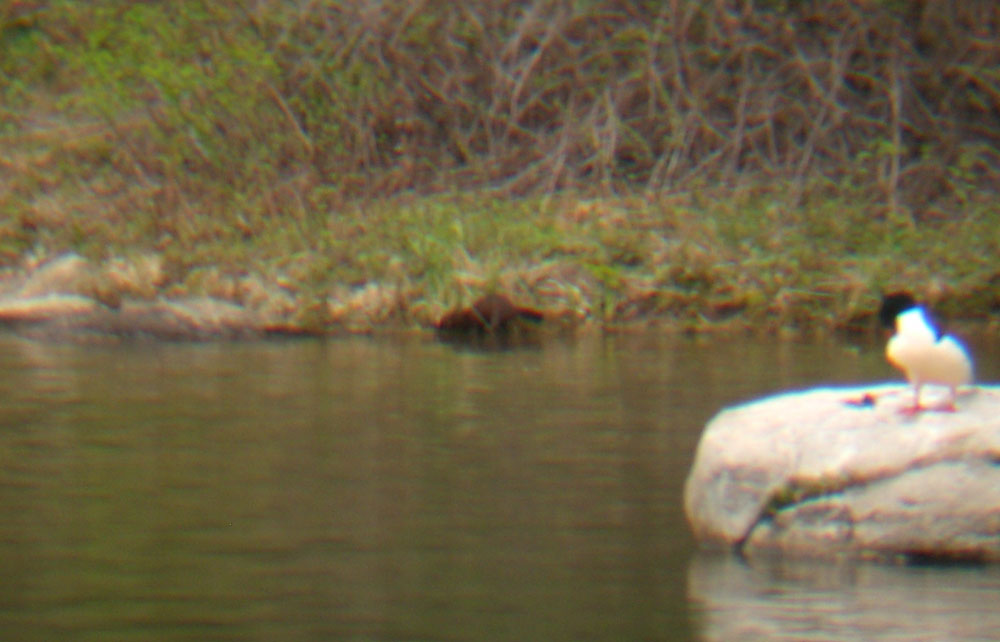
I saw something else at the woods today that I've never seen before: a medium-sized brown mammal, of the weasel-ish variety, loping along the shore of one of the lakes. Here's an extremely blurry picture of the creature -- it's running to the left, with its tail sticking out behind it (and a Common Merganser looking on):
And here I thought there were too many people and dogs frequenting this area for furry things like this to be around, let alone to show themselves! From the color and the length of the tail (and the habitat), my best guess is that this is an American Mink, and I've certainly never encountered one of these creatures before. What a cool and totally unexpected discovery!
Here are some other assorted finds from today's adventure:
This pretty butterfly landed in my path and didn't stay around long (hence the blurry picture). I believe it's an American Painted Lady (although it could just be a regular Painted Lady).
Here's Dwarf Cinquefoil. This flower is a little abnormal in that it has six petals instead of the usual five. But oh well, things like that happen sometimes.
This is Japanese Barberry, an invasive species. From what I've read, these plants can really take over wooded areas, but fortunately I only found this one bush here.
And here's another new violet! This is one I just learned about because it recently showed up in two other nature blogs I read (Saratoga Woods and Waterways, and You Hike the Giant, too!): it's an Arrow-leaved violet (also called Ovate-leaved violet, Viola fimbriatula), which can be identified by its fuzzy-furry leaves and stems, and leaves that are oblong rather than heart-shaped. I just love the colors and patterns on those flowers. :)
I'll close this post with another bizarre fungus, one that I don't have a name for. These growths are about the same size, shape, and color as acorn caps, and kind of cute:
Today was another good day for birds in the Naugatuck State Forest. I saw three new species that I'd never seen before, all awesome, and all moving too quickly and too far away for pictures: a Wood Thrush (pretty enough, I think, to suit its beautiful song), a pair of Black-throated Blue Warblers, and an American Redstart. (The Wood Thrush has a brilliant white breast, so I'm tempted to make some poorly-formed comment about the patriotic aspect of this trio of birds, but I won't stretch quite that far.)
This Gray Catbird was singing softly near a thick rose bush next to the path:
It was quite a pretty song, all warbling and ramble-y. When it saw me standing there, however, it switched to the mew-like call that gives this bird its name -- an alarm perhaps? I've seen a catbird hanging out around this bush before, which makes me wonder whether there might be a nest in there. Don't worry, little bird, I wouldn't bother your babies. ("Oh, no?")
In another part of the forest, I found this tiny, bizarre bug relaxing on a leaf by the path:
From a distance, this looked like something the trees might have shed after flowering, but nope, it's got eyes and wings. The body parts are a little strangely-proportioned, but it's definitely a creature. After a little research, I'm pretty sure this is some sort of Thick-headed Fly (Myopa sp., I think), so called because their heads are, well, thick, in comparison to their thorax. I have never heard of -- nor seen -- a creature like this before, but I am convinced even more of how weird bugs are!
I've been watching these plants for a little while now, waiting to see what kind of flowers would grow so I could try to identify them:
Presumably these flowers will grow larger, straighten out, and turn white (as they are in the pictures I've found online), because this is most likely False Solomon's Seal. "False" because, well, it's not Solomon's Seal -- another plant that grows in these woods -- although the one plant without its flowers sure looks a lot like the other. Poor plant, named for not being something else. To be fair, though, it has other names as well: Solomon's Plume, or Treacleberry. So I guess it's OK. Also, sometimes I just have to laugh at the silly names people think of for plants. :P
Here's the last picture for the day, an Orange Jelly Fungus growing on a branch:
In a post about birds and flowers, did you expect a fungus to be the brightest thing around? Sometimes nature is surprising like that. :P
Look who's arrived in the Connecticut woods after his northward journey:
It's a Scarlet Tanager! I don't know whether I've actually seen one of these guys in real life before, but boy are they something -- and bright. Pretty bird. :)
Also, I would just like to point out all the greenery growing on that tree. Soon it will be even harder to get pictures of birds, but I'm willing to make that sacrifice if it means beautiful summer-green forests!
Even though I've seen owls in the woods a dozen times or more by now (since I was watching that Great Horned Owl nest), I don't think I'll ever get used to the shock when I stumble across one. They're just so awesome. This owl was watching me from a tree near the path this morning, and I had a hard time containing my excitement when I looked up and saw it there:
It's a Barred Owl, maybe even the same individual that I saw in March in this same area. Do you love the pattern of stripes on its breast and belly? And the wide rings around its face, with one side arching slightly higher than the other, like a raised eyebrow? I do. This bird seemed so calm, so big and peaceful, and I felt lucky to be in its presence. What a truly magnificent creature.
And there were more cool birds at the woods today as well. This Northern Parula (a migrating warbler that nests in eastern North America) was flitting around and singing in a rose bush right next to the entrance to the woods. He flashed his bright yellow throat with his pretty orange/gray collar right at me for a photo -- how nice of him. :)
A pair of Common Mergansers flew down and landed in the lake in front of me. I've posted about these birds before, but I couldn't resist taking more pictures with these two so close. Here's the male:
And here's the female (yep, she's definitely the prettier one):
I found new flowers in the woods, too -- everything's growing by leaps and bounds out there!
Yes, it's another violet (I said there are a lot of different violet species around here, didn't I?). This one's a Dog Violet (Viola conspersa), and I feel pretty confident about my identification since this plant has all the right characteristics for the species: leaves on the flower stem, hairs on the petals, and a long spur on the back of the flower, which you can see in this next picture:
The pretty flower in this next picture is Sessileleaf Bellwort (also called Sessile Bellwort, or Wild Oats, Uvularia sessilifolia):
I love how these delicate lily-like flowers look, all bowed down, and blending so well with the ferns unfurling in the background of this picture. This is yet another cool thing that I never knew existed until now. Hooray for the woods and hooray for spring!
Paul went with me to the woods this morning, where we saw turtles basking and water snakes slithering, and other fun things. The most photogenic creatures we found, however, were small and delicately winged (i.e., insects).
These two Eastern Tiger Swallowtails, for instance, were dancing in the sun on a sandy spit of land jutting out into the lake:
The two butterflies were flitting around and probing the wet sand with their proboscises, a behavior that the internet tells me is called "puddling." Apparently, adult butterflies -- especially males -- suck up nutrients (salts, amino acids, etc.) from wet patches on the ground, and they sometimes congregate in groups while doing this. These are the first swallowtails I've seen this year, and since Tiger Swallowtails hibernate as chrysalises (the internet teaches me so many new things), I'm wondering if these are newly-emerged butterflies. They look so crisp and fresh, and maybe this is their way of stocking up on nutrients before the mating season begins (and before many flowers are open). Such beautiful creatures!
This bumble bee (I don't know the exact species) was dancing around on the forest floor not far away (this photo is courtesy of Paul):
If you look closely at this picture (click to zoom in), you can see that this bee's proboscis is out and active, too -- this little fellow appears to be doing the same thing as the butterflies, dabbing up liquid and nutrients from the damp ground. Is this something that bees usually do?
Strangely enough, both Paul and I were perfectly at ease taking pictures of the bee while it was on the ground, but as soon as it took off into the air and started buzzing around, we jumped back and quickly moved along. I don't think this bee would've hurt us -- or paid any attention to us at all, really -- but I guess we've thoroughly absorbed the idea that we should be as far away as possible from flying, stinging insects. I'm just proud of myself for getting as close to this creature as I did, since I used to be desperately afraid of bees when I was little. Go, me. :P