On Friday morning, I visited the beach near our house and wandered along the edge of the high-tide water. It was a lovely, sunny morning, and the waves had brought out all sorts of interesting creatures, including several creatures that were deceased, washed up from their ocean homes and onto the sand.
Several strange, thick, jellyfish-like things were scattered along the beach, and they turned out to be a totally bizarre animal called a salp (it's worth looking these guys up to read about their life cycle and to see pictures of them underwater):
More specifically, the salps on this beach were the largest species of salp in the world, the strangely named Thetys vagina. (Some online sources suggest that this species' name doesn't actually come from an anatomical reference, but I don't know for sure.) In any case, I am once again struck by the strangeness of things that come from the ocean. I had no idea such a creature even existed:
Several large and beautiful Dungeness Crabs were also washed up on the beach, dead:
The beach was also teeming with Pacific Mole Crabs (Emerita analoga), and they were very much alive. At one point, I saw a spot behind a receding wave where the sand was practically roiling, and I (perhaps foolhardily) stuck my hand into the spot and felt more crabs than sand! These little crabs are such impressive diggers, but I managed to flip one out of the sand for closer viewing. I believe this is a female, with her orange eggs just visible behind her tucked-up legs (she's head-down in this picture):
Several birds were foraging along the water's edge, including this flock of Whimbrels:
A very handsome Black-crowned Night-Heron was patrolling the area as well:
It's always nice to meet one of these fancy herons, and the beach backdrop is a cool bonus:
It occurs to me now that this will probably be one of the last times I visit the Pacific Ocean for quite a while. We now have a week left before the move (ah!), so I'll be wrapping up my Northern California experience as best as I can during that time. Here we go!
In just two weeks, the Piping Plover chicks near Silver Sands State Park have grown from the size of cotton balls to nearly the size of their parents. Here's a family portrait I took yesterday morning with Mom on the right and the four not-so-little babies on the left; I don't think these guys will fit under Mom's wings anymore!
These chicks have still got some growing to do before they can set off on their own, but it's cool to see them getting closer to adulthood. Such big babies:
Unfortunately, one of the four hatchlings now has an injured leg.... I'm not sure how or when this happened, but at least the poor little guy seemed to be getting around pretty well (foraging and running nearly as fast as its siblings). I reported the injury, but apparently there isn't much people can do at this point, and based on other reports the bird actually seems to be improving. So I'll just continue to keep my fingers crossed for the hurt bird and its so-far-healthy siblings!
I've posted many pictures of the father plover already, but I can't resist sharing one more of this handsome fellow amongst colorful reflections from man-made structures:
While the Piping Plover family was foraging on one part of the beach, this Black-crowned Night-Heron was hunting for creatures buried in the sand a little ways away:
I often see Black-crowned Night-Herons at Silver Sands State Park, but I'm pretty sure this is the first time I've gotten to watch one of these creatures fairly close up. This is such a fancy bird, with those bright red eyes and flowing tassels (for lack of a better word to describe the crazy feathers sticking out of the back of its head). Herons and egrets tend to get into some weird postures while they're hunting, and this guy was no exception; heron necks sure are extendable!
I'm not sure what this bird was finding in the sand (some sort of mollusc, perhaps?), but it was getting a good meal. Yum:
Here's a brief video of the heron in action (with a bonus Ring-billed Gull shuffling through the scene at one point):
The park was filled with activity, despite the heat and humidity. I'll close with a lovely dragonfly (some sort of Meadowhawk, I think, genus Sympetrum) who posed so nicely at the edge of a green and flowering field:
What a fun and interesting beach day!
So this year, I decided to do something crazy and new: I volunteered to be a Piping Plover monitor for the US Fish and Wildlife Service!
Piping Plovers are a federally threatened species (not quite endangered, but still, they're in trouble) that nests on sandy beaches scattered along the Connecticut coast, and every year, the USFWS, the Connecticut DEEP, and the Audubon Society get together to ask for volunteers to go out onto the beaches and look for these birds so we can try to protect them (with fences, signs, etc.). About a month ago, I went to a training session and filled out an official government form, they gave me a fancy USFWS hat and ID card, and now on Wednesday afternoons for the rest of the spring and summer, I am in charge of surveying Silver Sands State Park for these little birds. (And I'm supposed to tell the Powers That Be about other species-of-interest that I see as well.) So basically, I get an excuse to go walk on the beach every week and do something that I like to do anyway, and it actually might help our coastal birds. It's kind of a great deal!
Anyway, yesterday was my first afternoon "on the job," and I had a great time and saw lots of cool creatures. No Piping Plovers -- no one's seen them at this park yet this year, actually, and they might not even show up at all -- but now that migration is in full swing, a bunch of interesting birds are streaming back into the area, herons chief among them.
This Yellow-crowned Night Heron -- a new bird for me -- was hunting at the edge of one of the marshes between the parking lot and the beach:
I'm liking that mask! Although I can't help thinking this bird's rat-tail hairdo looks a little silly from the back:
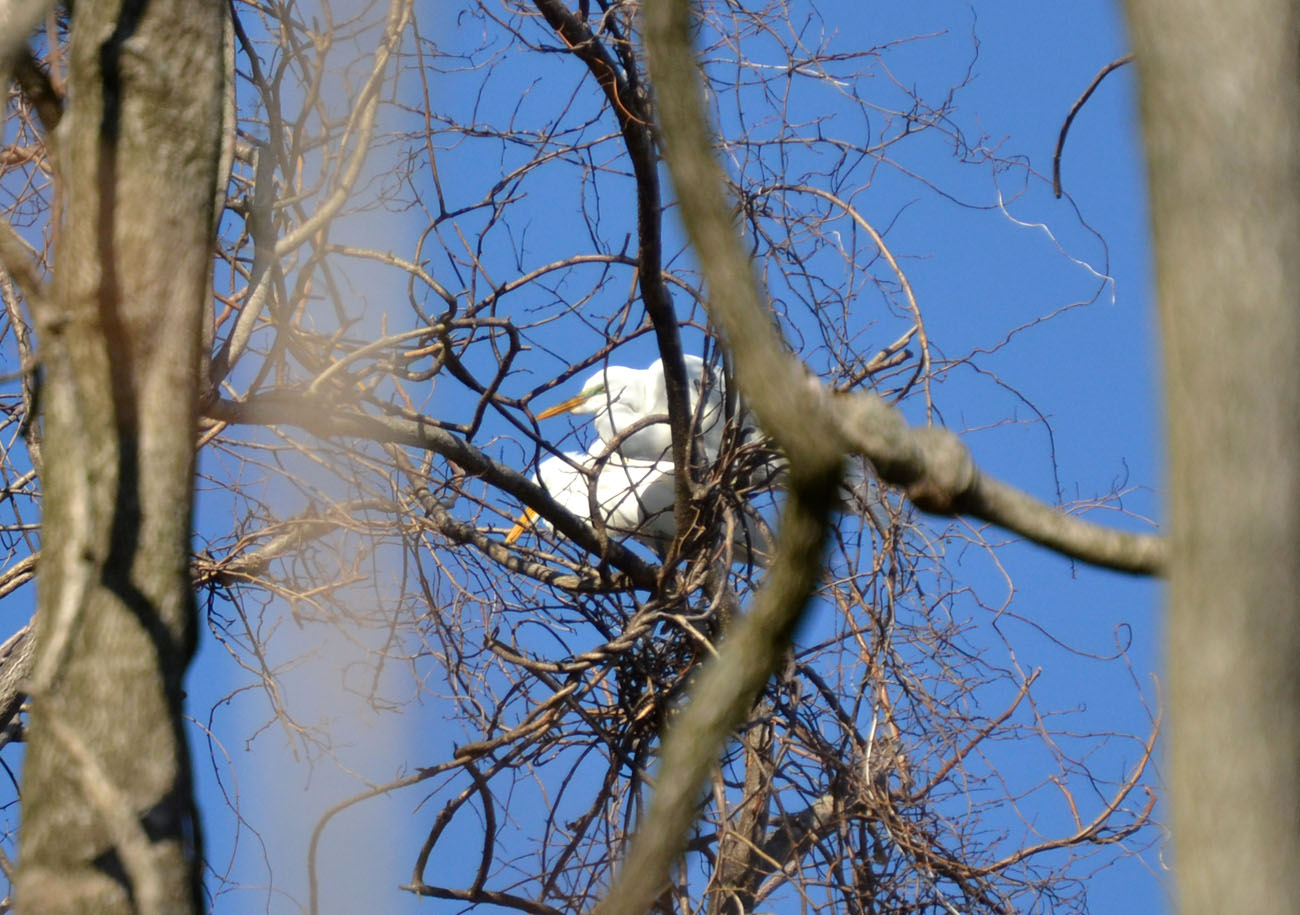
I happened to arrive at the beach as the tide was going out, so I took the chance to walk across the magically-appearing sandbar to Charles Island. In a month, the island will be closed off to the public to protect the herons and egrets that will be nesting there, and some birds were already starting to set up shop! The trees in the center of the island were dotted with big white shapes, like this pair of Great Egrets:
It's difficult to see in this picture (just think how much harder it'll be when the trees leaf out!), but these egrets were decked out in their breeding finery: long flowing feathers and bright green markings on their faces.
I think you can just make out the red eyes of this pair of Black-crowned Night Herons, similarly shrouded in the branches of another tree -- the two were touching beaks and acting all lovey-dovey while I was there:
The herons and egrets weren't the only birds thinking about nesting on Charles Island, either. Several pairs of Canada Geese were honking and flapping (and hissing!) at me, making sure I didn't come too close. (I wasn't about to try!) And one pair of geese had something interesting to show:
I reported my sightings of these two birds at reportband.gov, and I'm waiting to see if I get a response -- people band wild birds for all sorts of studies and things (yay science!), and sometimes, you get to learn the history of the banded bird when you report it. (Or so I've been told.) I'll update this post if I hear anything!
Update (4/7/12): I got two emails yesterday with some information about these birds. C255 is a boy, and C274 is a girl, and they were both banded on the same day right around this same area (near Milford) last summer. I've read that Canada Geese are monogamous, and it's kind of cool to see some evidence for that myself. And I actually think it's sweet that these two are still together (through a banding process and everything). I hope you have a nice family this summer, geese!
Before I move on, I just have to share one more picture of these geese. I just think this picture looks cool, but Paul thinks it looks like a goose with two heads:
I wish all the birds nesting on Charles Island the best of luck this year!
Back on the mainland, there were more birds to see, including two Ospreys (also recently-returned migrants) swooping overhead and calling to each other. One even came low enough for a picture (gosh, what a bird!):
The Herring Gulls were fighting over crabs -- these two youngsters stole a meal from the adult screaming in the back:
And even a regular old American Robin caught my eye yesterday, with its rusty orange breast glowing in the afternoon sun as it foraged with its fellows:
So I'll be back at the beach next week, and every week for the foreseeable future. It'll be an interesting change for me, since I'm still so much more used to woods than ocean. Who knows what will turn up next time!