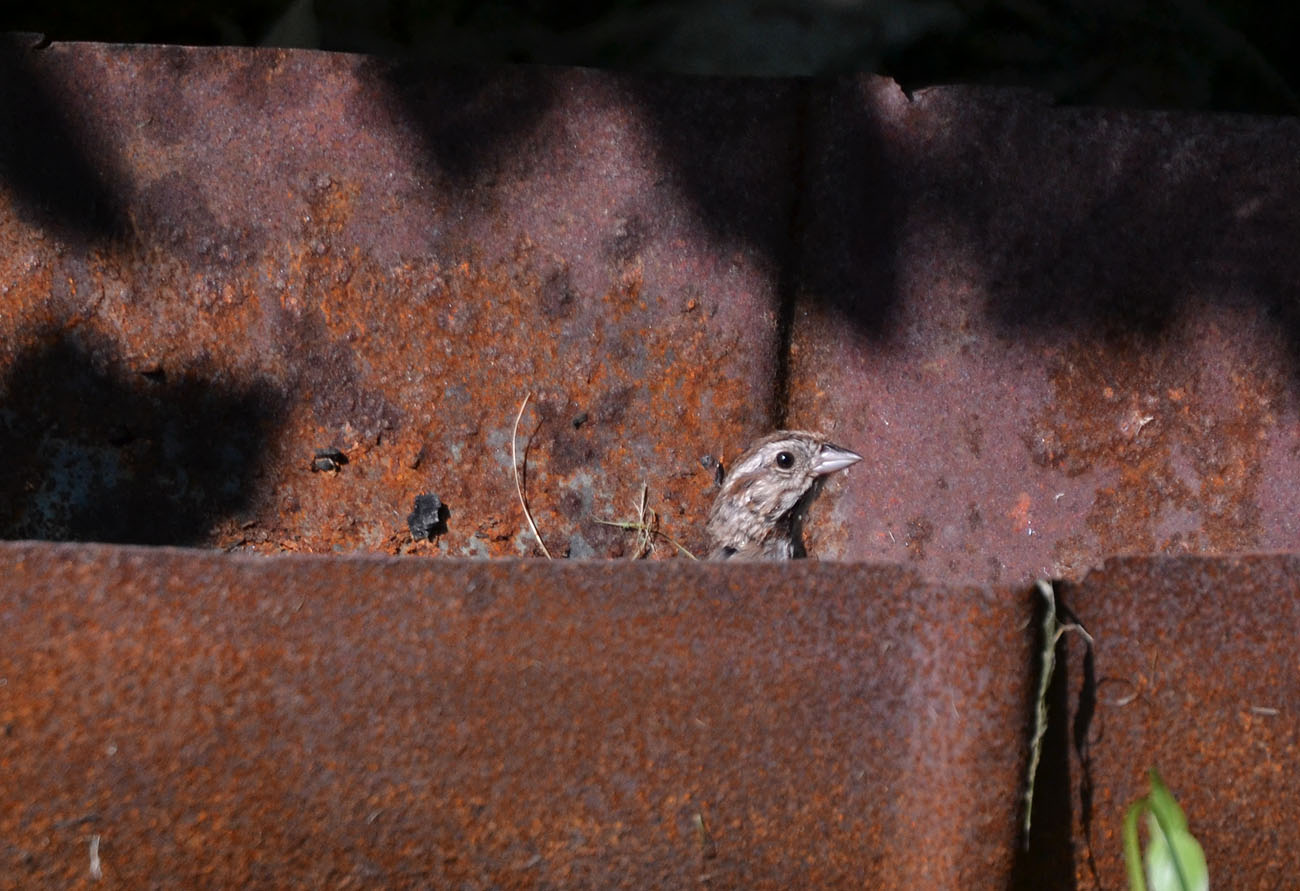
There's a small pile of junk tucked away in the corner of the yard near my garden, mostly bits of old metal that look like they might've been there since before our landlord bought this place. (Or maybe they're technically in the neighbor's yard, it's hard to tell.) Anyway, in this junk pile is some sort of rusty basin -- half of a tank or barrel or something -- and several times over the past couple of weeks, I've been out in my garden and a little Song Sparrow has come down to bathe in the water that collects here. I'm sure this can't be the cleanest place to take a bath, and hopefully it's not too unhealthy, because the Song Sparrow keeps coming back, and it looks like it's having fun! Yesterday morning, I brought my camera out into the yard with me, and the Song Sparrow obliged with a bath time visit:
Yay, water!
I love Song Sparrows, and it's so nice to have company while I'm working in the garden. This little fellow kept going in and out of the water, and shaking tiny droplets everywhere:
You're not very sleek when you're dripping wet, little bird, but I still think you're extremely cute!
Hello in there!
Ready for another dip?
(Yes.)
Sometimes the sparrow would disappear entirely, but all that water dancing out of the basin means that someone's in there doing some very thorough cleaning:
Little Sparrow, you're making it rain:
Someday, I'll have full control over a yard of my own, and then I'll make sure our bird neighbors have a clean place to bathe. For now, though, I'll just admire this Song Sparrow's resourcefulness on these hot days.
Today was a beach day, and it was a really lovely one, with perfect weather -- not too hot, not too cool -- and bright sunny skies. I got to spend some time this morning checking out Milford Point, where lots of different types of birds are busy tending nests. A pair of Ospreys have their nest on a platform in the marsh:
(And yes, that's a live web cam up there!)
Nearby, there's a colony of Purple Martins, a large species of swallow whose numbers are declining in Connecticut and is listed as a state threatened species. These birds are apparently entirely dependent on human-provided housing in eastern North America, and these guys at a Milford Point have a few housing options. You've got your apartment-style complex (hey, who let that House Sparrow take a room?):
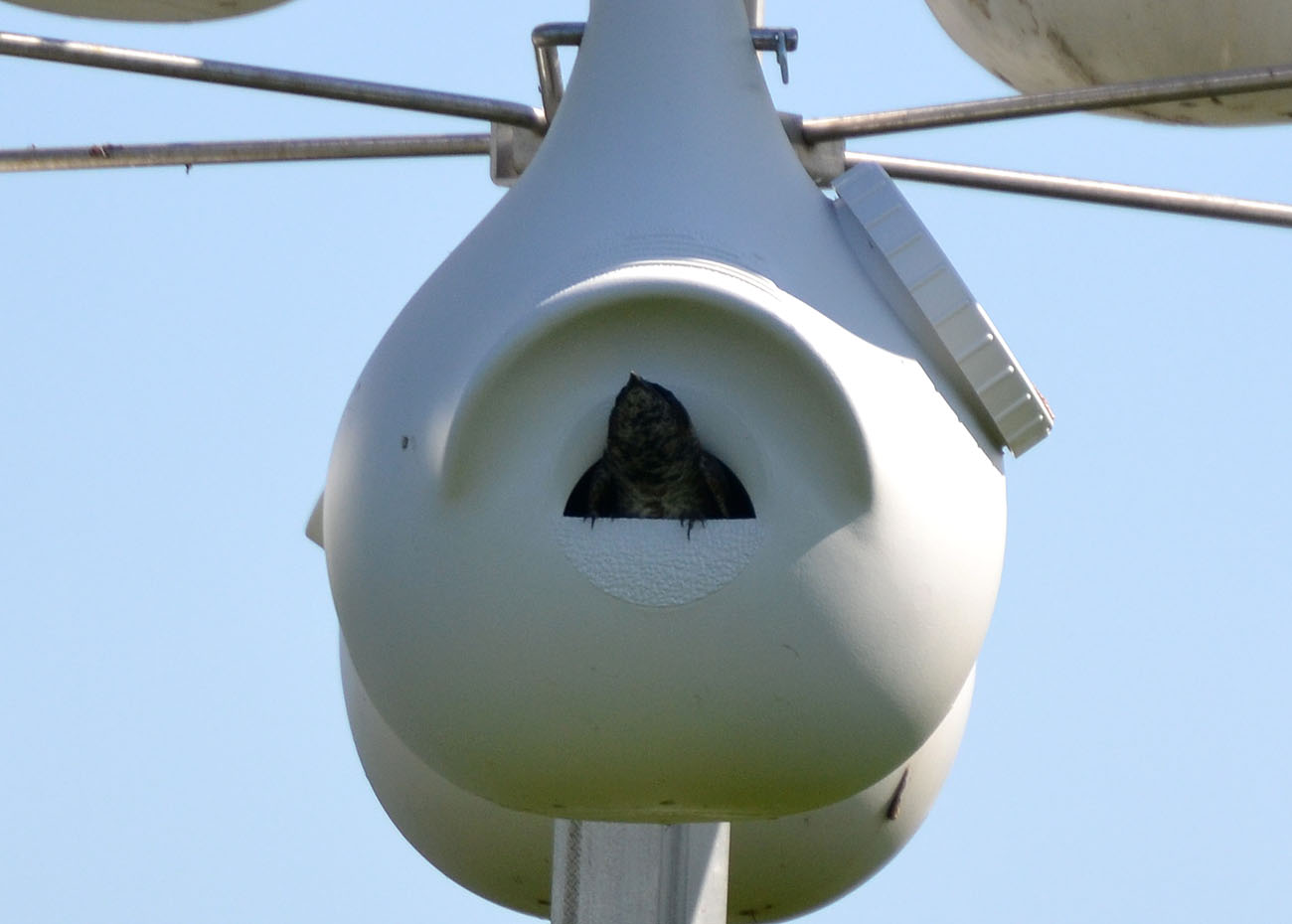
And a bunch of single-family hanging gourds:
These birds were constantly flying around, catching insects and popping in and out of nest box holes. All the activity was a bit overwhelming, but it was a lot of fun to get to see these communal birds just doing their thing:
The males were especially impressive with their deep purple glossy feathers:
But the browner/splotchier females were cool, too. This girl spent some time peering out of her window (watching the neighbors?):
And then she squeeeezed out of that small hole:
And took off:
Most of the martins I saw in this colony were banded, and I'm sure they're closely monitored. Here's hoping these cool birds do well in the years to come.
Speaking of birds in trouble, the sandy shoreline at Milford Point happens to be a nesting haven for some more state threatened birds, Least Terns and Piping Plovers (the Piping Plovers are federally threatened as well). This prime nesting area is currently swarming with Least Terns (I counted at least 100), and a few plover pairs have also taken up residence:
This whole area is surrounded by string fencing and signs to keep people away, but that thicker fencing at the left in the above picture is there to protect a single Piping Plover nest. The tiny plovers can wander in and out of the fencing at will, but potential predators can't get through. (Piping Plovers need all the help they can get around here. If I remember correctly, there were only around 50 recorded successful plover nests last year in all of Connecticut.)
It's best to stay away from these nesting areas -- to avoid disturbing the birds, or worse, accidentally stepping on a well-camouflaged chick. And that was my plan today... until a large school group strayed too close to the fencing and I felt obligated to put on my volunteer-plover-monitoring hat to go out there and let them know that they should probably move to another part of the beach. I spent as little time as possible near the birds, but I did take a quick picture (from a distance) of one of these very special Piping Plover nests. Can you make out the little plover right in the middle of this fencing?
Their camouflage is really very good, and they're quite small birds. Here's a zoomed-in view -- look for a tiny orange and black beak and a tiny black eye:
It's good to see that these birds are doing the best they can, at least, to increase their population. Good luck, little plover!
Finally, here are a few other assorted sights from today's beach visit. It still surprises me that we have cacti in Connecticut, but yes, here's a wild Prickly Pear, and in bloom no less:
I actually started this morning's trip in nearby Silver Sands State Park, where there were unfortunately no signs of nesting shorebirds, but where I did get to see a bit of drama in the form of a pair of Red-winged Blackbirds who would not stop dive-bombing this Great Egret:
The egret must have been too close to the blackbirds' nest, but surely the blackbirds were also too close to the egret!
So many interesting things to see on this lovely day!
With the warm temperatures, the diversity of
insects in our yard has exploded. I feel like I’m visiting some sort of exotic
zoo every time I go outside. Here’s a selection of some of the cool little
creatures that have shown up around our house over the past couple of weeks.
There seem to always be dragonflies flying around
our yard right now, and this handsome Common Whitetail made our garden his
hunting ground one day:
He would find a stick for a perch, and then
zoom off after some smaller flying insect, then back to the perch again. It’s
not often dragonflies are so obliging for me and my camera!
A couple of other fancy flying creatures have been hanging around the garden as well. This male Zabulon Skipper (what an awesome
name) was very pretty with his checkered orange wings:
He looked maybe even more striking when back-lit:
And it probably wasn’t a coincidence that a female
Zabulon Skipper was also flying around the yard at the same time. I never would
have guessed that this dark brown butterfly is the same species as the first one:
Sometimes I’ll take a step in the garden and a
tiny grasshopper will launch up from my feet, only to blend in almost perfectly
with the soil when it lands again:
A bunch of stink bug eggs have hatched on one of my
plants on the porch. I’m not exactly sure what species these are, but these
teeny pinhead-sized dots are pretty darn cute:
(I ended up washing away most of these babies,
lest they collectively hurt the plant when they get bigger and start eating
more.)
At night, a whole different menagerie of bugs
comes out, and I get to see them when they come to my porch light. This large
Tulip-tree Beauty moth (Epimecis hortaria) was gracefully draped around our
porch’s railing one night:
And we get a lot of Green Pug moths (Pasiphila
rectangulata) this time of year, some individuals a lovely dark green-gray (which my camera's flash does not at all do justice, unfortunately):
And others with more faded colors:
This tiny weevil (I think it’s a Cambium Curculio
weevil, Conotrachelus anaglypticus) came to show off its funny elongated snout
(complete with antennae on the end):
And I had no idea what to make of this strange-looking
beetle at first, but it turns out that it’s actually a type of weevil as well, an Oak Timberworm
weevil (Arrhenodes minutus):
So basically, if you want to see something pretty,
or bizarre, or just plain cool, some insect hanging around will almost
certainly fit the bill!
The good news: Brood II of the periodical cicadas (genus Magicicada) is here! These big bugs have emerged from their 17 (or for some species, 13) years underground, shed their nymphal exoskeletons, and are now crawling and flying around in Connecticut.
The not-as-good news: I had somehow gotten the impression -- with all the media hype -- that this was going to be a big and widespread emergence (which it is in the sense that it covers many states), and since Connecticut is in this brood's range, I figured there would be cicadas pretty much all over the place. It turns out, however, that Connecticut's Brood II cicadas really only occupy a small portion of the state, and unfortunately that portion is not where I live. So my dreams of a cicada-covered yard (fueled by memories of the extreme can't-take-a-step-without-stepping-on-cicadas Brood X emergence at my parents' house in Maryland in 2004) were not to be. BUT, luckily enough, Brood II is hanging out only a couple towns away from me. So today I went on a field trip to see the Magicicadas, and Paul -- who seems to have a complex ew-gross/hey-cool relationship with bugs -- came with me.
And through the magic of the internet (where you can find maps of recent Magicicada sightings), and by following the UFO-like sounds of hundreds of cicadas calling, we found them! Hello, fancy bugs!
It's amazing how different these guys look from the normal cicadas that we get every year. The spot we found was buzzing with the periodical cicadas, black and orange/red blobs on all the bushes and trees. There weren't as many as I was expecting to see, but it was still a lot of cicadas. Most bushes had both brightly colored adults and brown shed exoskeletons clinging to them:
And some of the adults seemed to be pairing off:
It was amazing to see these guys up close. Paul absolutely refused to touch a cicada, but I loved interacting with these very placid creatures:
 |
| (Photo courtesy of Paul) |
The shed exoskeletons from the cicadas' nymph forms were interesting, too:
But the adult periodical cicadas were just way too pretty:
After a few weeks, the mating will be done, the eggs will be laid, and all these adults will die. Then their babies will burrow underground and emerge again only after another 17 years. As far as I can tell, Brood II is the only brood of Magicicadas in Connecticut, so the state will be without these fancy bugs until then. I don't know when I'll next get to see periodical cicadas, so I'm very happy we made the trip today. Hooray for unusual creatures!
For more cool stuff about periodical cicadas, check out this article on cicada life cycles, and this high-def video of the sights and sounds of periodical cicada courtship.
This morning I decided to go on an adventure in a brand new woods (new to me, that is). Off I went to the Bent of the River Audubon sanctuary!
This place turned out to be basically wonderful. It had deep woods with delightful streams and pools, and wide meadows dotted with huge trees:
And a long trail following the river that gives the sanctuary its name:
The most amazing thing to me, though, was how obviously well cared-for this place is. I saw no trash at all on the whole 2+ miles of trails I walked. None. Every other park I go to around here always has at least the occasional (sometimes more than that) beer can, fishing line, cigarette butt, etc., so this seemed pretty crazy by comparison. I also didn't see any other people on the trails. I'm sure the fact that Bent of the River doesn't allow dogs, bikes, or fishing is related to all this. In any case, I loved it. Except for the well-groomed trails and occasional nesting box, this place really felt like it was more about nature than it was about people. I felt totally comfortable ambling along these trails (and not at all dorky with my binoculars and camera), and I was happy to pay the suggested $5 trail fee to get to hang out here.
And as for my actual woods walk, there was plenty to see! Now that the canopy has entirely leafed out, I heard a lot more birds than I saw, but that just meant I got to work on identifying by ear. (Normally I take pictures of things I don't recognize to figure out IDs later, and today I was doing a lot of sound recording for the same reason.)
Although the birds stayed out of camera range, several other creatures did come close. A few Little Wood Satyr butterflies were chasing each other through the woods and fields, and one let me creep up on it for a picture:
(I love those orange antennae.)
A dark fishfly (genus Nigronia) fluttered around on oversized wings:
And this Ebony Jewelwing damselfly was definitely jewel-like in the light-dappled forest:
At one point, I turned around to face where I had just been walking, and I was surprised to find that an Eastern Garter Snake had suddenly appeared a few feet away from me and directly in my path:
Sneaky snake! Oo, look at your pretty red and black tongue:
I looked away to check my camera's settings, and when I looked back up the snake had completely disappeared again. I think this snake might have some ninja skills.
I had been hoping to see Pink Lady's Slippers in bloom in these woods, but all I managed to find were several large flower-less plants:
Oh well, maybe these plants will have flowers next year.
The Mountain Laurel was just opening its fancy flowers:
These flowers are gorgeous, but I also really like the way these buds look before they open, like little shooting stars lighting up the woods:
Continuing the lighting theme, these (I think) Varnish Shelf Fungi (Ganoderma tsugae) were like weirdly-shaped lanterns:
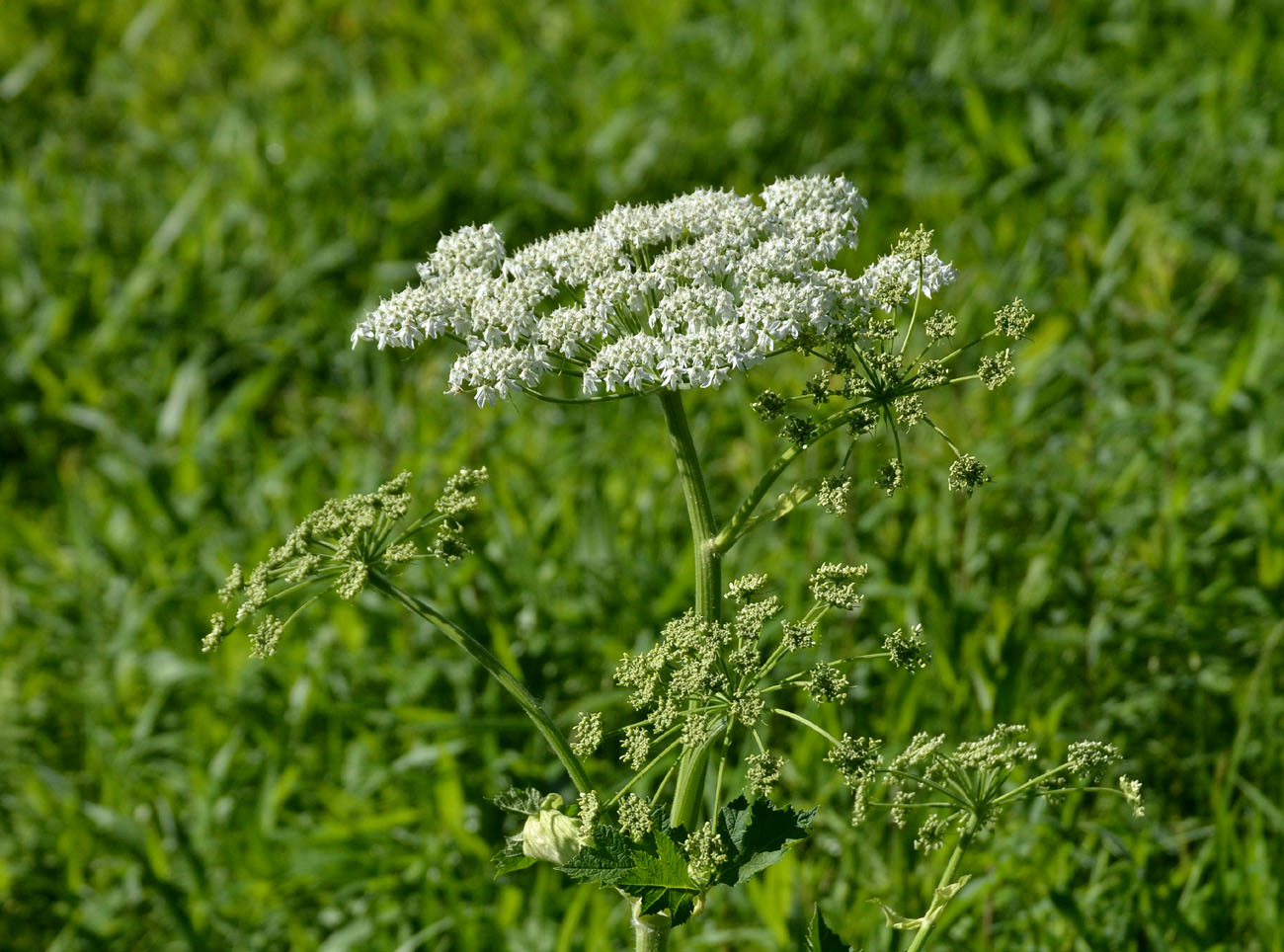
In the fields, huge Cow Parsnip plants were opening their big flower-umbrellas a few feet above the ground:
It was definitely a good morning, and if I lived closer to this place it would become one of my frequent haunts. And really, any nature walk gets bonus awesome points when it ends with a field of horses:
:)