The Arcata Bottoms really are a haven for raptors (and shorebirds, and geese, and ducks, and so on...). In a previous post, I noted that the many fence posts around these pastures seem to make excellent perches for the wide variety of raptors that hunt here. After new visits to the Arcata Bottoms last weekend and again this morning, I have some more fence post sentries to add to the list, starting with this little American Kestrel (with lounging cows for a backdrop):
American Kestrels are our smallest raptors, but Merlins aren't much bigger, and these fence posts seem to be just the right size for those little hunters as well:
Aren't Turkey Vultures too big for these wooden posts? I guess not:
One Turkey Vulture on a roadside post let me inch up next to it in my car, at least up to a point; I'm pretty sure this is the closest I've been to a Turkey Vulture in the wild, and it took off (to land on a post further away) just after I took this picture:
Wow, what beautiful massive wings, and what a bizarre skull-like head. Turkey vultures are so cool.
While I'm already sharing sights from the Bottoms, how about some water birds? Three male Buffleheads paddled around together (while a group of several female Buffleheads hung out a little ways away):
And a big flock of American Coots demonstrated how cool their black-white-gray outfits look en masse:
We've had rainy and gray weather for what seems like forever at this point, but even when rain threatens at least I can drive through the Bottoms and still get to see new and interesting things!
On Tuesday afternoon, I drove out to Sheldon Marsh State Nature Preserve to see what this place is like in the very earliest stages of spring. This was only my third time visiting this preserve since moving to Ohio in August, but I feel like I'm getting a pretty good feel for the place across the changing seasons. As with my previous visits (in the fall and winter, respectively), there were lots of things to see!
I'll just dive in with what I consider the most exciting sight of the trip. Turtles! Yes, it really must be spring if there are turtles out and about. And even cooler, these are Blanding's Turtles (I saw two individuals; the second is just outside of the next picture), a species listed as threatened in Ohio and considered endangered by the IUCN because of their declining populations. I've never encountered this creature before, and I love that bright yellow chin:
These turtles were quite large, maybe around a foot long including their heads. Apparently Blanding's Turtles are super long-lived (70 years and up in the wild) and they don't reach maturity until 12-20 years old, which probably isn't helping their population problems. (The much more common Painted Turtles, by contrast, are ready to reproduce after 2-16 years.) I've also read that predation of eggs and hatchlings is a big problem for these guys. Perhaps the two turtles I saw will make some eggs, and maybe those eggs won't get eaten.... I don't want these sun-chinned creatures to go away!
Waterfowl migration is in full swing, and there were plenty of birds swimming around in the ice-free marsh. A variety of ducks were dabbling in the back of the marsh, but I was pretty well entranced by a small group of American Coot -- relatives of rails -- foraging near the path:
Coot! So cute, with that little tail and head:
These birds mainly eat aquatic vegetation, and they must've been finding some good meals in this shallow water. Mmm, greenery:
Coots have so many weird features, like that red knob on the top of their beak that looks so much like a third eye to me in the above picture. And their feet are these big lobed things, all the better for paddling in water and walking on mud:
The lobes fold up (again, weird), but the foot remains large:
These really are quite handsome birds, and I'm glad I got to hang out with them for a bit:
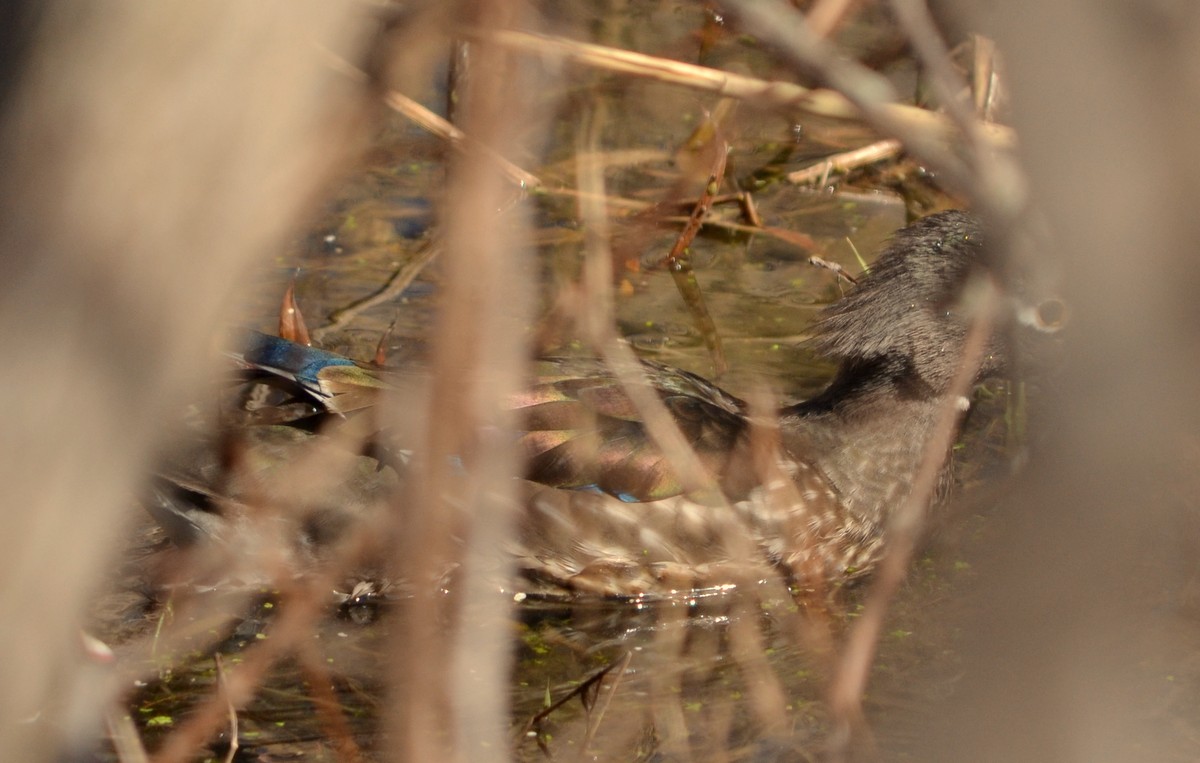
A pair of Wood Ducks foraged close to the path as well, giving me just the briefest of glimpses of their amazing costumes through the reeds. It's kind of interesting to see just parts of these ducks at a time, little details picked out from the whole. Like the male's fantastic green-purple-pink ponytail:
And his fancy painted beak and speckled chestnut breast:
I'm astonished by the colors peeking through on the female's wings:
And an entire pool of the same swirling iridescence -- what incredible color! -- on top of the male:
Yes, these are some pretty amazing birds, in part and in whole!
I was glad to see a pair of Killdeer patrolling the marsh, making me think of the Connecticut shore (where I would be just starting to monitor for Piping Plovers and other shorebirds if I lived there now; sigh):
Several pairs of Canada Geese made a dramatic (and loud) presence. I hope the Muskrats don't mind that one of their many mounds seems to be under consideration as a potential nest site:
The Muskrats seem to be thriving in this marsh. I didn't see any signs of the American Mink I spotted here on my last visit, but there were definitely Muskrats splashing in and out of the water (trailing their weird snake-like tails behind them):
This male Red-winged Blackbird chirped at me from within the reeds next to the path, his shoulder patches demurely covered:
A Red-tailed Hawk landed on a pole and surveyed the marsh, totally confident and comfortable even with people walking by right below:
After a few minutes it took off again:
And headed down the path right toward me (passing over my head close enough that I could hear the small sounds it made with every wingbeat):
Ah, so many cool creatures in this place!
Speaking of close encounters, I'm sure that people hand-feed the squirrels in this preserve (I had a couple more Fox Squirrels walk right up to me) and I suspect that they feed the birds as well. This Black-capped Chickadee flew over and nearly landed on me when I stopped at its patch of the marsh, and then it perched nearby to look me over. Well, if this creature's going to offer me an adorable chickadee photo op, I'm certainly not going to pass it up!
This Eastern Chipmunk also seemed ridiculously confident, peeking out of its hole right on the edge of the path:
Do you have something in your cheek pouches, little chipmunk, or are they always that pudgy?
Another chipmunk across the way must have been working on a nest, with all those leaves in her mouth; she dove into a nearby hole right after I took this picture:
Wow, I really did see a lot of things! And all while getting to be out in the bright sunlight, which did a good deal to make the cold day feel warmer, and made for a lovely misty marsh:
This past Friday (the 23rd), while visiting with family in New Jersey for the holidays, Paul's dad and I took a trip out to the Edwin B. Forsythe National Wildlife Refuge on the Jersey shore. This place is a haven for wintering shorebirds, including some very cool visitors from the far north (more on that later), and the trip was fantastic. We saw so many awesome things, and it was hard sometimes just to keep moving forward with all the activity around us. We saw at least 34 species of bird, including six I'd never seen before. I wasn't able to get pictures of everything, but here are some highlights from the trip! One of the main features of the refuge is an 8-mile drive through fresh- and saltwater marshes to get up close to the creatures hanging out there. But before we started on the drive, we got out of the car and poked around the shrubs and trees by the visitor's center for a little while. There were tons of small birds hanging out there, and we couldn't believe how unceasingly active they were! Along with the usual titmice, chickadees, etc., there was a particularly handsom Red-bellied Woodpecker, with more red on his face than I think I've seen before:
He even showed off his reddish-tinged belly, something I don't often get to see on these birds:
A beautiful female Eastern Towhee was scuffling in the dry leaves:
And we even saw an unusual visitor:
This Pine Warbler is supposed to be much farther south at this time of year, and it actually got flagged as "rare" and required confirmation when I reported it on eBird. (This is the first time something like that has happened to me.) It was a very active bird, and it didn't seem to care that it was a well out of its normal range.
Once we finally tore ourselves away from the songbirds and drove on into the wetlands, we were surrounded by waterfowl -- thousands of ducks and geese on every side. The Snow Geese, especially, come to this refuge in the winter in huge numbers, although these snow-white birds with black-tipped wings prefered to stay some distance away from us during this trip:
These birds spend their summers in the high arctic and their winters down here -- I'm always amazed when I think of creatures traveling so far to find suitable seasonal habitats. When our Snow Geese moved, their expansive flocks made quite an impressive sight streaming across the sky:
Some of the smaller waterfowl we saw were really cool as well. This adorable little bird is an American Coot -- it kept wiggling its tail as it paddled along:
I love the warm cinnamon patterns on these female Northern Pintails -- somehow I managed to not take any pictures of the male pintails, whose striking brown and white coloring and pointy black tails make them look like they might belong to a different species from the females:
And these Northern Shovelers look almost alien, with those monstrously oversized bills:
My favorite of the waterfowl, though, was one that we came across toward the end of the drive. A flock of about a dozen Tundra Swans, huge and white with black beaks and legs, were hanging out in the marsh with a bunch of Canada Geese and Green-winged Teal. Like the Snow Geese, the Tundra Swans spend their summers right at the very top of the continent, and it feels special to get to see them here all the way down here (even if this is their normal wintering ground). We watched a few of the Tundra Swans circle above the larger group:
And then come in for a landing:
The swans were very active, calling constantly to each other in a wonderfully musical honking/cooing sound. Here's a quick video I took -- you might need to turn the volume up a little to hear the calls clearly:
So the waterfowl was awesome, but that's not all we saw! There was a Peregrine Falcon feeding on top of a nesting platform:
And in possibly the best part of the trip, we watched two adult Bald Eagles taking part in what looked like a bonding ritual -- one eagle would bend down to the ground and then straighten up and touch beaks with the other eagle, perhaps passing it a tasty morsel:
While we watched, the eagles both startled and hopped up into the air at exactly the same time:
The two birds immediately settled back down again and continued their earlier activity. Whatever alarmed them must not have been any real threat.
The trip ended with an as-yet-unsolved mystery -- a rather large mammal swimming past us:
Its head doesn't look quite right for a mink, and I can't tell whether it might be a large rodent of some sort (a Nutria perhaps?). I'm open to suggestions if anyone has any ideas!
There were so many amazing things to see on this trip -- the reserve is well worth a visit.