OK, I'm hooked. Who knew there were so many interesting creatures roaming around at night, waiting to be drawn into sight by my porch light? My foray into the night-creature world earlier this week turned up several different types of insects (and one amphibian -- more on that later), and I've been checking the light every night since then. Here's a brief overview of some of the widely disparate creatures I've found since Wednesday.
First is some species of crane fly, a huge and harmless member of the fly family (order Diptera) -- when I was little, I had many, many arguments with my friends about whether these are mosquitoes or not; they're not:
Speaking of mosquitoes, though, this next creature should be familiar to most people. I don't know exactly what species of mosquito it is, but from what I've read, I'm pretty sure it's a female -- males tend to have "fuzzier" antennae. Thankfully, she didn't try to make a meal of me:
This tiny creature may look like a moth, but in fact it's a fly (order Diptera again, so more closely related to the crane fly and mosquito above than to actual moths) -- moth flies like this Filter Fly (Clogmia albipunctata) are apparently very helpful for cleaning sewage pipes and the like, and are often found near buildings and especially bathrooms (yay?):
Here's a Leaf-footed Bug (Acanthocephala terminalis), the adult form of the blue-butted nymph I found in my garden earlier this year:
This rather large leafhopper (Coelidia olitoria, my goodness but the people at BugGuide.net are helpful) looks positively alien, staring at me as it hangs upside down from the ceiling:
Bugs don't get much more alien than this next creature, though, a completely new one for me -- it's a Long-necked Seed Bug (Myodocha serripes), appropriately named for its long "neck" (look for the eyes to help orient you to this creature's anatomy) and the fact that it eats seeds:
Also visiting were a few different types of caddisflies (order Trichoptera), which somewhat resemble moths with their feathery wings, but which are actually a different type of insect altogether. Here's a rather large caddisfly which I thought was quite pretty with its auburn shading (I don't know the exact species):
Beetles apparently like the lights, too. I've seen quite a few of this species of beetle over the past few nights -- it's some sort of click beetle or false click beetle, I think, although I haven't been able to make an exact identification:
This lovely green beetle I was able to identify, and it's probably a good thing I did. It's a Northern Corn Rootworm (Diabrotica barberi), a pest insect on corn. We're thinking about trying to grow corn next year, so I guess I'll be keeping my eye out for these guys in the future:
I was a little surprised to see this mayfly (order Ephemeroptera) hanging around, since they're supposed to stick close to water -- but then, we do have a stream across the street from our back yard, so I guess that counts:
Moths are always fun to look at, and even in shades of brown and gray they often show such interesting and intricate patterns. I especially like the pattern on this Yellow-striped Armyworm Moth (Spodoptera ornithogalli):
And this geometrid moth (genus Hypagyrtis) has some pretty cool wings as well, and nice feathery antennae to boot:
Here's a small crambid snout moth (genus Diathrausta), with its slate-gray wings and decorative white spots:
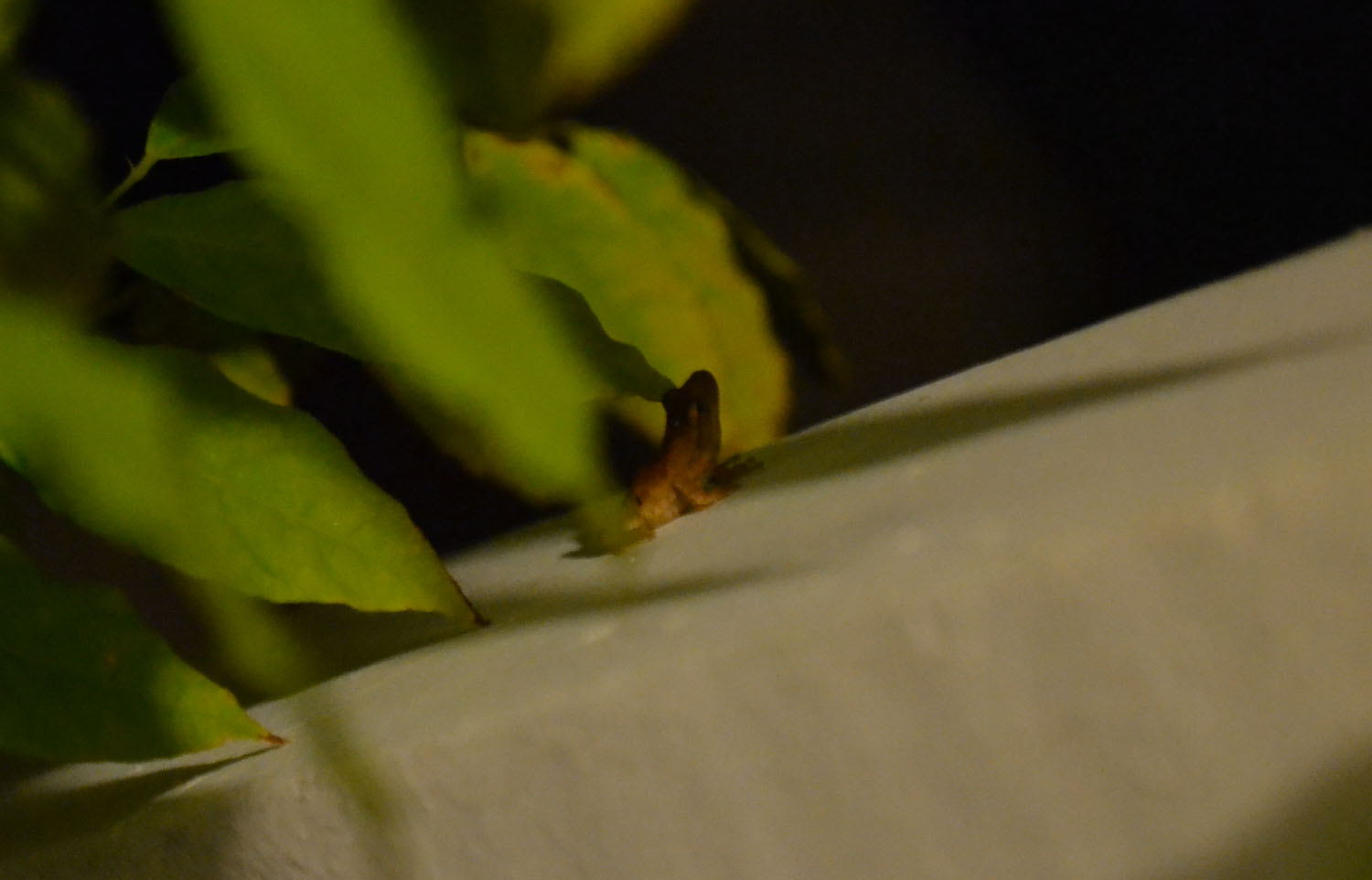
Finally, a happy observation: The Spring Peeper (dubbed "Kristoff"; I can only assume it's the same frog) is still hanging around! I took the opportunity to snap a photo of him/her on Wednesday next to my lens cap -- the cap is ~2 inches (5 cm) in diameter, so that should give you an idea of how dinky this frog is (and I didn't use flash this time, to spare the little guy's eyes):
Update (8/22/11): I just now thought to compare the pictures of this frog to the previous pictures I posted, and it turns out they're not the same individual after all -- the patterns on the two frogs' backs are subtly different, but different all the same. I saw yet a third peeper on the porch last night, again with a different identifying pattern, so rather than a single frog hanging around, it looks like we have a population of peepers who stop by every once in a while. That's perfectly fine with me. :)
I looked away for a few minutes, and when I looked for Kristoff again, he wasn't on the step anymore... but scurrying up the railing instead. Those padded toes really do their job!
I'll continue checking the lights for as long as creatures keep coming to them, but I'll refrain from making a post until I see something really cool. I'm holding out for a super awesome moth!
The weather is definitely getting cooler. Or at least, it was quite cool this morning -- almost chilly, really -- when I went for a walk around my usual loop in the Naugatuck State Forest. As always, there were plenty of exciting things to see.
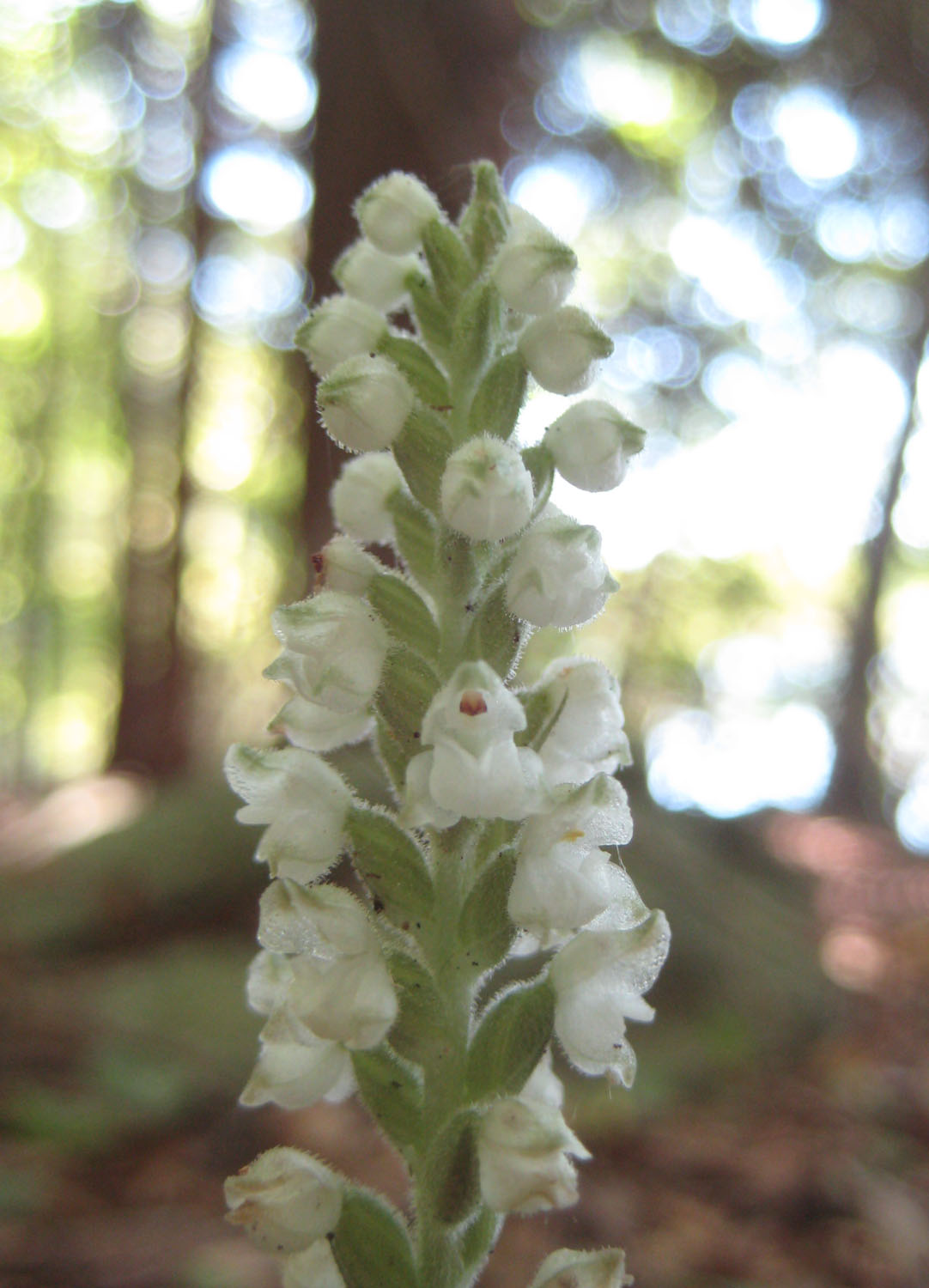
I've been keeping my eyes out for this plant ever since I first learned it last year, yet somehow I managed to completely overlook this patch right next to my normal path until today, when the flowers are already mostly faded. This is one of our native orchids, Downy Rattlesnake Plantain (Goodyera pubescens):
I love the patterns on those leaves, and the tiny white flowers are quite pretty as well. But really, I think all orchids are wonderful. Just so you can get an idea of this plant in its full glory, here's a close-up picture of these flowers when we found them last year (July 31, 2010) in West Rock Ridge State Park (photo courtesy of Paul):
I learned a couple of new plants today as well, and they both happen to be hawkweeds. Here's Canada Hawkweed (Hieracium canadense):
And Panicled Hawkweed (Hieracium paniculatum), whose flowers seem almost to be floating on those thin stems:
The waterways were bursting with life today. I startled this small Green Frog from its rock into a shallow stream, where it watched me carefully with its feet just touching the sandy bottom (what a beautiful shade of green you have on your face, little frog):
A pair of aptly-named Ebony Jewelwings (a species of damselfly) were fluttering above another stream -- this creature was even brighter in real life, if you can believe it:
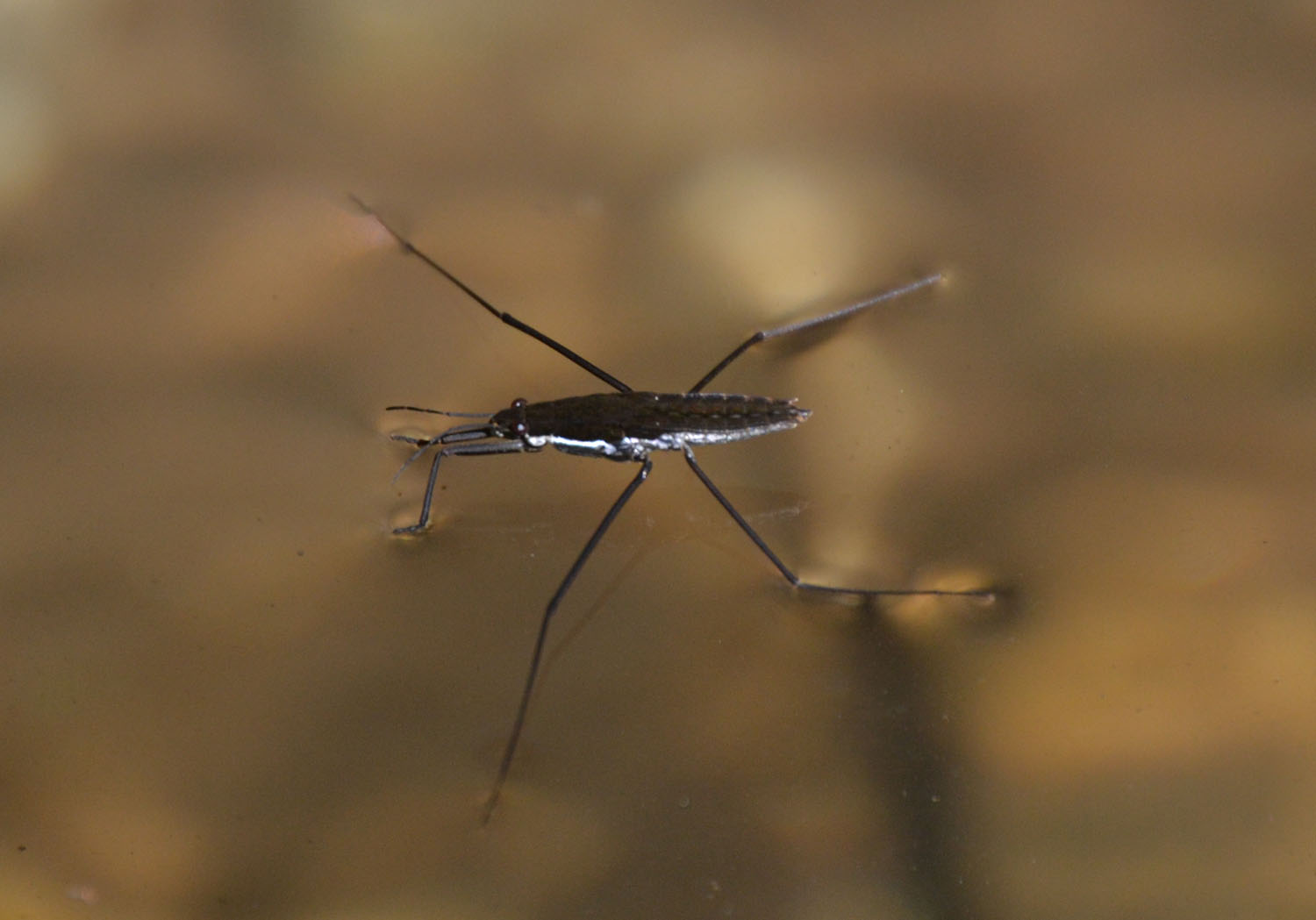
And on the stream's surface, big water striders (family Gerridae) skimmed about:
It's quite an amazing ability these insects have. The water looks like pliant plastic under their limbs, or like a trampoline ready to spring. From a distance, the striders were visible mostly by the interesting paw-print shadows they cast in the stream:
I saw some birds today that I'd never seen in this part of the woods before, which makes me wonder if the fall migration is imminent.... The seasons continue to change, but summer isn't quite done yet!
I have recently discovered that my front porch, at night, is awesome. More specifically, the bright light on my porch draws in all sorts of amazing nocturnal creatures that I wouldn't normally get to see, and that makes it awesome.
Last night, I decided to take the camera out to the porch to see who was visiting -- it turned out to be a party out there, with so many cool attendees! Perhaps not surprisingly, moths were making the strongest presence, in all sorts of different shapes. Here's a pretty standard moth to start things off, probably a cutworm moth of the genus Euxoa (I had some help from people on BugGuide.net in identifying these first three creatures):
The Euxoa moth was not big, probably about an inch or so long, but the rest of the moths I saw were tiny by comparison. This next creature is some sort of Crambid Snout Moth (family Crambidae), and those big pointy structures at the front of its head are not legs, as I originally thought, but mouth-parts called labial palps:
Towards the non-moth-like end of the spectrum is this tiny Casebearer Moth (genus Coleophora), with its feathery wings and long antennae pointing straight ahead:
And this fancy creature is an Ailanthus Webworm Moth (Atteva aurea):
The Ailanthus Webworm Moth is a native species, but strangely enough, its main larval food plant is the so-called Tree of Heaven (Ailanthus altissima), an invasive species introduced from Asia that now gives the moth its common name. I looked up pictures of this plant, and sure enough, there's one growing across the street from my apartment. How interesting that a native species would benefit so well from the introduction of a non-native plant -- if these moths were a little more voracious, would they be able to keep the invasive Ailanthus altissima under control?
In addition to the moths, several other flying insects were joining in on the party as well. This little treehopper was observing from a nearby vine, making excellent use of its camouflage:
(Update 8/11/11: Now that I actually took the time to look this bug up, it turns out it's a planthopper, not a treehopper. And I can actually give it a species ID: Acanalonia conica (note the cone-shaped nose).)
A Green Lacewing (family Chrysopidae) was lounging on the wall -- lacewing larvae eat other insects like aphids, so they're good creatures to have around:
An Ichneumon Wasp (family Ichneumonidae) was hanging around as well:
And several of these small, shiny, deep-maroon-colored beetles were climbing just about everywhere. I'm pretty sure this is an Asiatic Garden Beetle (Maladera castanea), a species introduced from Asia (as the name implies):
After looking at all these assorted bugs -- so much diversity in such a small space! -- I then noticed the best guest of all. I happened to look over at the porch railing, and who should be sitting there, happy as can be, but a Spring Peeper:
I've never seen Spring Peepers outside of their mating season before, when they converge on ponds and low-lying brush and loudly (deafeningly) announce their presence, so it was a real treat to see one just climbing around and doing its froggie thing. And what an honor that it chose my porch on which to do it! This frog was teeny tiny -- it couldn't have been more than an inch long, which is small even by peeper standards. The Spring Peeper is one of only two species of tree frog that we have in Connecticut, and I love love love these guys!
As soon as I took that first picture, my camera died. But even after half an hour of charging the battery, when I came outside again, the frog was still there. I suppose this must be an excellent place for the little guy -- a veritable froggie-buffet, with so many bugs drawn to the light. And yes, I admit it, I'm a horrible person and I used a flash to get this next picture.... I hope the little fellow can forgive me!
Feel free to stick around as long as you like, little peeper!
I had so much fun doing this, I will probably make it a habit of checking the porch from now on. I'm sure I'm not the first person to think of looking for animals under a light at night, but it sure was an exciting discovery for me. :)
(P.S. Paul says the peeper's name is Kristoff... which is oddly appropriate considering the frog gets its Latin name (Pseudacris crucifer) from the cross-like markings on its back. Thanks for visiting, Kristoff, and I'm sorry if you're actually a girl!)
I love it when family visits me. Primarily, of course, because I get to see loved ones who live far away, but also because I get to show off some of my favorite parks. :) On Friday, I took my parents and my sister to Lake Wintergreen in West Rock Ridge State Park.
We saw some fun things while we were there, starting with a Great Blue Heron that flew to the other side of the lake with a big, black, and still flopping fish in its beak:
The heron, it seems, was having more luck than the horde of camp children with their fishing poles along the lake's edge, and that fish looks like quite a prize!
When I first saw this robin lying stretched out on the ground, I was a little concerned:
But not to worry, it was up and running about like normal after a few minutes:
My first thought was that this robin was taking part in a distraction display, feigning sickness and/or injury to draw a predator's (i.e. my) attention toward itself and away from a nearby nest -- I've seen other birds do this sort of thing, and while I'd never heard of a robin doing it, I didn't think it was out of the realm of possibility. After looking at some pictures online, however, I have come to a new explanation for the robin's behavior: sunbathing! Perhaps it feels good to stretch out in the sun, with limbs at awkward angles and feathers askew -- or it may be a helpful part of the grooming process. Whatever the exact reason, sunbathing is apparently a normal bird thing, and now I know not to be alarmed if I come across another bird doing this in the future. (Even if it does look really scary.)
As always, there were lovely flowers to see as well. Whole swathes of the lake were carpeted with these Fragrant Water Lilies (Nymphaea odorata), their white blooms practically glowing in the sun:
Tansy, a plant introduced from Europe, was growing in a large patch by the path -- I learned that the leaves, when bruised, smell really strongly and strangely floral:
And it wouldn't have been a visit from my family without Mr. Westley tagging along. He had a nice lie-down in the cool water, wading in as far in as his leash would allow:
Hooray for strange bird behavior, pretty flowers, and happy dogs. :)
OK, those are two words I never thought I'd say together. But when I went for a walk this morning in the Naugatuck State Forest, the place did have something of the tropical about it, starting with the sight when I first arrived:
Fog and mist, and everything damp, with the constant rustle of water as the leaves dripped last night's rain. I'm not used to seeing the woods like this, and it was a little like stepping into someone else's woods, in another part of the world.
Besides, could this really still be Connecticut, with flowers like this growing at the water's edge?
I've never seen Cardinal Flowers in real life before, only pictures online, and I was amazed at how brightly they shone, even from across the lake.
Close up, of course, the flowers are even more stunning.
I can't imagine a more brilliant shade of red, and I'm enjoying those weird purple structures arching over the top of each flower.
And there were more weird flowers growing in another part of the woods. These tiny Horse Balm blooms (Collinsonia canadensis, a member of the mint family) are among the stranger things I've seen:
Those two stamens remind me of antennae, and how about that super-frilly lower lip:
Strange or not, this sweat bee (Augochlora pura -- thank you, BugGuide.net!) didn't seem to have much trouble figuring the flowers out, although some contortion is apparently required:
And what would a rain forest be without amphibians? This small Pickerel Frog -- I called all spotted frogs "leopard frogs" when I was little, but I have since learned better -- was hopping around on the wet ground near the Cardinal Flowers, and I was glad for the chance to say hello:
OK, so it's not actually the tropics, but with all the diversity and crazy creatures around here (not to mention the weather), sometimes it's hard to tell the difference. :)