Paul and I have been to Silver Sands State Park in Milford a few times now, and we always have a great time there. Recently, we made it our goal to get out to Charles Island, which is connected to the park's shore by a half-mile-long sandbar that appears only at low tide. The island is closed to visitors during the summer, to protect the herons and other birds that nest there, but it re-opened in mid-September. So I learned how to read tide charts, and this past Sunday afternoon (a couple of days before the New Moon, when low tide is at its lowest), we set out on our adventure! We started seeing interesting things before we even got down to the beach. This gorgeous Green Heron, for instance, was hunting tiny silver fish in the marsh right next to the boardwalk:
It's been many years since I last saw a Green Heron, and I'd forgotten how small they are. Compared to the Great Blue Herons I'm used to seeing, this creature was positively dainty, and he/she moved slowly and carefully through the water on those long legs.
At another part of the boardwalk, we leaned over to watch a colony of Fiddler Crabs (I don't know the exact species) moving in and out of their holes and feeding in the mud. This male crab seems to be waving up at us with his giant claw (or perhaps he was warning us to keep away from the nearby female):
We got down to the beach just as the final sliver of the sandbar was surfacing above the water, about an hour before low tide:
And by the time we were half-way out, the water had receded enough to leave a nice wide path to the island:
There were lots of gulls around, but not a lot of other shore birds. Picking among rocks along the sandbar's shoreline, however, was maybe one of the most adorable sandpipers I've ever seen:
It was so tiny -- think of a sparrow with a long beak and long legs -- and it was so intent on foraging for food that it let me sneak up quite close to it. It didn't seem very concerned about my presence at all, really:
My identification skills are still greatly lacking when it comes to shore birds, but between the yellow legs and the very small size, I'm almost certain that this is a Least Sandpiper. I just love that pristine russet pattern on this bird's back:
As the water receded, it revealed rocks positively shaggy with algae, like bright-green mops of hair:
Paul pointed out that this rock seems to be showing signs of male-pattern baldness:
When we made it onto the island, we still had some time before low tide, so we decided to explore. The interior of the island was fenced off to protect the wildlife (with signs telling people to keep out) -- we found several places where the fence had fallen, but we didn't push our way into the path-less tangle of bushes and vines beyond. We saw a few signs of ruined buildings, remnants of old attempts to make the island habitable (attempts that were doomed to failure because of a centuries-old curse, according to some stories I've read online).
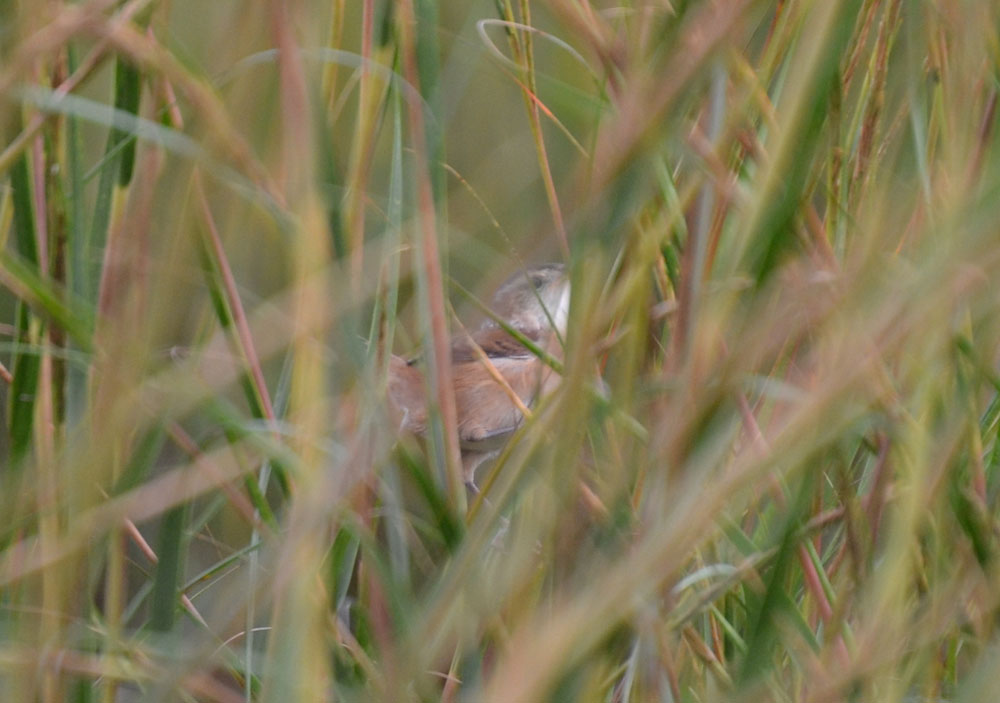
We walked through lovely stretches of tall marsh grass as we made our way around the outside of the island, and we kept up a pretty stiff pace. (I was afraid we'd miss the tide if we didn't move....) Cormorants fished from the rocks just off-shore, and small birds flitted in and out of the island's interior. This is the best view I got of a tiny Marsh Wren, as it hid expertly among the waist-high grass:
So we made it all the way around the island and we didn't even get trapped by the tide! (As it turns out, we had plenty of time, but better safe than sorry.) As we finished our loop, we watched several small fish flinging themselves above the surface of the water -- perhaps escaping from something below? By random chance, I happened to get a picture of one of these sea-creatures just as it became airborne:
And then our fun adventure was over, and we made our way back across the sandbar toward more reliable land:
I'm sure we'll be at Silver Sands State Park again sometime in the future, but perhaps not until next spring or summer. And we'll need to do another round of careful planning if we ever want to return to Charles Island. I'm game!
A few days ago, a gigantic spider took up residence on our front porch, stretching her wide web across the open air between posts. During the day, she lounges on a dead leaf, one foot touching the web (perhaps so she can feel the vibrations in case something lands in it):
At night, she takes up her position in the very center of her web:
When I say she's "gigantic", I mean that I have to do a double-take whenever I catch a glimpse of her out of the corner of my eye. Her body alone is about 3/4 of an inch long, and the distance from the tip of one toe to another is an inch and a half. I suspect her species may be Neoscona crucifera, but I don't know for sure -- and I'm fairly certain she's female just because of her large size.
I admit, I put a cricket in her web last night, and it was almost frightening how quickly she was on the smaller creature, rolling it up in an instant and sinking her fangs into its body.
From what I've seen watching this girl, Shelob and Aragog might not really be so far away....
Today's discovery: animals make really weird noises.
I was walking my normal loop through the Naugatuck State Forest this morning when a loud screeching call started echoing through the forest. It didn't sound like anything I'd heard before -- not like a hawk or a Blue Jay, which are the normal screamers around here. I thought it might be mammalian in origin, perhaps an agitated carnivore... which didn't make me very eager to get closer, I must say. But then the source of the sound moved, and it was now coming from above. I looked up into the trees above the path, and there, perched on a branch and very actively looking around and making that crazy sound, was a Great Horned Owl.
Great Horned Owls are the owls that make the classic "hoot-hoot" sound, usually at night, so I have no idea what this fellow was up to. I've read that juvenile Great Horned Owls make a screeching sound, but this creature's well out of the nest, so I don't know if that's a suitable explanation.
Here's a video I took of this owl making its crazy call -- I didn't think it would be post-worthy at first, but YouTube magically removed all the shaking, and now it's like a real video! The audio's quite soft, and you'll have to listen past the Blue Jay calling constantly in the background, but there's some cool stuff there. Also, if you right-click on the video to watch it on YouTube, and then enlarge it to full-screen, you can actually see the owl's mouth opening as it calls. The call right at the end is the best:
I just love owls, and any day I see one is immediately a best-day-ever. I wonder if this individual was part of the family of owls that was nesting in this same area earlier this year.... Be well, big fellow, and I hope your screaming got you whatever it was you wanted! Speaking of strange sounds in the woods, I've been hearing this hollow wood-block sound for a while now, but it wasn't until today that I finally found its source: an Eastern Chipmunk. Here's another video -- again, you'll have to turn up your volume to hear the sound (my camera doesn't have a great microphone, as I'm learning):
Apparently this is a sound that chipmunks make when there's an aerial predator in the area, and in fact, right after I saw this guy, a small falcon zoomed across the path (chased by a Blue Jay... what tenacious birds). I've already learned to recognize that persistent bird-like cheeping that chipmunks make, but I had no idea these little mammals could produce this strange sound as well. There's always something new to learn!
Not everything in the woods today was noisy, of course, and I saw some cool silent creatures as well. The Red Efts (the terrestrial, juvenile forms of Red-spotted Newts) were out in force today, trundling along the sides of paths in several parts of the forest. (I love these little guys. Love, love, love.) The first eft I saw has the distinction of being possibly the most orange thing ever, as well as the only eft I've seen climbing above the ground (only by a foot or so, but still). Maybe this fallen branch was a handy bridge toward wherever the eft was going:
This eft I saw later in my walk was decidedly browner than the first, but no less photogenic:
Hello, eft creature, what a perfect little newt face you have:
On my way out of the forest, I stopped to hang out with a Common Yellowthroat who was foraging on a goldenrod-covered bank, when a second warbler popped into view. It was a Blackpoll Warbler, a bird I've only seen once before and at a great distance. This one was content to forage close by, within camera range:
In the spring, male Blackpoll Warblers have striking black and white plumage, similar at first glance to a chickadee. But in the fall, both males and females take on this more subdued look. Even without the bold spring markings, however, I think this is one pretty bird:
And I love that olive-and-brown striped back:
It was quite the day -- so many new things to learn, and it's always exciting to see old friends like the efts. The weather forecast is predicting rain every day for the next week, but I'm hoping there will still be a chance to get outside again before too long!
Our gutters collect rain water, and the House Sparrows are perfectly happy to snuggle under the eaves to drink and bathe there -- and to peek into our windows just below. Hello, little sparrow.
Fall is quickly approaching! We woke up to lightly frosted cars this morning, and I spotted my first orange-tinged maple while I was driving yesterday. So my trip to the Naugatuck State Forest yesterday morning may be my last summer walk of the year, before fall starts really moving in!
I saw lots of exciting creatures, but many of them were too far away for good pictures. A Great Blue Heron was perched on a branch sticking out of the lake, preening its huge wings. A Belted Kingfisher was hunting, and I watched it catch a few small fish -- it would dive into the water while yelling at the top of its voice, which I wouldn't think would be a great hunting strategy, but I guess it works for the kingfisher! I saw a big owl up in the trees (the first owl I've seen since early May), but it was facing away from me, and it flew off before I could get a better look at it.
Not all the creatures stayed far away, however. At one point in my walk, a juvenile Red-tailed Hawk swooped down along the path, passing right over my head, and then perched on a nearby branch:
It was quite the experience, having a big raptor flying right at me. What a gorgeous bird. I'm glad it decided to stick around for a little while.
Fall migration is definitely happening now. This Palm Warbler was making a pit stop on its journey south, foraging in some bushes next to the path:
It's amazing how much this species changes over the year. This fellow was pretty, but so brown and washed-out compared to the brilliant yellow I saw when these birds passed through this forest in the spring. The only reason I was able to recognize this as a Palm Warbler at all, actually, was because it was constantly wagging its tail, and I remembered that behavior from my last encounter with these birds.
It was a good day for really crazy and awesome wasps. Both of these next two creatures are species of ichneumon wasp, and they're some of the fanciest-dressed wasps I've ever seen. This one, ready for Halloween with it's neon orange antennae and black body, is (I'm pretty sure) the species Gnamptopelta obsidianator:
I don't know the exact species of this next ichneumon, but now that I'm on a Halloween track, I can't help thinking how much its white-on-black pattern resembles a skeleton costume:
Here's something new to me -- Wild Grapes:
I'm not sure how it's possible that I've never encountered grapes in the wild before -- they're not particularly uncommon. Apparently one has to be careful, though, not to confuse these with other dark vine-growing berries, like the poisonous Moonseed. One way to know for sure that you have grapes is to check the number of seeds inside the fruit -- grapes have several large seeds, whereas Moonseed only has one.
So I tasted a few of the grapes, and I have to say, they were phenomenal. The flesh was very sour near the seeds (which was about 70% of the fruit), but just below the skin it was quite sweet and super grape-y. I can't really explain what I mean, but the flavor was about three times as grape as any domestic grapes I've eaten. It was amazing. So basically, I would peel a small bit of the thick skin from a grape, squeeze out the inner section of seeds and sour flesh, and then suck on the sweeter grape concentrate that was left within the hollowed-out skin. My method definitely wouldn't sustain me if I was starving in the woods, but it made for a tasty treat. Yum!
Here are some other assorted sights from my walk:
There was fungi popping up everywhere, but I'm not yet up to par on my fungi identification skills. I thought this group of pale- and bright-orange fungi was particularly pretty, whatever their species names might be:
Several trees have fallen in the recent storms and rain, and this snapped tree made quite a dramatic sight, with that tall stake pointing toward the sky:
When we were in Norway, we saw many small carefully-balanced rock cairns scattered across the landscape, left by tourists, or possibly trolls, if the guides were to be believed. Apparently the rock-builders have made their way here as well:
There's something very pleasing to me about this sight, and I hope the structure stays standing for a long time.
As a side note, deer hunting season started yesterday, but I didn't see any hunters on my walk. My sense is that this part of the forest (around the lakes) is close enough to human habitation, and so often frequented by runners and bikers and walkers that it should be relatively safe for me to visit during the week. I will, however, stay away from the deeper parts of the forest -- which includes the meadows that I so enjoy visiting -- and I will be sure to wear bright clothing whenever I'm in the woods. I don't anticipate any problems, but it's probably best to be cautious.